
Pulp Fiction, 1921 · page 109 of 200
Adventure Magazine Cover, February 3, 1921 — page 109: what you’re looking at
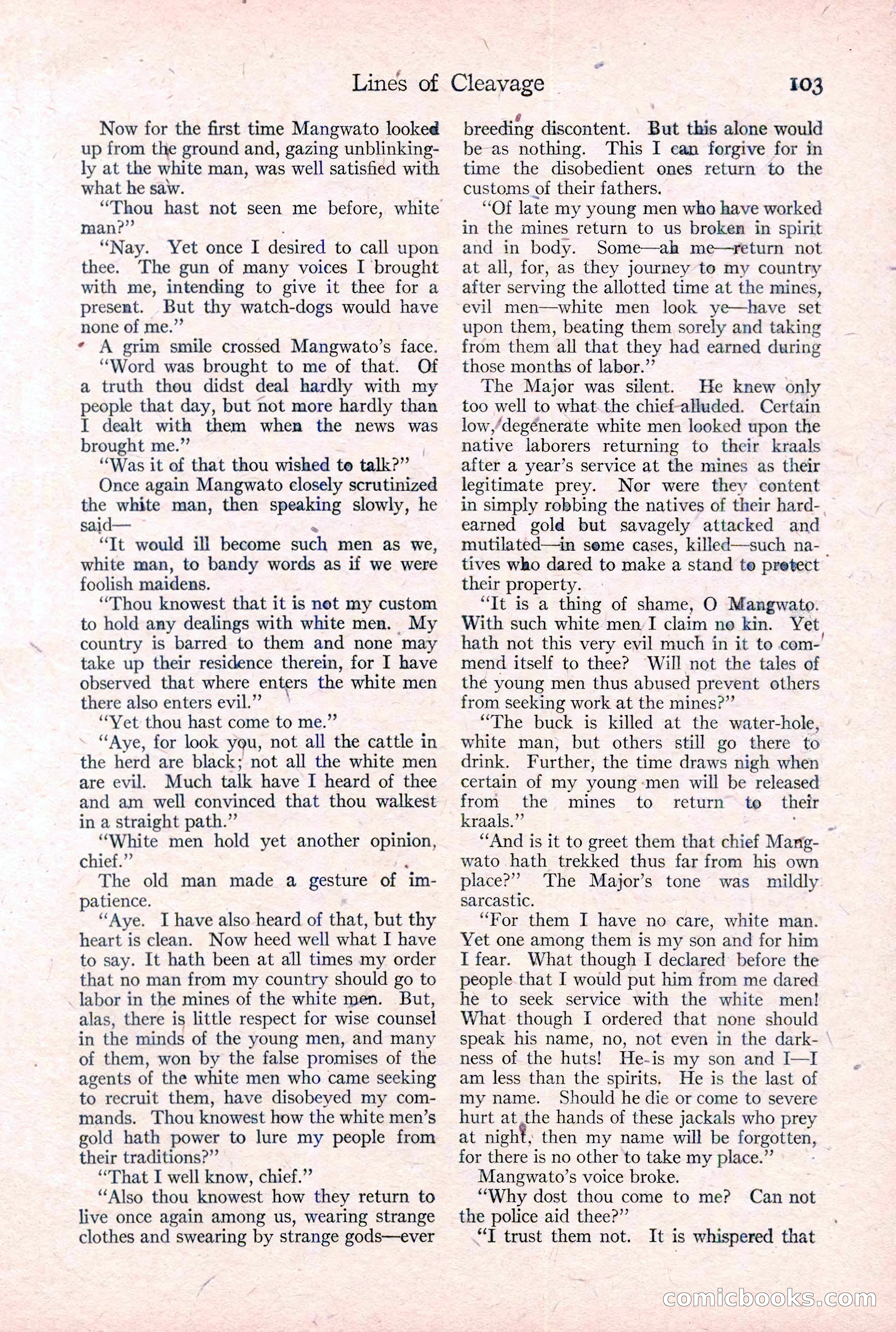
A restored page from Pulp Fiction, 1921. Page through the whole issue in the reader above.
📄 Transcribed text from this page (OCR, searchable)
Machine-transcribed from the original scan — historical spelling and the odd misread are preserved.
Lines of Cleavage Now for the first time Mangwato looked up from the ground and, gazing unblinking- ly at the white man, was well satisfied with what he saw. “Thou hast not seen me before, white man?” “Nay. Yet once I desired to call upon thee. The gun of many voices I brought with me, intending to give it thee for a present. But thy watch-dogs would have none of me.”’ * A grim smile crossed Mangwato’s face. “Word was brought to me of that. Of a truth theu didst deal hardly with my people that day, but not more hardly than I dealt with them when the news was brought me.” ) “Was it of that thou wished te talk?” Once again Mangwato closely scrutinized the white man, then speaking slowly, he said— ‘ “Tt would ill become such men as we, white man, to bandy words as if we were foolish maidens. “Thou knowest that it is net my custom to hold any dealings with white men. My country is barred to them and none may take up their residence therein, for I have observed that where enters the white men there also enters evil.” ° “Vet thou hast come to me.” “Aye, for look you, not all the cattle in the herd are black; not all the white men are evil. Much talk have I heard of thee and am well convinced that thou walkest in a straight path.” ‘White men hold yet another opinion, chief.” , The old man made a gesture of im- patience. “Aye. I have also heard of that, but thy heart is clean. Now heed well what I have to say. It hath been at all times my order that no man from my country should go to labor in the mines of the white men. But, alas, there is little respect for wise counsel in the minds of the young men, and many of them, won by the false promises of the agents of the white men who came seeking to recruit them, have disobeyed my com- mands. Thou knowest how the white men’s gold hath power to lure my people from their traditions?” “That I well know, chief.” “Also thou knowest how they return to live once again among us, wearing strange clothes and swearing by strange gods—ever 103 breeding discontent. But this alone would be as nothing. This I can forgive for in time the disobedient ones return to the customs of their fathers. “Of late my young men who have worked in the mines return to us broken in spirit and in body. Some—ah me—return not at all, for, as they journey to my country after serving the allotted time at the mines, evil men—white men look ye—have set upon them, beating them sorely and taking from them all that they had earned during those months of labor.”’ The Major was silent. He knew only too well to what. the chief-alluded. Certain low,/degénerate white men looked upon the native laborers returning to their kraals after a year’s service at the mines as their legitimate prey. Nor were they content in simply robbing the natives of their hard- earned gold but savagely attacked and mutilated—in seme cases, killed—such na- tives who dared to make a stand te pretect their property. “Tt is a thing of shame, O Mangwato. With such white men I claim no kin. Yet hath not this very evil much in it to com-’ mend itself to thee? Will not the tales of the young men thus abused prevent others from seeking work at the mines?” “The buck is killed at the water-hole, white man, but others still go there to drink. Further, the time draws nigh when certain of my young -men will be released from the mines to return to their kraals.”’ ‘And is it to greet them that chief Mang- wato hath trekked thus far from his own place?” The Mayjor’s tone was mildly sarcastic. “For them I have no care, white man. Yet one among them is my son and for him I fear. What though I declared before the people that I would put him from me dared he to seek service with the white men! What though I ordered that none should speak his name, no, not even in the dark- ness of the huts! He-is my son and I—I am less than the spirits. He is the last of my name. Should he die or come to severe hurt at,the hands of these jackals who prey at night, then my name will be forgotten, for there is no other to take my place.” Mangwato’s voice broke. “Why dost thou come to me? Can not the police aid thee?” “T trust them not. It is whispered that Gomichbooks = (©