
Pulp Fiction, 1921 · page 114 of 200
Adventure Magazine Cover, February 3, 1921 — page 114: what you’re looking at
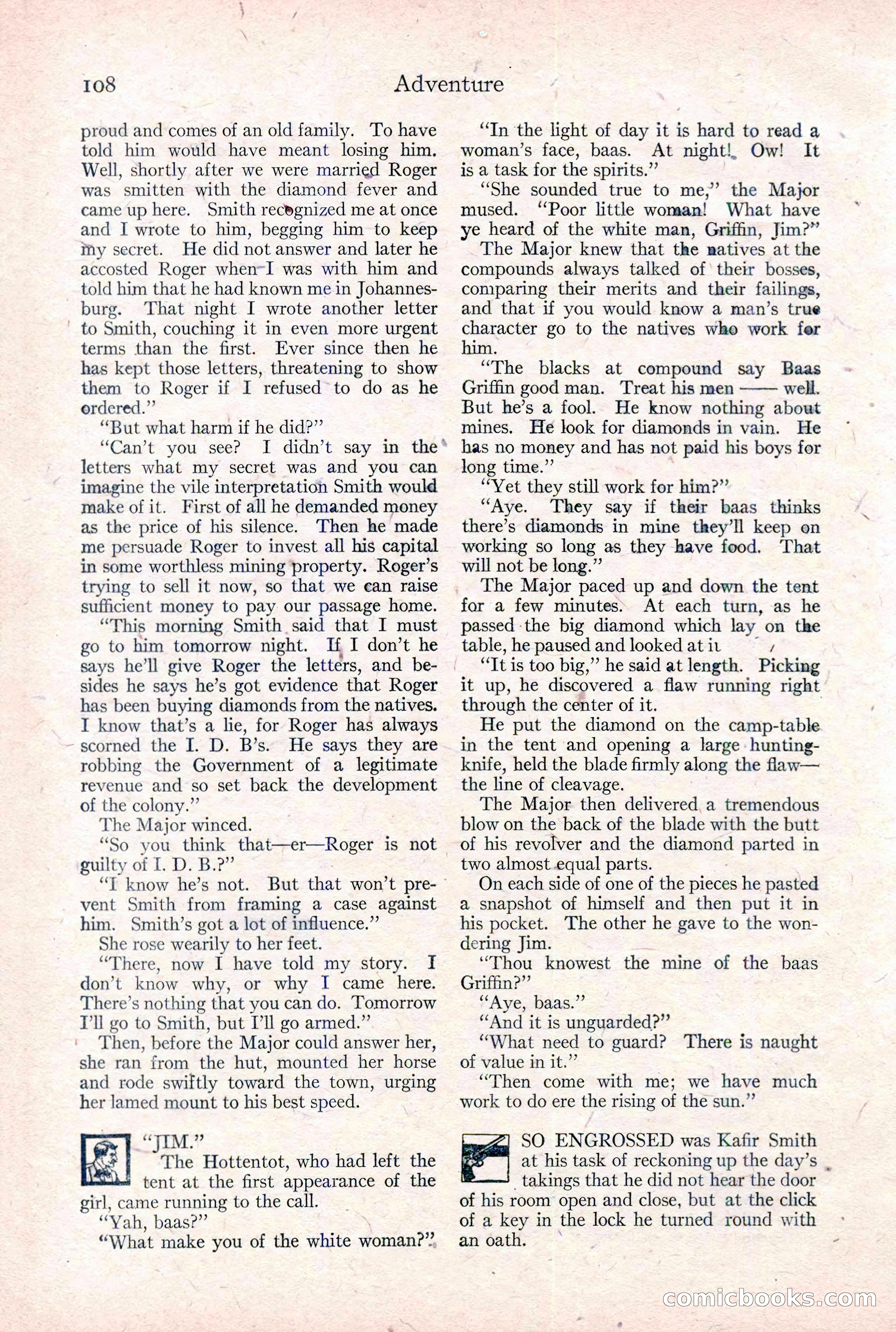
A restored page from Pulp Fiction, 1921. Page through the whole issue in the reader above.
📄 Transcribed text from this page (OCR, searchable)
Machine-transcribed from the original scan — historical spelling and the odd misread are preserved.
108 proud and comes of an old family. To have told him would have meant losing him. Well, shortly after we were married Roger was smitten with the diamond fever and came up here. Smith recegnized me at once and I wrote to him, begging him to keep my secret. He did not answer and later he accosted Roger when~I was with him and told him that he had known me in Johannes- burg. That night I wrote another letter to Smith, couching it in even more urgent terms than the first. Ever since then he has kept those letters, threatening to show them to Roger if I refused to do as he ordered.” “But what harm if he did?” “Can’t you see? I didn’t letters what my secret was and you can imagine the vile interpretation Smith would make of it. First of all he demanded money as the price of his silence. Then he made me persuade Roger to invest all his capital in some worthless mining property. Roger’s trying to sell it now, so that we ean raise sufficient money to pay our passage home. “This morning Smith said that I must go to him tomorrow night. If I don’t he says he’ll give Roger the letters, and be- sides he says he’s got evidence that Roger has been buying diamonds from the natives. I know that’s a lie, for Roger has always scorned the I. D. B’s. He says they are robbing the Government of a legitimate revenue and so set back the development of the colony.”’ The Major winced. “So you think that—er—Roger is not > guilty of I. D. B.?” “T know he’s not. But that won’t pre- vent Smith from framing a case against him. Smith’s got a lot of influence.” She rose wearily to her feet. “There, now I have told my story. I don’t know why, or why I came here. There’s nothing that you can do. Tomorrow T’ll go to Smith, but Pll go armed.” Then, before the Major could answer her, she ran from the hut, mounted her horse and rode swiftly toward the town, urging her lamed mount to his best speed. ra The Hottentot, who had left the hi tent at the first appearance of the girl, came running to the call. “Vah, baasP”’ “What make you of the white woman?” “OTM.” say in the’ Adventure : “In the light of day it is hard to read a woman’s face, baas. At night!, Ow! It is a task for the spirits.”’ “She sounded true to me,’ the Major mused. “Poor little woman! What have ye heard of the white man, Griffin, Jim?” The Major knew that the natives at the compounds always talked of their bosses, comparing their merits and their failings, and that if you would know a man’s true character go to the natives whe work fer “The blacks at compound say Baas Griffin good man. Treat his men well. But he’s a fool. He know nothing about mines. He look for diamonds in vain. He has no money and has not paid his boys for long time.” “Vet they still work for him?”’ “Aye. They say if their baas thinks there’s diamonds in mine they’ll keep on working so long as they have food. That will not be long.” The Major paced up and down the tent for a few minutes. At each turn, as he passed the big diamond which lay on the table, he paused and looked at it / “Tt is too big,” he said at length. Picking it up, he discovered a flaw running right through the center of it. He put the diamond on the camp-table in the tent and opening a large hunting- knife, held the blade firmly along the flaw— the line of cleavage. The Major then delivered a tremendous blow on the back of the blade with the butt of his revolver and the diamond parted in two almost equal parts. On each side of one of the pieces he pasted a snapshot of himself and then put it in his pocket. The other he gave to the won- dering Jim. “Thou knowest the mine of the baas Griffin?”’ “Ave, baas.”’ “And it is unguarded?” “What need to guard? There is naught of value in it.” “Then come with me; we have much work to do ere the rising of the sun.” ae 20 ENGROSSED was Kafir Smith Eo _takings that he did not hear the door of his room open and close, but at the click of a key in the lock he turned round with anoath — NOOK (C@ =) a at his task of reckoning up the day’s . (C@