
Pulp Fiction, 1921 · page 188 of 200
Adventure Magazine Cover, February 3, 1921 — page 188: what you’re looking at
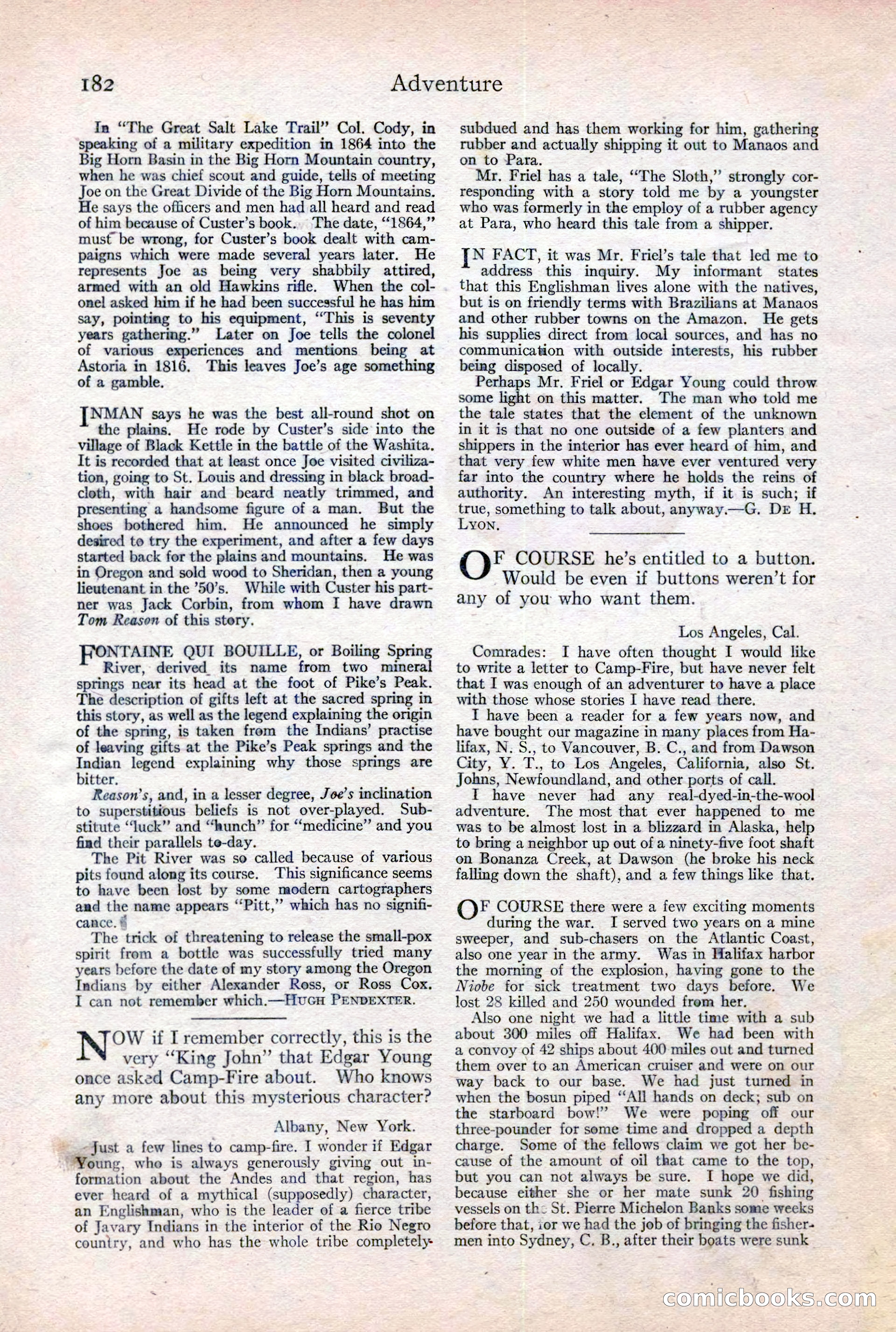
A restored page from Pulp Fiction, 1921. Page through the whole issue in the reader above.
📄 Transcribed text from this page (OCR, searchable)
Machine-transcribed from the original scan — historical spelling and the odd misread are preserved.
182 In “The Great Salt Lake Trail’? Col. Cody, in speaking of a military expedition in 1864 into the Big Horn Basin in the Big Horn Mountain country, when he was chief scout and guide, tells of meeting Joe on the Great Divide of the Big Horn Mountains. He says the officers and men had all heard and read of him because of Custer’s book. The date, “1864,” must be wrong, for Custer’s book dealt with cam- paigns which were made several years later. He represents Joe as being very shabbily attired, armed with an old Hawkins rifle. When the col- onel asked him if he had been successful he has him say, pointing to his equipment, “This is seventy years gathering.” Later on Joe tells the colonel of various experiences and mentions being at Astoria in 1816. This leaves Joe’s age something of a gamble. [NMAN says he was the best all-round shot on the plains. He rode by Custer’s side into the village of Black Kettle in the battle of the Washita. It is recorded that at least once Joe visited civiliza- tion, going to St. Louis and dressing in black broad- cloth, with hair and beard neatly trimmed, and presenting a handsome figure of a man. But the shoes bothered him. He announced he simply desired to try the experiment, and after a few days started back for the plains and mountains. He was in Oregon and sold wood to Sheridan, then a young lieutenant in the ’50’s. While with Custer his part- ner was Jack Corbin, from whom I have drawn Tom Reason of this story. FONTAINE QUI BOUILLE, or Boiling Spring River, derived its name from two mineral springs near its head at the foot of Pike’s Peak. The description of gifts left at the sacred spring in this story, as well as the legend explaining the origin of the spring, is taken frem the Indians’ practise of leaving gifts at the Pike’s Peak springs and the Indian legend explaining why those springs are bitter. Reason’s, and, in a lesser degree, Joe’s inclination to superstitious beliefs is not over-played. Sub- stitute “luck” and “hunch” for “medicine” and you find their parallels te-day. The Pit River was so called because of various pits found along its course. This significance seems to have been lost by some modern cartographers and the name appears “Pitt,’’ which has no signifi- cance. § The trick of threatening to release the small-pox spirit frem a bottle was successfully tried many years before the date of my story among the Oregon Indians by either Alexander Ross, or Ross Cox. I can not remember which.—Hucn PENDEXTER. OW if Iremember correctly, this is the very “King John” that Edgar Young once asked Camp-Fire about. Who knows any more about this mysterious character? Albany, New York. - Just a few lines to camp-fire. I wonder if Edgar oung, who is always generously giving out in- formation about the Andes and that region, has ever heard of a mythical (supposedly) character, an Englishman, who is the leader of a fierce tribe of Javary Indians in the interior of the Rio Negro country, and who has the whole tribe completely Adventure subdued and has them working for him, gathering rubber and actually shipping it out to Manaos and on to Para. Mr. Friel has a tale, “The Sloth,” strongly cor- responding with a story told me by a youngster who was formerly in the employ of a rubber agency at Para, who heard this tale from a shipper. N FACT, it was Mr. Friel’s tale that led me to address this inquiry. My informant states that this Englishman lives alone with the natives, but is on friendly terms with Brazilians at Manaos and other rubber towns on the Amazon. He gets his supplies direct from local sources, and has no communication with outside interests, his rubber being disposed of locally. Perhaps Mr. Friel or Edgar Young could throw some light on this matter. The man whe told me the tale states that the element of the unknown in it is that no one outside of a few planters and shippers in the interior has ever heard of him, and that very few white men have ever ventured very far into the country where he holds the reins of authority. An interesting myth, if it is such; if ee. something to talk about, anyway.—G. Dr H. YON, F COURSE he’s entitled to a button. Would be even if buttons weren’t for any of you who want them. Los Angeles, Cal. Comrades: I have often thought I would like to write a letter to Camp-Fire, but have never felt that I was enough of an adventurer to have a place with those whose stories I have read there. I have been a reader for a few years now, and have bought our magazine in many places from Ha- lifax, N. S., to Vancouver, B. C., and from Dawson City, Y. T., to Los Angeles, California, also St. Johns, Newfoundland, and other ports of call. I have never had any real-dyed-in-the-wool adventure. The most that ever happened to me was to be almost lost in a blizzard in Alaska, help to bring a neighbor up out of a ninety-five foot shaft on Bonanza Creek, at Dawson (he broke his neck falling down the shaft), and a few things like that. OF COURSE there were a few exciting moments during the war. I served two years on a mine sweeper, and sub-chasers on the Atlantic Coast, also one year in the army. Was in Walifax harbor the morning of the explosion, having gone to the Niobe for sick treatment two days before. We lost 28 killed and 250 wounded frem her. Also one night we had a little time with a sub about 300 miles off Halifax. We had been with a convoy of 42 ships about 400 miles out and turned them over to an American cruiser and were on our way back to our base. We had just turned in when the bosun piped “All hands on deck; sub on the starboard bow!” We were poping off our three-pounder for some time and dropped a depth charge. Some of the fellows claim we got her be- cause of the amount of oil that came to the top, but you can not always be sure. I hope we did, because either she or her mate sunk 20 fishing vessels on th St. Pierre Michelon Banks some weeks before that, ior we had the job of bringing the fisher- men into Sydney, C. B., after their boats were sunk eoniiclooks (C@