
Pulp Fiction, 1921 · page 190 of 200
Adventure Magazine Cover, February 3, 1921 — page 190: what you’re looking at
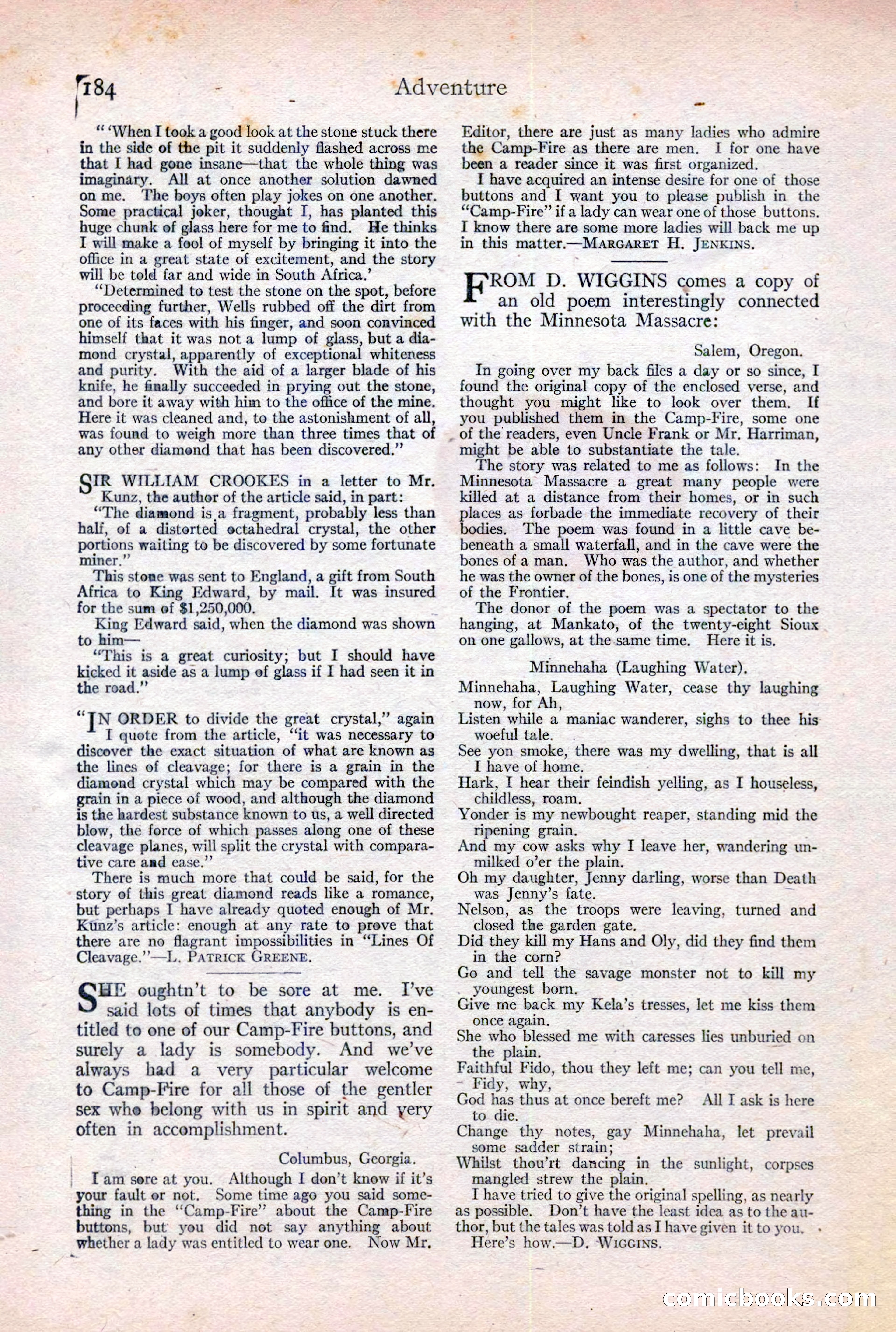
A restored page from Pulp Fiction, 1921. Page through the whole issue in the reader above.
📄 Transcribed text from this page (OCR, searchable)
Machine-transcribed from the original scan — historical spelling and the odd misread are preserved.
* “When I took a good look at the stone stuck there in the side of the pit it suddenly flashed across me that I had gone insane—that the whole thing was imaginary. All at once another solution dawned on me. The boys often play jokes on one another. Some practical joker, thought I, has planted this huge chunk of glass here for me to find. He thinks I will make a fool of myself by bringing it into the office in a great state of excitement, and the story will be told far and wide in South Africa.’ “Determined to test the stone on the spot, before proceeding further, Wells rubbed off the dirt from one of its faces with his finger, and soon convinced himself that it was not a lump of glass, but a dia- mond crystal, apparently of exceptional whiteness and purity. With the aid of a larger blade of his knife, he finally succeeded in prying out the stone, and bore it away with him to the office of the mine. Here it was cleaned and, to the astonishment of all, was found to weigh more than three times that of any other diamend that has been discover Sir WILLIAM CROOKES in a letter to Mr. Kunz, the author of the article said, in part: “The diamond is a fragment, probably less than half, of a distorted ectahedral crystal, the other portions waiting to be discovered by some fortunate miner.’ This stone was sent to England, a gift from South Africa to King Edward, by mail. It was insured for the sum of $1,250 000. King Edward said, when the diamond was shown to him— “This is a great curiosity; but I should have kicked it aside as a lump ef glass if I had seen it in the road.” “IN ORDER to divide the great crystal,” again I quote from the article, “it was necessary to discover the exact situation of what are known as the lines of cleavage; for there is a grain in the diamond crystal which may be compared with the grain in a piece of wood, and although the diamond is the hardest substance known to us, a well directed blow, the force of which passes along one of these cleavage planes, will split the crystal with compara- tive care and ease.”’ There is much more that could be said, for the story of this great diamond reads like a romance, but perhaps I have already quoted enough of Mr. Kunz’s article: enough at any rate to prove that there are no flagrant impossibilities in “Lines Of Cleavage.’’—L. Patrick GREENE. ee oughtn’t to be sore at me. I’ve said lets of times that anybody is en- titled to one of our Camp-Fire buttons, and surely a lady is somebody. And we've always had a very particular welcome to Camp-Fire for all those of the gentler sex whe belong with us in spirit and very often in accomplishment. Columbus, Georgia. fam sere at you. Although I don’t know if it’s your fault er not. Some time ago you said some- thing in the “Camp-Fire” about the Camp-Fire buttons, but you did not say anything about whether a lady was entitled to wear one. Now Mr, } } Adventure Editor, there are just as many ladies who admire the Camp-Fire as there are men. I for one have a reader since it was first organized. I have acquired an intense desire for one of those buttons and I want you to please publish in the “Camp-Fire”’ if a lady can wear one of those buttons. I know there are some more ladies will back me up in this matter. —Marcaret H. JENKINS. | 5 ieee D. WIGGINS comes a copy of an old poem interestingly connected with the Minnesota Massacre: Salem, Oregon. In going over my back files a day or so since, I found the original copy of the enclosed verse, and thought you might like to leok over them. If you published them in the Camp-Fire, some one _ of the readers, even Uncle Frank or Mr. Harriman, might be able to substantiate the tale. The story was related to me as follows: In the Minnesota Massacre a great many people were killed at a distance from their homes, or in such places as forbade the immediate recovery of their bodies. The poem was found in a little cave be- beneath a small waterfall, and in the cave were the bones of aman. Who was the author, and whether he was the owner of the bones, is one of the mysteries of the Frontier. The donor of the poem was a spectator to the hanging, at Mankato, of the twenty-eight Sioux on one gallows, at the same time. Here it is. Minnehaha (Laughing Water). Minnehaha, Laughing Water, cease thy laughing now, for Ah, Listen while a maniac wanderer, sighs to thee his woeful tale. See yon smoke, there was my dwelling, that is all I have of home. Hark, I hear their feimitcls yelling, as I houseless, childless, roam. Yonder is my newbought reaper, standing mid the ripening grain. And my cow asks why I leave her, wandering un- milked o’er the plain. Oh my daughter, Jenny darling, worse than Death was Jenny’s fate. Nelson, as the troops were leaving, turned and closed the garden gate. Did they kill my Hans and Oly, did they find them in the corn? Go and tell the savage monster not to kill my youngest born. Give me back my Kela’s tresses, let me kiss them once again. She who blessed me with caresses lies unburied on the plain. Faithful Fido, thou they left me; can you tell me, ~ Fidy, why, God uae thus at once bereft me? All I ask is here to aie. Change thy notes, gay Minnehaha, some sadder strain; Whilst thou’rt dancing in the sunlight, corpses mangled strew the plain. I have tried to give the original spelling, as nearly as possible. Don’t have the least idea as to the au- thor, but the tales was told as I have given it to you, Here’s how.—D. Wiccrs. let prevail ~ (eo) oOo = a (C@