
Pulp Fiction, 1921 · page 57 of 200
Adventure Magazine Cover, February 3, 1921 — page 57: what you’re looking at
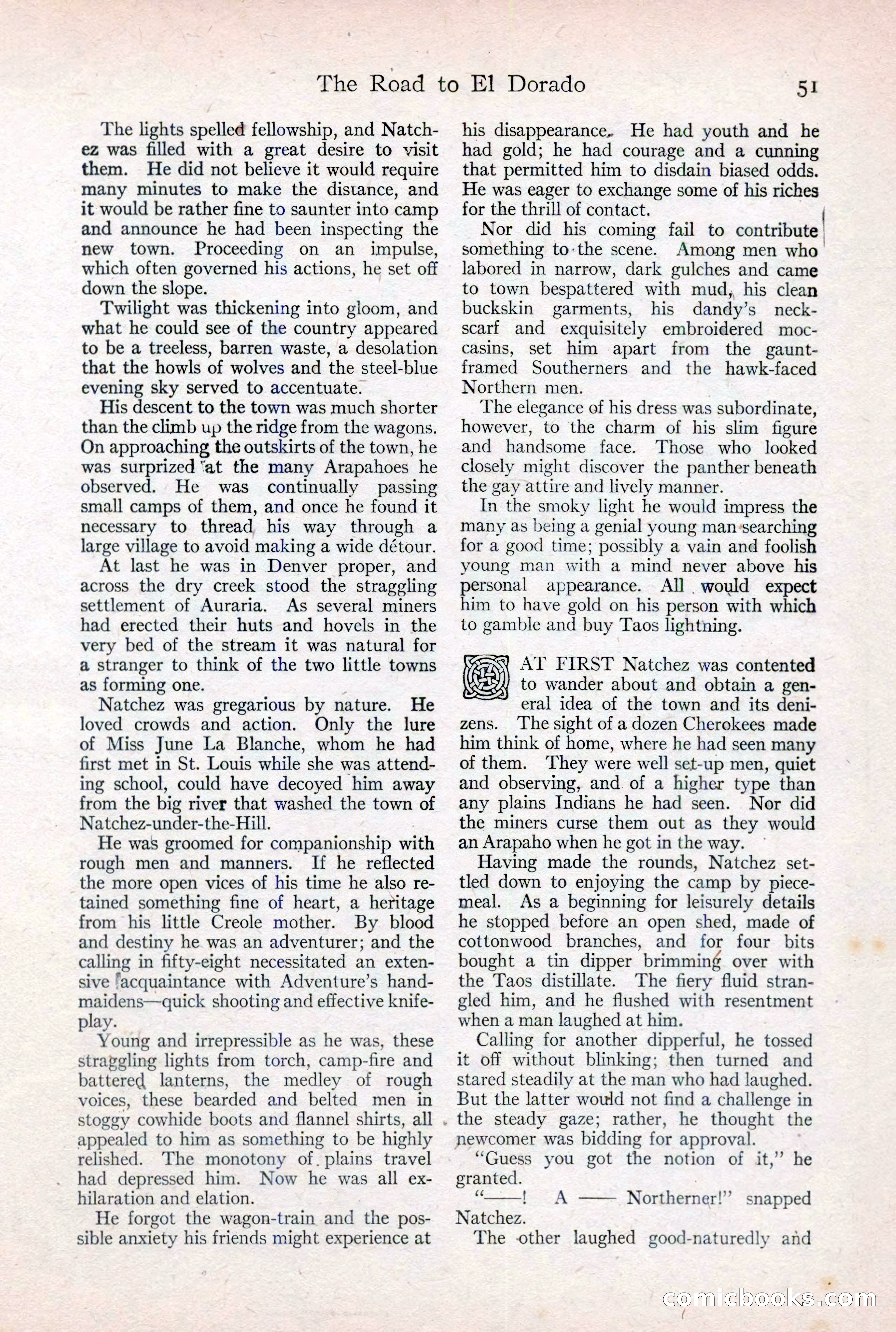
A restored page from Pulp Fiction, 1921. Page through the whole issue in the reader above.
📄 Transcribed text from this page (OCR, searchable)
Machine-transcribed from the original scan — historical spelling and the odd misread are preserved.
The Road to El Dorado The lights spelled fellowship, and Natch- ez was filled with a great desire to visit them. He did not believe it would require many minutes to make the distance, and it would be rather fine to saunter into camp and announce he had been inspecting the new town. Proceeding on an impulse, which often governed his actions, he set off down the slope. Twilight was thickening into gloom, and what he could see of the country appeared to be a treeless, barren waste, a desolation that the howls of wolves and the steel-blue evening sky served to accentuate. His descent to the town was much shorter than the climb up the ridge from the wagons. On approaching the outskirts of the town, he was surprized “at the many Arapahoes he observed. He was continually passing small camps of them, and once he found it necessary to thread his way through a large village to avoid making a wide détour. At last he was in Denver proper, and across the dry creek stood the straggling settlement of Auraria. As several miners had erected their huts and hovels in the very bed of the stream it was natural for a stranger to think of the two little towns as forming one. Natchez was gregarious by nature. He loved crowds and action. Only the lure of Miss June La Blanche, whom he had first met in St. Louis while she was attend- ing school, could have decoyed him away from the big river that washed the town of Natchez-under-the-Hill. He was groomed for companionship with rough men and manners. If he reflected the more open vices of his time he also re- tained something fine of heart, a heritage from his little Creole mother. By blood and destiny he was an adventurer; and the calling in fifty-eight necessitated an exten- sive facquaintance with Adventure’s hand- maidens—quick shooting and effective knife- lay. 2 Young and irrepressible as he was, these straygling lights from torch, camp-fire and battered lanterns, the medley of rough voices, these bearded and belted men in stoggy cowhide boots and flannel shirts, all . appealed to him as something to be highly relished. The monotony of. plains travel had depressed him. Now he was all ex- hilaration and elation. He forgot the wagon-train and the pos- sible anxiety his friends might experience at 51 his disappearance. He had youth and he had gold; he had courage and a cunning that permitted him to disdain biased odds. He was eager to exchange some of his riches for the thrill of contact. | Nor did his coming fail to contribute something to:the scene. Among men who_ labored in narrow, dark gulches and came to town bespattered with mud, his clean buckskin garments, his dandy’s neck- scart and exquisitely embroidered moc- casins, set him apart from the gaunt- framed Southerners and the hawk-faced Northern men. The elegance of his dress was subordinate, however, to the charm of his slim figure and handsome face. Those who looked closely might discover the panther beneath the gay attire and lively manner. In the smoky light he would impress the many as being a genial young man:searching for a good time; possibly a vain and foolish young man with a mind never above his personal appearance. All would expect him to have gold on his person with which to gamble and buy Taos lightning. ox AT FIRST Natchez was contented (ey) to wander about and obtain a SS) : +o eral idea of the town and its deni- zens. ‘The sight of a dozen Cherokees made him think of home, where he had seen many of them. ‘They were well set-up men, quiet and observing, and of a higher type than any plains Indians he had seen. Nor did the miners curse them out as they would an Arapaho when he got in the way. Having made the rounds, Natchez set- tled down to enjoying the camp by piece- meal. As a beginning for leisurely details he stopped before an open shed, made of cottonwood branches, and for four bits bought a tin dipper brimming over with the Taos distillate. The fiery fluid stran- gled him, and he flushed with resentment when a man laughed at him. Calling for another dipperful, he tossed it off without blinking; then turned and stared steadily at the man who had laughed. But the latter would not find a challenge in the steady gaze; rather, he thought the newcomer was bidding for approval. “Guess you got the notion of it,’ he granted. “1 A ——. Northerner!” snapped Natchez. The other laughed good-naturedly and COMME OOOKS / { (C@