
Pulp Fiction, 1921 · page 90 of 200
Adventure Magazine Cover, February 3, 1921 — page 90: what you’re looking at
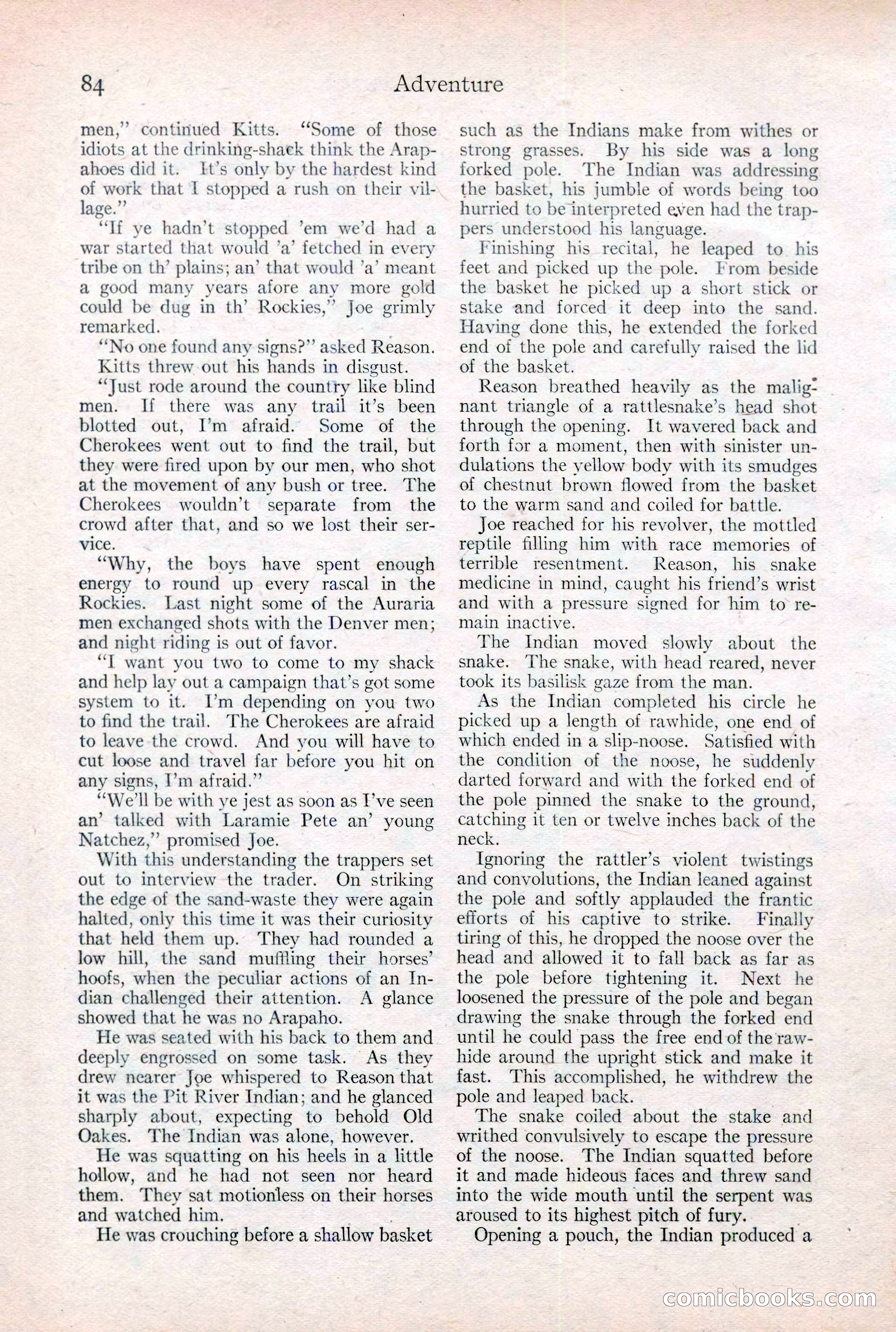
A restored page from Pulp Fiction, 1921. Page through the whole issue in the reader above.
📄 Transcribed text from this page (OCR, searchable)
Machine-transcribed from the original scan — historical spelling and the odd misread are preserved.
84 men,’ continued Kitts. “Some of those idiots at the drinking-shaek think the Arap- ahoes did it. It’s only by the hardest kind of work that I stopped a rush on their vil- lage.” “If ye hadn’t stopped ’em we’d had a war started that would ’a’ fetched in every tribe on th’ plains; an’ that would ’a’ meant a good many years afore any more gold could be dug in th’ Rockies,” Joe grimly remarked. ‘No one found any signs?” asked Reason. Kitts threw out his hands in disgust. “Just rode around the country like blind men. If there was any trail it’s been blotted out, I’m afraid. Some of the Cherokees went out to find the trail, but they were fired upon by our men, who shot at the movement of any bush or tree. The Cherokees wouldn’t separate from the crowd after that, and so we lost their ser- vice. “Why, the boys have spent enough energy to round up every rascal in the Rockies. Last night some of the Auraria men exchanged shots with the Denver men; and night riding is out of favor. “I want you two to come to my shack and help lay out a campaign that’s got some system to it. Vm depending on you two to find the trail. The Cherokees are afraid to leave the crowd. And you will have to cut loose and travel far before you hit on any signs, I’m afraid.” ‘We'll be with ye jest as soon as I’ve seen an’ talked with Laramie Pete an’ young Natchez,” promised Joe. With this understanding the trappers set out to interview the trader. On striking the edge of the sand-waste they were again halted, only this time it was their curiosity that held them up. They had rounded a low hill, the sand muffling their horses’ hoofs, when the peculiar actions of an In- dian challenged their attention. A glance showed that he was no Arapaho. He was seated with his back to them and deeply engrossed on some task. As they drew nearer Joe whispered to Reason that it was the Pit River Indian; and he glanced sharply about, expecting to behold Old Oakes. The Indian was alone, however. He was squatting on his heels in a little hollow, and he had not seen nor heard them. They sat motionless on their horses and watched him. . : He was crouching before a shallow basket Adventure such as the Indians make from withes or strong grasses. By his side was a long forked pole. The Indian was addressing the basket, his jumble of words being too hurried to be interpreted even had the trap- pers understood his language. Finishing his recital, he leaped to_ his feet and picked up the pole. From beside the basket he picked up a short stick or stake and forced it deep into the sand. Having done this, he extended the forked end of the pole and carefully raised the lid of the basket. Reason breathed heavily as the malig- nant triangle of a rattlesnake’s head shot through the opening. It wavered back and forth for a moment, then with sinister un- dulations the yellow body with its smudges of chestnut brown flowed from the basket to the warm sand and coiled for battle. Joe reached for his revolver, the mottled reptile filling him with race memories of terrible resentment. Reason, his snake medicine in mind, caught his friend’s wrist and with a pressure signed for him to re- main inactive. The Indian moved slowly about the snake. The snake, with head reared, never took its basilisk gaze from the man. As the Indian completed his circle he picked up a length of rawhide, one end of which ended in a slip-noose. Satisfied with the condition of the noose, he suddenly darted forward and with the forked end of the pole pinned the snake to the ground, catching it ten or twelve inches back of the neck. Ignoring the rattler’s violent twistings and conyolutions, the Indian leaned against the pole and softly applauded the frantic efforts of his captive to strike. Finally tiring of this, he dropped the noose over the head and allowed it to fall back as far as the pole before tightening it. Next he loosened the pressure of the pole and began drawing the snake through the forked end until he could pass the free end of the raw- hide around the upright stick and make it fast. ‘This accomplished, he withdrew the pole and leaped back. : The snake coiled about the stake and writhed convulsively to escape the pressure of the noose. The Indian squatted before it and made hideous faces and threw sand into the wide mouth until the serpent was aroused to its highest pitch of fury. : Opening a pouch, the Indian produced a COMmMicoooks (C@