
Pulp Fiction, 1921 · page 125 of 204
Adventure Magazine Cover — page 125: what you’re looking at
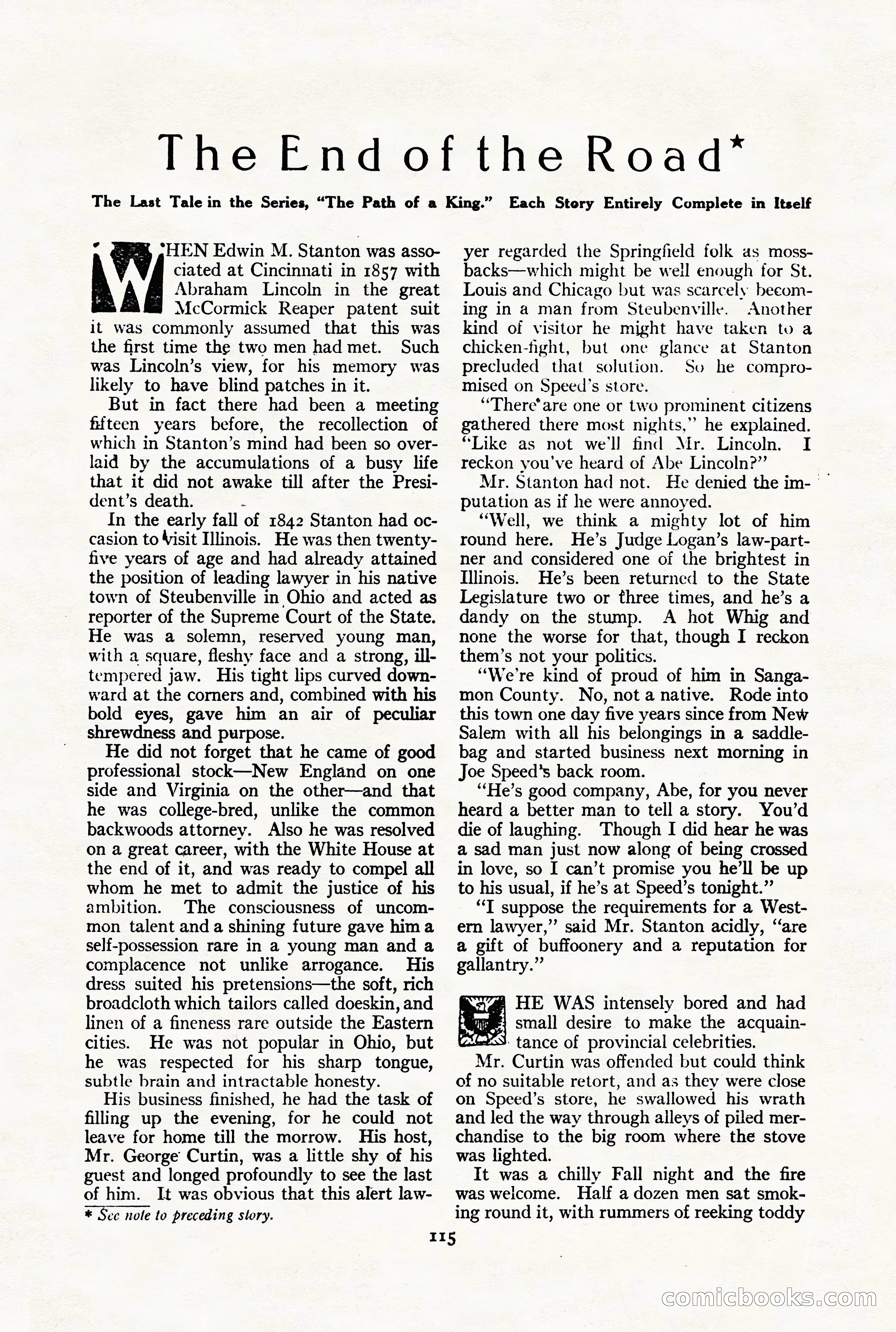
A restored page from Pulp Fiction, 1921. Page through the whole issue in the reader above.
📄 Transcribed text from this page (OCR, searchable)
Machine-transcribed from the original scan — historical spelling and the odd misread are preserved.
The End of the Road“ The Last Tale in the Series, “The Path of a King.” "HEN Edwin M. Stanton was asso- \ / ciated at Cincinnati in 1857 with Abraham Lincoln in the great McCormick Reaper patent suit it was commonly assumed that this was the first time the two men had met. Such was Lincoln’s view, for his memory was likely to have blind patches in it. But in fact there had been a meeting fifteen years before, the recollection of which in Stanton’s mind had been so over- laid by the accumulations of a busy life that it did not awake till after the Presi- dent’s death. In the early fall of 1842 Stanton had oc- casion to Visit Illinois. He was then twenty- five years of age and had already attained the position of leading lawyer in ‘his native town of Steubenville in Ohio and acted as reporter of the Supreme Court of the State. He was a solemn, reserved young man, with a square, fleshy face and a strong, ill- tempered jaw. His tight lips curved down- ward at the corners and, combined with his bold eyes, gave him an air of peculiar shrewdness and purpose. He did not forget that he came of good professional stock—New England on one side and Virginia on the other—and that he was college-bred, unlike the common backwoods attorney. Also he was resolved on a great career, with the White House at the end of it, and was ready to compel all whom he met to admit the justice of his ambition. The consciousness of uncom- mon talent and a shining future gave hima self-possession rare in a young man and a complacence not unlike arrogance. His dress suited his pretensions—the soft, rich broadcloth which tailors called doeskin, and linen of a fineness rare outside the Eastern cities. He was not popular in Ohio, but he was respected for his sharp tongue, subtle brain and intractable honesty. His business finished, he had the task of filling up the evening, for he could not leave for home till the morrow. His host, Mr. George Curtin, was a little shy of his guest and longed profoundly to see the last of him. It was obvious that this alert law- * See nole to preceding story. Each Story Entirely Complete in Itself yer regarded the Springfield folk as moss- backs—which might be well enough for St. Louis and Chicago but was scarcely becom- ing in a man from Steubenville. Another kind of visitor he might have taken to a chicken-fight, but one glance at Stanton precluded that solution. So he compro- mised on Speed’s store. “There’are one or two prominent citizens gathered there most nights,”’ he explained. “Like as not we'll find Mr. Lincoln. I reckon you've heard of Abe Lincoln?” Mr. Stanton had not. putation as if he were annoyed. “Well, we think a mighty lot of him round here. He’s Judge Logan’s law-part- ner and considered one of the brightest in Illinois. He’s been returned to the State Legislature two or three times, and he’s a dandy on the stump. A hot Whig and none the worse for that, though I reckon them’s not your politics. “We're kind of proud of him in Sanga- mon County. No, not a native. Rode into this town one day five years since from New Salem with all his belongings in a saddle- bag and started business next morning in Joe Speed’s back room. ‘“‘He’s good company, Abe, for you never heard a better man to tell a story. You’d die of laughing. Though I did hear he was a sad man just now along of being crossed in love, so I can’t promise you he’ll be up to his usual, if he’s at Speed’s tonight.” “T suppose the requirements for a West- ern lawyer,” said Mr. Stanton acidly, “are a gift of buffoonery and a reputation for gallantry.” ae HE WAS intensely bored and had orae; small desire to make the acquain- ‘tance of provincial celebrities. Mr. Curtin was offended but could think of no suitable retort, and as they were close on Speed’s store, he swallowed his wrath and led the way through alleys of piled mer- chandise to the big room where the stove was lighted. It was a chilly Fall night and the fire was welcome. Half a dozen men sat smok- ing round it, with rummers of reeking toddy 115 COmiclbooks He denied the im- | ©