
Pulp Fiction, 1921 · page 130 of 204
Adventure Magazine Cover — page 130: what you’re looking at
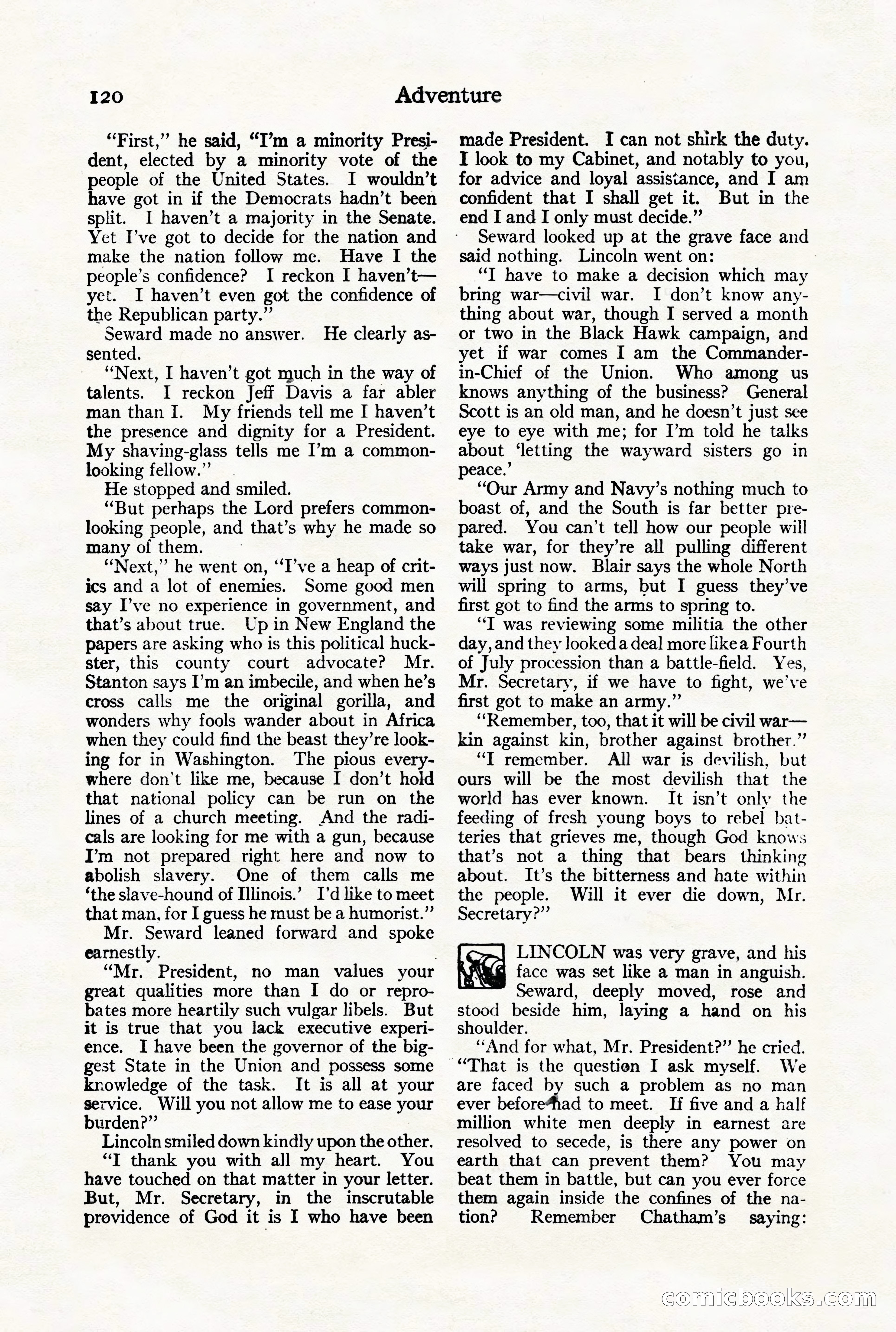
A restored page from Pulp Fiction, 1921. Page through the whole issue in the reader above.
📄 Transcribed text from this page (OCR, searchable)
Machine-transcribed from the original scan — historical spelling and the odd misread are preserved.
I20 “First,” he said, “I’m a minority Presi- dent, elected by a minority vote of the ‘people of the United States. I wouldn’t have got in if the Democrats hadn’t been split. I haven’t a majority in the Senate. Yet I’ve got to decide for the nation and make the nation follow me. Have I the people’s confidence? I reckon I haven’t— yet. I haven’t even got the confidence of the Republican party.” Seward made no answer. sented. “Next, I haven’t got much in the way of talents. I reckon Jeff Davis a far abler man than I. My friends tell me I haven’t the presence and dignity for a President. My shaving-glass tells me I’m a common- looking fellow.” He stopped and smiled. “But perhaps the Lord prefers common- looking people, and that’s why he made so many of them. : “Next,” he went on, ‘I’ve a heap of crit- ics and a lot of enemies. Some good men say I’ve no experience in government, and that’s about true. Up in New England the papers are asking who is this political huck- ster, this county court advocate? Mr. Stanton says I’m an imbecile, and when he’s cross calls me the original gorilla, and wonders why fools wander about in Africa when they could find the beast they’re look- ing for in Washington. The pious every- where don't like me, because I don’t hold that national policy can be run on the lines of a church meeting. And the radi- cals are looking for me with a gun, because I’m not prepared right here and now to abolish slavery. One of them calls me ‘the slave-hound of Illinois.’ I'd like to meet that man, for I guess he must be a humorist.”’ Mr. Seward leaned forward and spoke earnestly. He clearly as- “Mr. President, no man values your great qualities more than I do or repro- bates more heartily such vulgar libels. But it is true that you lack executive experi- ence. I have been the governor of the big- gest State in the Union and possess some knowledge of the task. It is all at your service. Will you not allow me to ease your burden?” Lincoln smiled down kindly upon the other. “T thank you with all my heart. You have touched on that matter in your letter. But, Mr. Secretary, in the inscrutable providence of God it is I who have been Adventure made President. I can not shirk the duty. I look to my Cabinet, and notably to you, for advice and loyal assistance, and I am confident that I shall get it. But in the end I and I only must decide.” Seward looked up at the grave face and said nothing. Lincoln went on: “YT have to make a decision which may bring war—civil war. I don’t know any- thing about war, though I served a month or two in the Black Hawk campaign, and yet if war comes I am the Commander- in-Chief of the Union. Who among us knows anything of the business? General Scott is an old man, and he doesn’t just see eye to eye with me; for I’m told he talks about ‘letting the wayward sisters go in peace.’ “Our Army and Navy’s nothing much to boast of, and the South is far better pre- pared. You can’t tell how our people will take war, for they’re all pulling different ways just now. Blair says the whole North will spring to arms, but I guess they’ve first got to find the arms to spring to. “T was reviewing some militia the other day, and they looked a deal more likea Fourth of July procession than a battle-field. Yes, Mr. Secretary, if we have to fight, we’ve first got to make an army.” ‘‘Remember, too, that it will be civil war— kin against kin, brother against brother.” “T remember. All war is devilish, but ours will be the most devilish that the world has ever known. It isn’t only the feeding of fresh young boys to rebel bat- teries that grieves me, though God knows that’s not a thing that bears thinking about. It’s the bitterness and hate within the people. Will it ever die down, Mr. Secretary?” LINCOLN was very grave, and his face was set like a man in anguish. Seward, deeply moved, rose and stood beside him, laying a hand on his shoulder. ‘“‘And for what, Mr. President?” he cried. Ry, aS LAs “That is the question I ask myself. We are faced by such a problem as no man ever beforefhad to meet. If five and a half million white men deeply in earnest are resolved to secede, is there any power on earth that can prevent them? You may beat them in battle, but can you ever force them again inside the confines of the na- tion? Remember Chatham’s - saying: COmiclbook C©