
Pulp Fiction, 1921 · page 134 of 204
Adventure Magazine Cover — page 134: what you’re looking at
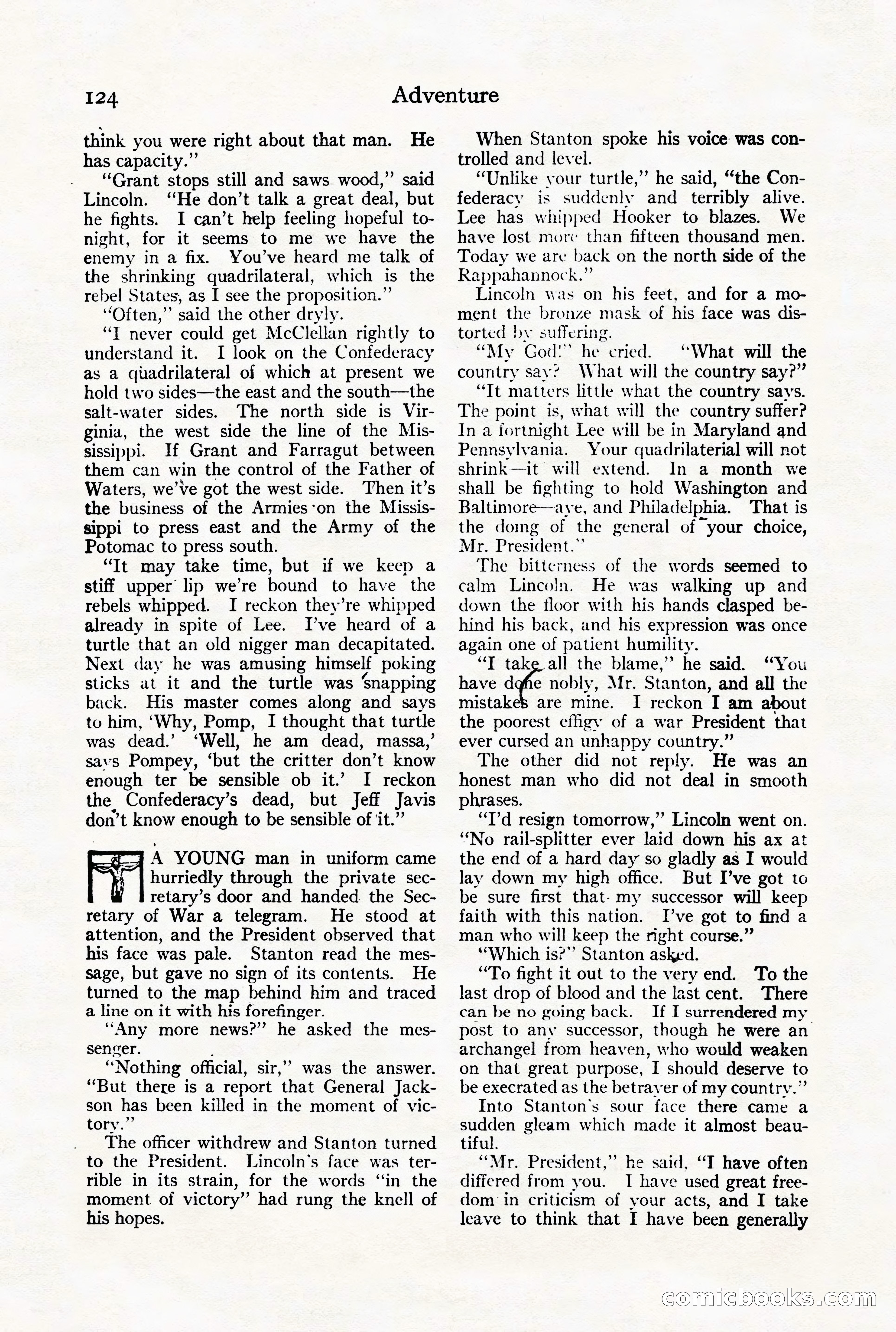
A restored page from Pulp Fiction, 1921. Page through the whole issue in the reader above.
📄 Transcribed text from this page (OCR, searchable)
Machine-transcribed from the original scan — historical spelling and the odd misread are preserved.
124 think you were right about that man. He has capacity.” “Grant stops still and saws wood,” said Lincoln. ‘He don’t talk a great deal, but he fights. I can’t help feeling hopeful to- night, for it seems to me we have the enemy in a fix. You’ve heard me talk of the shrinking quadrilateral, which is the rebel States, as I see the proposition.”’ “Often,” said the other dryly. “T never could get McClellan rightly to understand it. I look on the Confederacy as a quadrilateral of which at present we hold two sides—the east and the south—the salt-water sides. The north side is Vir- ginia, the west side the line of the Mis- sissippi. If Grant and Farragut between them can win the control of the Father of Waters, we’ve got the west side. Then it’s the business of the Armies-on the Missis- sippi to press east and the Army of the Potomac to press south. “Tt may take time, but if we keep a stiff upper lip we’re bound to have the rebels whipped. I reckon they’re whipped already in spite of Lee. Ive heard of a turtle that an old nigger man decapitated. Next day he was amusing himself poking sticks at it and the turtle was Snapping back. His master comes along and says to him, ‘Why, Pomp, I thought that turtle was dead.’ ‘Well, he am dead, massa,’ savs Pompey, ‘but the critter don’t know enough ter be sensible ob it.’ I reckon the Confederacy’s dead, but Jeff Javis don’t know enough to be sensible of it.” = A YOUNG man in uniform came | + red through the private sec- retary’s door and handed the Sec- retary of War a telegram. He stood at attention, and the President observed that his face was pale. Stanton read the mes- sage, but gave no sign of its contents. He turned to the map behind him and traced a line on it with his forefinger. “Any more news?” he asked the mes- senger. “Nothing official, sir,” was the answer. “But there is a report ‘that General Jack- son has been killed in the moment of vic- tory.”’ The officer withdrew and Stanton turned to the President. Lincoln's face was ter- rible in its strain, for the words ‘in the moment of victory” had rung the knell of his hopes. ” Adventure When Stanton spoke his voice was con- trolled and level. “Unlike vour turtle,” he said, “the Con- federacy is suddenly and terribly alive. Lee has whipped Hooker to blazes. We have lost more than fifteen thousand men. Today we are back on the north side of the Rappahannock.” Lincoln was on his feet, and for a mo- ment the bronze mask of his face was dis- torted bv suffering. “My God’” he cried. “What will the country sav’ What will the country say?” “Tt matters little what the country savs. The point is, what will the country suffer? In a fortnight Lee will be in Maryland and Pennsylvania. Your quadrilaterial will not shrink—it will extend. In a month we shall be fighting to hold Washington and Baltimore—aye, and Philadelphia. That is the domg of the general of your choice, Mr. President.” The bitterness of the words seemed to calm Lincoln. He was walking up and down the tloor with his hands clasped be- hind his back, and his expression was once again one of patient humility. “T take all the blame,’* he said. “You have cf nobly, Mr. Stanton, and all the mistakes are mine. I reckon I am about the poorest efligy of a war President that ever cursed an unhappy country.” The other did not reply. He was an honest man who did not deal in smooth phrases. “T’d resign tomorrow,’”’ Lincoln went on. “No rail-splitter ever laid down his ax at the end of a hard day so gladly as I would lay down my high office. But I’ve got to be sure first that- my successor will keep faith with this nation. I’ve got to find a man who will keep the right course.” “Which is?”’ Stanton asked. “To fight it out to the very end. To the last drop of blood and the last cent. There can be no going back. If I surrendered my post to any successor, though he were an archangel from heaven, who would weaken on that great purpose, I should deserve to be execrated as the betrayer of my countrv.” Into Stanton’s sour face there came a sudden gleam which made it almost beau- tiful. “Mr. President,” he said, “T have often differed from you. I have used great free- dom ‘in criticism of your acts, and I take leave to think that I have been generally CO MICLOOOKS 5}