
Pulp Fiction, 1921 · page 137 of 204
Adventure Magazine Cover — page 137: what you’re looking at
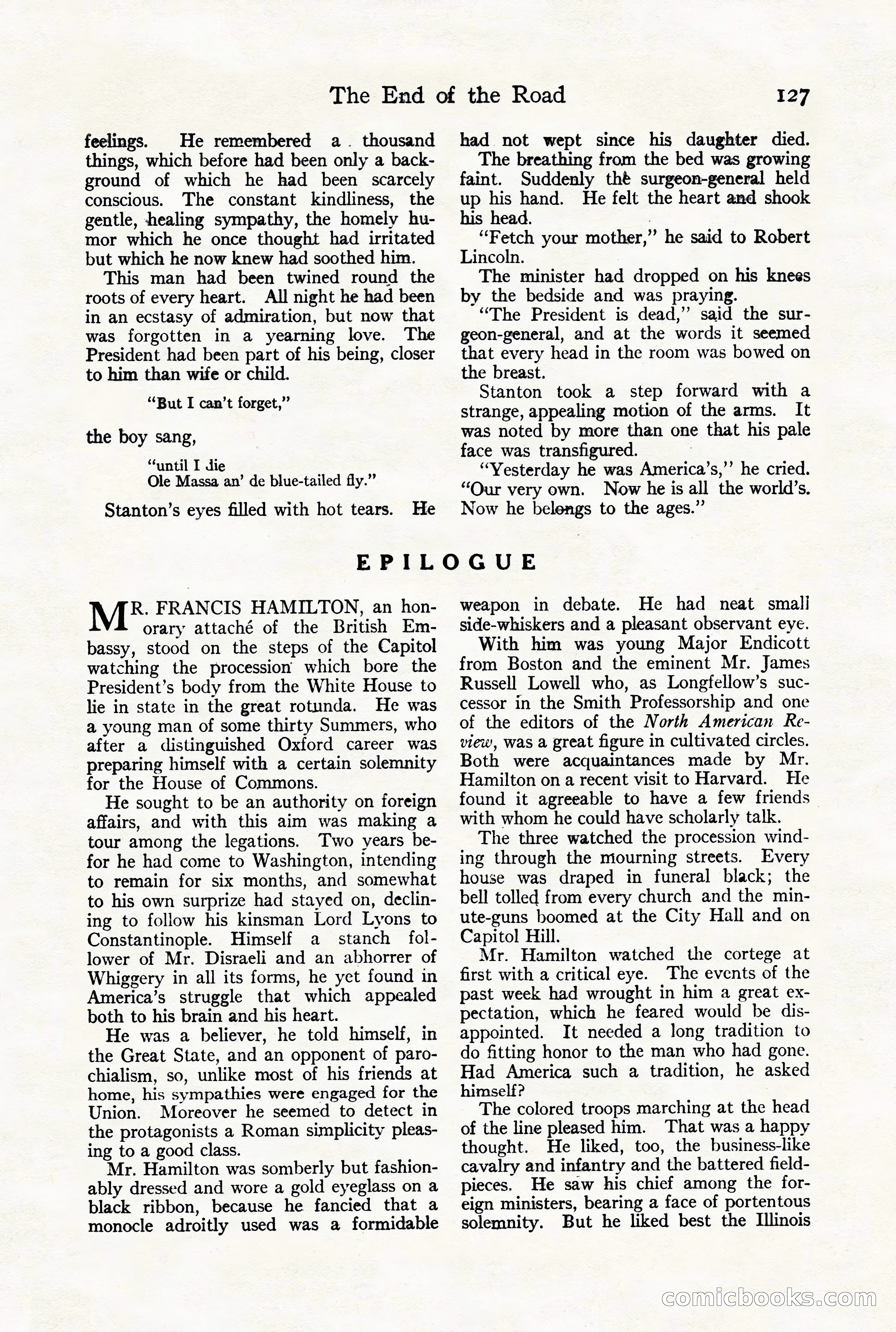
A restored page from Pulp Fiction, 1921. Page through the whole issue in the reader above.
📄 Transcribed text from this page (OCR, searchable)
Machine-transcribed from the original scan — historical spelling and the odd misread are preserved.
The End of the Road feelings. He remembered a. thousand things, which before had been only a back- ground of which he had been scarcely conscious. The constant kindliness, the gentle, healing sympathy, the homely hu- mor which he once thought had irritated but which he now knew had soothed him. This man had been twined round the roots of every heart. All night he had been in an ecstasy of admiration, but now that was forgotten in a yearning love. The President had been part of his being, closer to him than wife or child. “But I can’t forget,” the boy sang, “until I die Ole Massa an’ de blue-tailed fly.” Stanton’s eyes filled with hot tears. He 127 had not wept since his daughter died. The breathing from the bed was growing faint. Suddenly thé surgeon-general held up his hand. He felt the heart and shook his head. 7 “Fetch your mother,” he said to Robert Lincoln. The minister had dropped on his knees by the bedside and was praying. “The President is dead,” said the sur- geon-general, and at the words it seemed that every head in the room was bowed on the breast. Stanton took a step forward with a strange, appealing motion of the arms. It was noted by more than one that his pale face was transfigured. : “Yesterday he was America’s,’’ he cried. “Our very own. Now he is all the world’s. Now he belengs to the ages.” EPILOGUE R. FRANCIS HAMILTON, an hon- orary attaché of the British Em- bassy, stood on the steps of the Capitol watching the procession which bore the President’s body from the White House to lie in state in the great rotunda. He was a young man of some thirty Summers, who after a distinguished Oxford career was preparing himself with a certain solemnity for the House of Commons. He sought to be an authority on foreign affairs, and with this aim was making a tour among the legations. Two years be- for he had come to Washington, intending to remain for six months, and somewhat to his own surprize had stayed on, declin- ing to follow his kinsman Lord Lyons to Constantinople. Himself a stanch _ fol- lower of Mr. Disraeli and an abhorrer of Whiggery in all its forms, he yet found in America’s struggle that which appealed both to his brain and his heart. He was a believer, he told himself, in the Great State, and an opponent of paro- chialism, so, unlike most of his friends at home, his sympathies were engaged for the Union. Moreover he seemed to detect in the protagonists a Roman simplicity pleas- ing to a good class. Mr. Hamilton was somberly but fashion- ably dressed and wore a gold eyeglass on a black ribbon, because he fancied that a monocle adroitly used was a formidable weapon in debate. He had neat small side-whiskers and a pleasant observant eye. With him was young Major Endicott from Boston and the eminent Mr. James Russell Lowell who, as Longfellow’s suc- cessor in the Smith Professorship and one of the editors of the North American Re- view, was a great figure in cultivated circles. Both were acquaintances made by Mr. Hamilton on a recent visit to Harvard. He found it agreeable to have a few friends with whom he could have scholarly talk. The three watched the procession wind- ing through the mourning streets. Every house was draped in funeral black; the bell tolled from every church and the min- ute-guns boomed at the City Hall and on Capitol Hill. Mr. Hamilton watched the cortege at first with a critical eye. The events of the past week had wrought in him a great ex- pectation, which he feared would be dis- appointed. It needed a long tradition to do fitting honor to the man who had gone. Had America such a tradition, he asked himself? The colored troops marching at the head of the line pleased him. That was a happy thought. He liked, too, the business-like cavalry and infantry and the battered field- pieces. He saw his chief among the for- eign ministers, bearing a face of portentous solemnity. But he liked best the Illinois Comicbook C©