
Pulp Fiction, 1921 · page 166 of 204
Adventure Magazine Cover — page 166: what you’re looking at
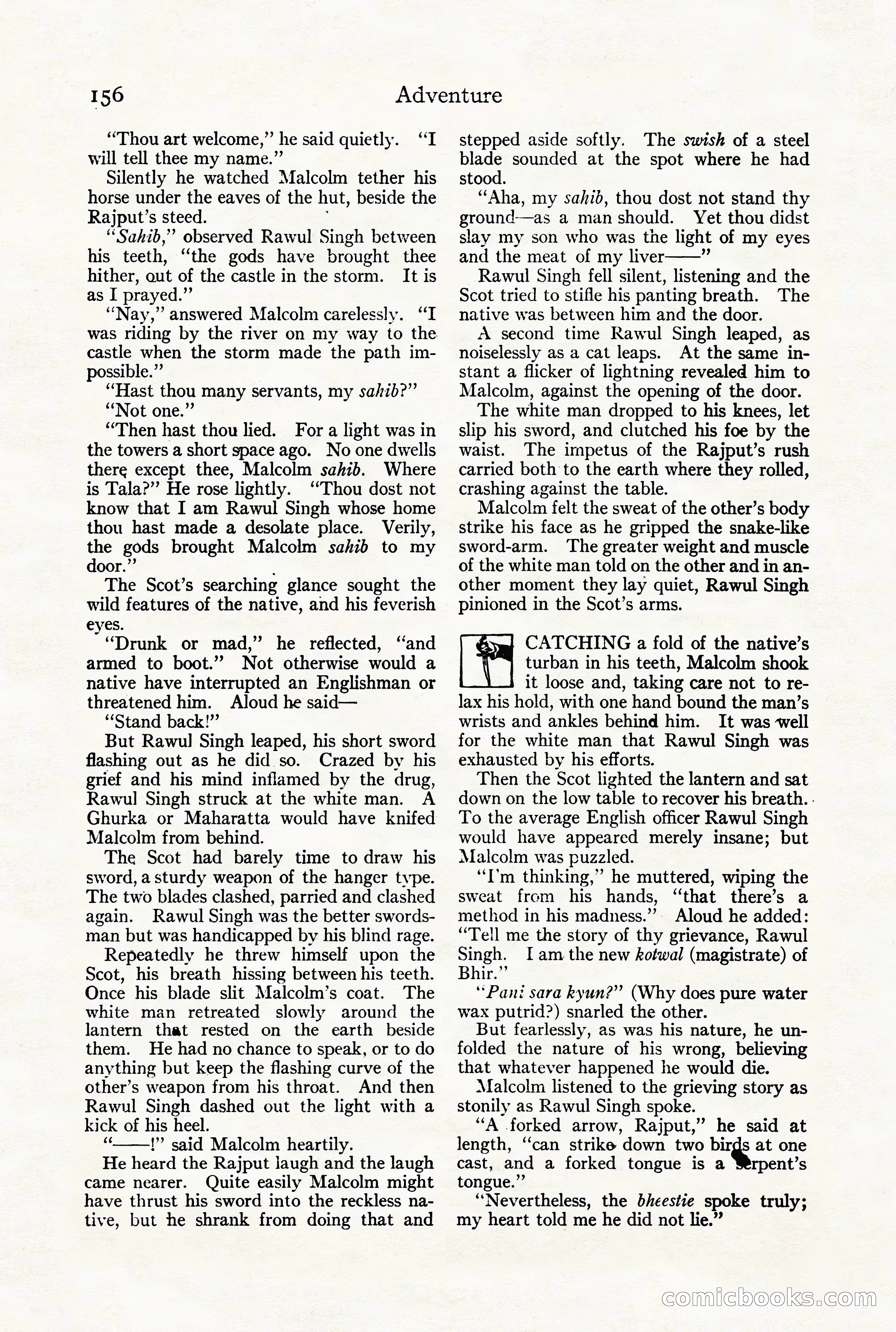
A restored page from Pulp Fiction, 1921. Page through the whole issue in the reader above.
📄 Transcribed text from this page (OCR, searchable)
Machine-transcribed from the original scan — historical spelling and the odd misread are preserved.
156 ‘Thou art welcome,” he said quietly. ‘‘I will tell thee my name.” Silently he watched Malcolm tether his horse under the eaves of the hut, beside the Rajput’s steed. “Sahib,” observed Rawul Singh between his teeth, ‘the gods have brought thee hither, out of the castle in the storm. It is as I prayed.” “Nay,” answered Malcolm carelessly. ‘‘I was riding by the river on my way to the. castle when the storm made the path im- possible.” “Hast thou many servants, my sahib?”’ “Not one.” “Then hast thou lied. For a light was in the towers a short space ago. No one dwells there except thee, Malcolm sahib. Where is Tala?” He rose lightly. “Thou dost not know that I am Rawul Singh whose home thou hast made a desolate place. Verily, the gods brought Malcolm sahib to my door.” The Scot’s searching glance sought the wild features of the native, and his feverish eyes. “Drunk or mad,” he reflected, ‘‘and armed to boot.” Not otherwise would a native have interrupted an Englishman or threatened him. Aloud he said— “Stand back!” But Rawul Singh leaped, his short sword flashing out as he did so. Crazed by his grief and his mind inflamed by the drug, Rawul Singh struck at the white man. A Ghurka or Maharatta would have knifed Malcolm from behind. The Scot had barely time to draw his sword, a sturdy weapon of the hanger tvpe. The two blades clashed, parried and clashed again. Rawul Singh was the better swords- man but was handicapped by his blind rage. Repeatedly he threw himself upon the Scot, his breath hissing between his teeth. Once his blade slit Malcolm’s coat. The white man retreated slowly around the lantern that rested on the earth beside them. He had no chance to speak, or to do anything but keep the flashing curve of the other’s weapon from his throat. And then Rawul Singh dashed out the light with a kick of his heel. ‘*___!”? said Malcolm heartily. He heard the Rajput jaugh and the laugh came nearer. Quite easily Malcolm might have thrust his sword into the reckless na- tive, but he shrank from doing that and Adventure stepped aside softly. The swisk of a steel blade sounded at the spot where he had stood. “Aha, my sahib, thou dost not stand thy ground—as a man should. Yet thou didst slay my son who was the light of my eyes and the meat of my liver——” Rawul Singh fell silent, listening and the Scot tried to stifle his panting breath. The native was between him and the door. A. second time Rawul Singh leaped, as noiselessly as a cat leaps. At the same in- stant a flicker of lightning revealed him to Malcolm, against the opening of the door. The white man dropped to his knees, let slip his sword, and clutched his foe by the waist. The impetus of the Rajput’s rush carried both to the earth where they rolled, crashing against the table. Malcolm felt the sweat of the other’s body strike his face as he gripped the snake-like sword-arm. ‘The greater weight and muscle of the white man told on the other and in an- other moment they lay quiet, Rawul Singh pinioned in the Scot’s arms. ka turban in his teeth, Malcolm shook it loose and, taking care not to re- lax his hold, with one hand bound the man’s wrists and ankles behind him. It was well for the white man that Rawul Singh was exhausted by his efforts. Then the Scot lighted the lantern and sat down on the low table to recover his breath. - To the average English officer Rawul Singh would have appeared merely insane; but Malcolm was puzzled. ‘I'm thinking,” he muttered, wiping the sweat from his hands, “that there’s a method in his madness.’”’ Aloud he added: “Tell me the story of thy grievance, Rawul Singh. I am the new kotwal (magistrate) of Bhir.”’ “Pani sara kywn?” (Why does pure water wax putrid?) snarled the other. But fearlessly, as was his nature, he un- folded the nature of his wrong, believing that whatever happened he would die. Malcolm listened to the grieving story as stonily as Rawul Singh spoke. “A .forked arrow, Rajput,” he said at length, ‘‘can strike down two birds at one cast, and a forked tongue is a Strpent’s tongue.” ‘Nevertheless, the bheestie spoke truly; my heart told me he did not lie.” CATCHING a fold of the native’s COmiclbook CO