
Pulp Fiction, 1921 · page 172 of 204
Adventure Magazine Cover — page 172: what you’re looking at
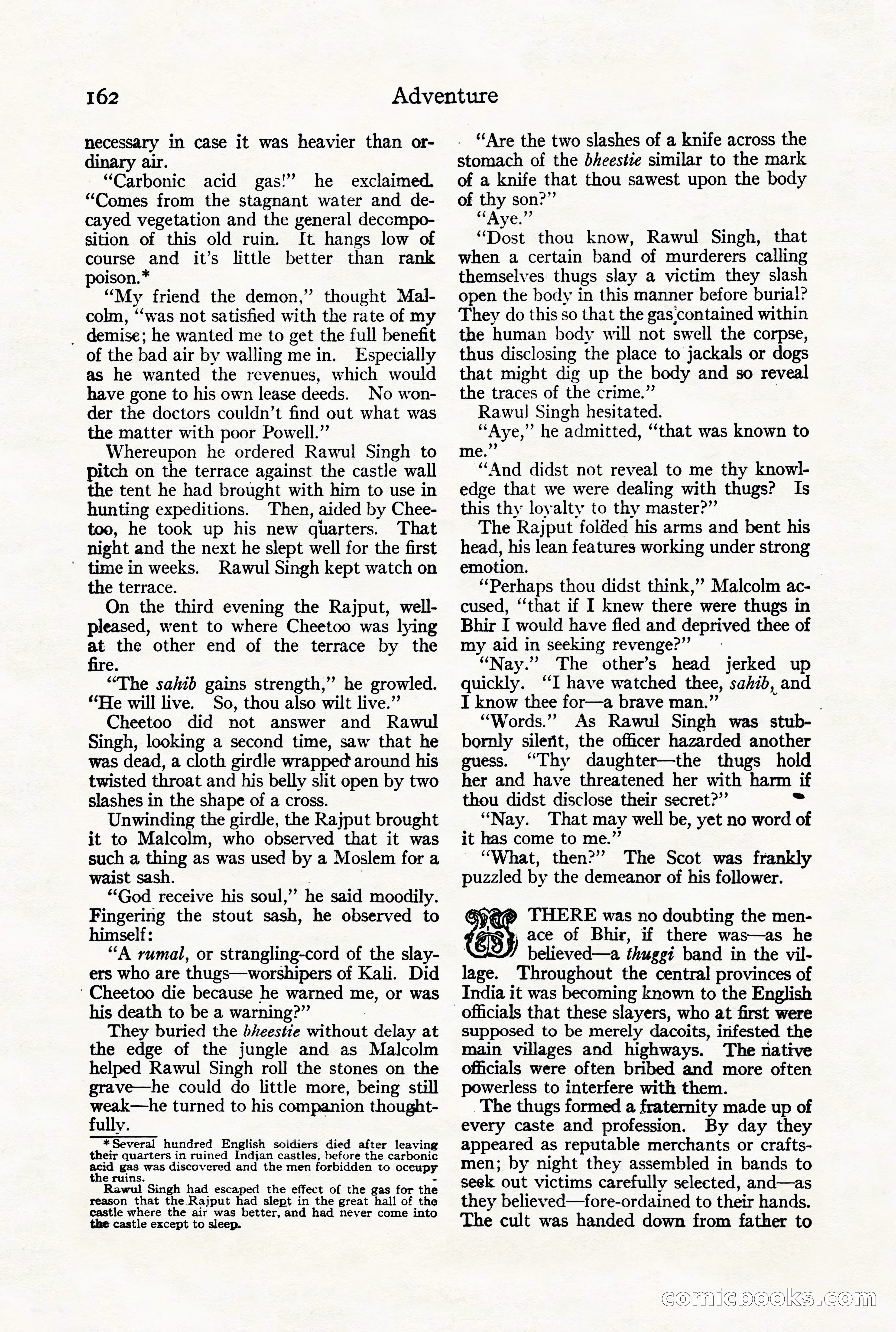
A restored page from Pulp Fiction, 1921. Page through the whole issue in the reader above.
📄 Transcribed text from this page (OCR, searchable)
Machine-transcribed from the original scan — historical spelling and the odd misread are preserved.
162 necessary in case it was heavier than or- dinary air. “Carbonic acid gas!” he exclaimed. “Comes from the stagnant water and de- cayed vegetation and the general deccmpo- sition of this old ruin. It hangs low of course and it’s little better than rank ison. * “My friend the demon,” thought Mal- colm, ‘‘was not satisfied with the rate of my _ demise; he wanted me to get the full benefit of the bad air by walling mein. Especially as he wanted the revenues, which would have gone to his own lease deeds. No won- der the doctors couldn’t find out what was the matter with poor Powell.” Whereupon he ordered Rawul Singh to pitch on the terrace against the castle wall the tent he had brought with him to use in hunting expeditions. Then, aided by Chee- too, he took up his new quarters. That night and the next he slept well for the first ’ time in weeks. Rawul Singh kept watch on the terrace. On the third evening the Rajput, well- pleased, went to where Cheetoo was lying re the other end of the terrace by the e. “The sahib gains strength,” he growled. ‘He will live. So, thou also wilt live.” Cheetoo did not answer and Rawul Singh, looking a second time, saw that he was dead, a cloth girdle wrapped around his twisted throat and his belly slit open by two slashes in the shape of a cross. Unwinding the girdle, the Rajput brought it to Malcolm, who observed that it was such a thing as was used by a Moslem for a waist sash. “God receive his soul,” he said moodily. Fingering the stout sash, he observed to himself: “A rumal, or strangling-cord of the slay- ers who are thugs—worshipers of Kali. Did ‘ Cheetoo die because he warned me, or was his death to be a warning?” They buried the bheestie without delay at the edge of the jungle and as Malcolm 199 helped Rawul Singh roll the stones on the - grave—he could do little more, being still weak—he turned to his companion thought- fully. * Several hundred English soldiers died after leaving their quarters in ruined Indian castles, before the carbonic acid gas was discovered and the men forbidden to oceupy the ruins. Rawul Singh had escaped the effect of the gas for the reason that the Rajput had slept in the great hall of the castle where the air was better, and had never come into the castle except to sleep. Adventure “Are the two slashes of a knife across the stomach of the bheestie similar to the mark of a knife that thou sawest upon the body of thy son?” éé Ay e. 9 “Dost thou know, Rawul Singh, that when a certain band of murderers calling themselves thugs slay a victim they slash open the body in this manner before burial? They do this so that the gas contained within the human body will not swell the corpse, thus disclosing the place to jackals or dogs that might dig up the body and so reveal the traces of the crime.”’ : Rawul Singh hesitated. “Aye,” he admitted, ‘that was known to me.” “And didst not reveal to me thy knowl- edge that we were dealing with thugs? Is this thy loyalty to thy master?” The Rajput folded his arms and bent his head, his lean features working under strong emotion. “Perhaps thou didst think,’”’ Malcolm ac- cused, ‘‘that if I knew there were thugs in Bhir I would have fled and deprived thee of my aid in seeking revenge?” “Nay.” The other’s head jerked up quickly. ‘I have watched thee, sahib, and I know thee for—a brave man.’ “Words.” bornly silerit, the officer hazarded another guess. “Thy daughter—the thugs hold her and have threatened her with harm if thou didst disclose their secret?”’ = “Nay. That may well be, yet no word of it has come to me.” “What, then?” The Scot was frankly puzzled by the demeanor of his follower. » THERE was no doubting the men- ace of Bhir, if there was—as he : believed—a thuggt band in the vil- lage. Throughout the central provinces of India it was becoming known to the English officials that these slayers, who at first were supposed to be merely dacoits, infested the main villages and highways. The native officials were often bribed and more often powerless to interfere with them. The thugs formed a fraternity made up of every caste and profession. By day they appeared as reputable merchants or crafts- men; by night they assembled in bands to seek out victims carefully selected, and—as they believed—fore-ordained to their hands. The cult was handed down from father to COmiclbook As Rawul Singh was stub- : CO