
Pulp Fiction, 1921 · page 186 of 204
Adventure Magazine Cover — page 186: what you’re looking at
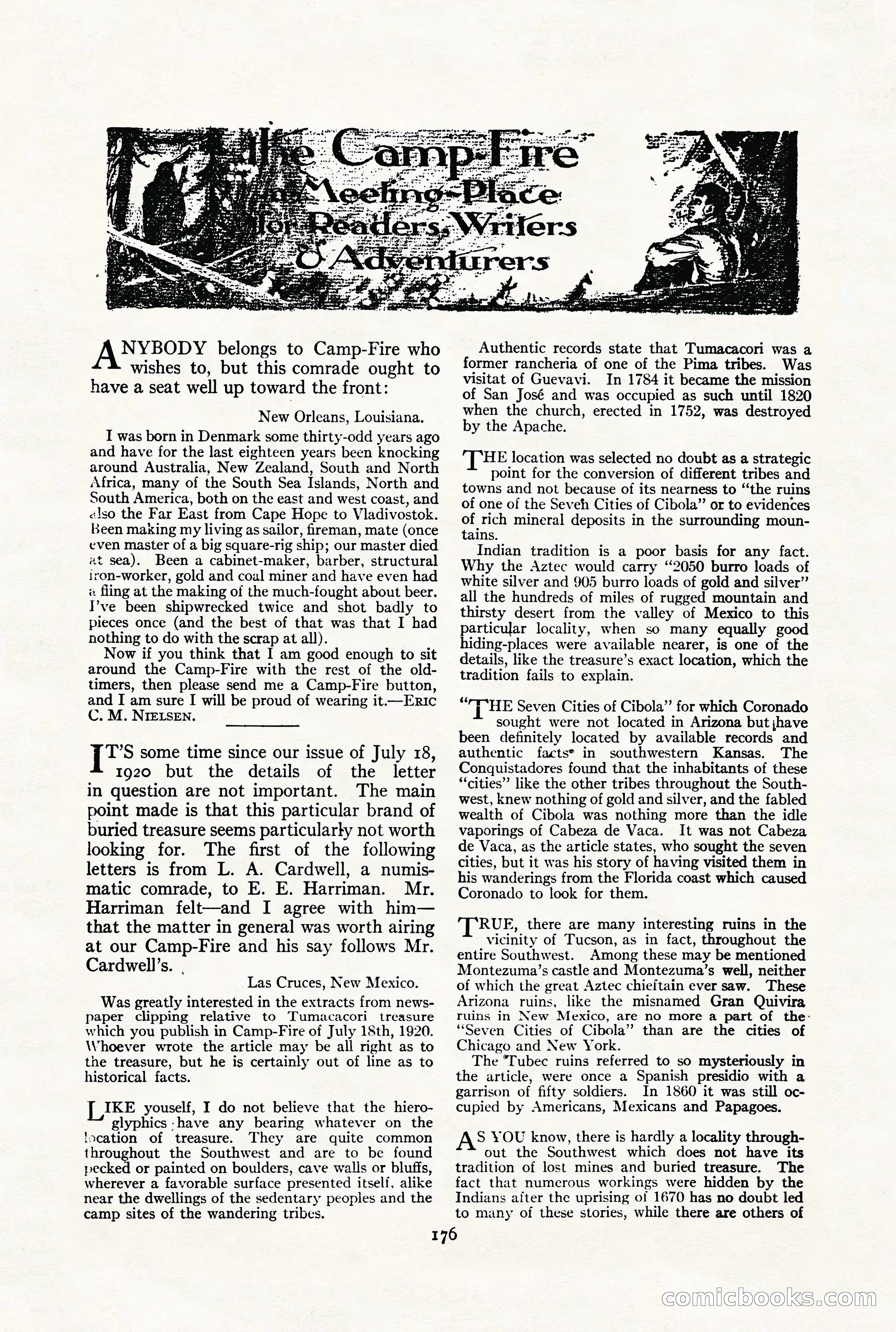
A restored page from Pulp Fiction, 1921. Page through the whole issue in the reader above.
📄 Transcribed text from this page (OCR, searchable)
Machine-transcribed from the original scan — historical spelling and the odd misread are preserved.
NYBODY belongs to Camp-Fire who wishes to, but this comrade ought to have a seat well up toward the front: New Orleans, Louisiana. I was born in Denmark some thirty-odd years ago and have for the last eighteen years been knocking around Australia, New Zealand, South and North Africa, many of the South Sea Islands, North and South America, both on the east and west coast, and ¢lso the Far East from Cape Hope to Vladivostok. Been making my living as sailor, fireman, mate (once even master of a big square-rig ship; our master died at sea). Been a cabinet-maker, barber, structural iron-worker, gold and coal miner and have even had « fling at the making of the much-fought about beer. I’ve been shipwrecked twice and shot badly to pieces once (and the best of that was that I had nothing to do with the scrap at all). Now if you think that I am good enough to sit around the Camp-Fire with the rest of the old- timers, then please send me a Camp-Fire button, and I am sure I will be proud of wearing it. Eric C. M. NIELSEN. ars some time since our issue of July 18, 1920 but the details of the letter in question are not important. The main point made is that this particular brand of buried treasure seems particularly not worth looking for. The first of the following letters is from L. A. Cardwell, a numis- matic comrade, to E. E. Harriman. Mr. Harriman felt—and I agree with him— that the matter in general was worth airing at our Camp-Fire and his say follows Mr. Cardwell’s. . Las Cruces, New Mexico. Was greatly interested in the extracts from news- paper clipping relative to Tumacacori treasure which you publish in Camp-Fire of July 18th, 1920. Whoever wrote the article may be all right as to the treasure, but he is certainly out of line as to historical facts. IKE youself, I do not believe that the hiero- glyphics -have any bearing whatever on the Iscation of treasure. They are quite common throughout the Southwest and are to be found pecked or painted on boulders, cave walls or bluffs, wherever a favorable surface presented itself, alike near the dwellings of the sedentary peoples and the camp sites of the wandering tribes. Authentic records state that Tumacacori was a former rancheria of one of the Pima tribes. Was visitat of Guevavi. In 1784 it became the mission of San José and was occupied as such until 1820 when the church, erected in 1752, was destroyed by the Apache. HE location was selected no doubt as a strategic point for the conversion of different tribes and towns and not because of its nearness to “the ruins of one of the Seveh Cities of Cibola’’ or to evidences of rich mineral deposits in the surrounding moun- tains. Indian tradition is a poor basis for any fact. Why the Aztec would carry ‘2050 burro loads of white silver and 905 burro loads of gold and silver’’ all the hundreds of miles of rugged mountain and thirsty desert from the valley of Mexico to this particular locality, when so many equally good hiding-places were available nearer, is one of the details, like the treasure’s exact location, which the tradition fails to explain. “PM HE Seven Cities of Cibola” for which Coronado sought were not located in Arizona but jhave been definitely located by available records and authentic facts* in southwestern Kansas. The Conquistadores found that the inhabitants of these “cities” like the other tribes throughout the South- west, knew nothing of gold and silver, and the fabled wealth of Cibola was nothing more than the idle vaporings of Cabeza de Vaca. It was not Cabeza de Vaca, as the article states, who sought the seven cities, but it was his story of having visited them in his wanderings from the Florida coast which caused Coronado to look for them. RUE, there are many interesting ruins in the vicinity of Tucson, as in fact, throughout the entire Southwest. Among these may be mentioned Montezuma’s castle and Montezuma’s well, neither of which the great Aztec chieftain ever saw. These Arizona ruins, like the misnamed Gran Quivira ruins in New Mexico, are no more a part of the- ‘Seven Cities of Cibola” than are the cities of Chicago and New York. The “Tubec ruins referred to so mysteriously in the article, were once a Spanish presidio with a garrison of fifty soldiers. In 1860 it was still oc- cupied by Americans, Mexicans and Papagoes. AS YOU know, there is hardly a locality through- out the Southwest which does not have its tradition of lost mines and buried treasure. The fact that numerous workings were hidden by the Indians after the uprising of 1670 has no doubt led to many of these stories, while there are others of 176 COmiclbooks CO