
Pulp Fiction, 1921 · page 71 of 204
Adventure Magazine Cover — page 71: what you’re looking at
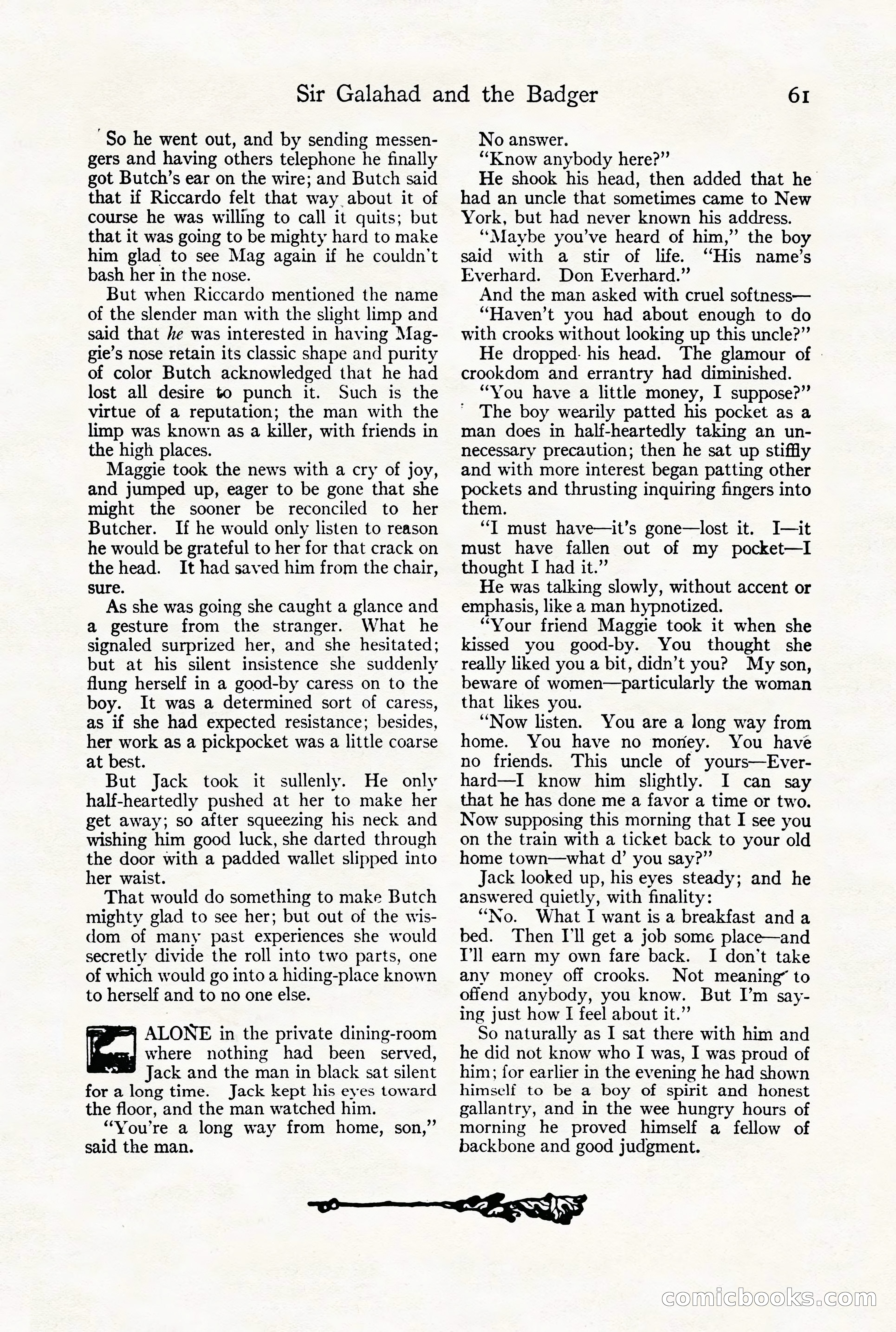
A restored page from Pulp Fiction, 1921. Page through the whole issue in the reader above.
📄 Transcribed text from this page (OCR, searchable)
Machine-transcribed from the original scan — historical spelling and the odd misread are preserved.
sir Galahad and the Badger So he went out, and by sending messen- gers and having others telephone he finally got Butch’s ear on the wire; and Butch said that if Riccardo felt that way about it of course he was willing to call it quits; but that it was going to be mighty hard to make him glad to see Mag again if he couldn't bash her in the nose. But when Riccardo mentioned the name of the slender man with the slight limp and said that ke was interested in having Mag- gie’s nose retain its classic shape and purity of color Butch acknowledged that he had lost all desire to punch it. Such is the virtue of a reputation; the man with the limp was known as a killer, with friends in the high places. Maggie took the news with a cry of joy, and jumped up, eager to be gone that she might the sooner be reconciled to her Butcher. If he would only listen to reason he would be grateful to her for that crack on the head. It had saved him from the chair, sure. As she was going she caught a glance and a gesture from the stranger. What he signaled surprized her, and she hesitated; but at his silent insistence she suddenly flung herself in a good-by caress on to the boy. It was a determined sort of caress, as if she had expected resistance; besides, her work as a pickpocket was a little coarse at best. But Jack took it sullenly. He only half-heartedly pushed at her to make her get away; so after squeezing his neck and wishing him good luck, she darted through the door with a padded wallet slipped into her waist. That would do something to make Butch mighty glad to see her; but out of the wis- dom of many past experiences she would secretly divide the roll into two parts, one of which would go into a hiding-place known to herself and to no one else. ALONE in the private dining-room where nothing had been served, Jack and the man in black sat silent for along time. Jack kept his eyes toward the floor, and the man watched him. “You’re a long way from home, son,” said the man. , ' 61 No answer. “Know anybody here?” He shook his head, then added that he had an uncle that sometimes came to New York, but had never known his address. “Maybe you’ve heard of him,” the boy said with a stir of life. “His name’s Everhard. Don Everhard.” And the man asked with cruel softness— ‘““Haven’t you had about enough to do with crooks without looking up this uncle?” He dropped: his head. The glamour of » crookdom and errantry had diminished. “Vou have a little money, I suppose?”’ ' The boy wearily patted his pocket as a man does in half-heartedly taking an un- necessary precaution; then he sat up stiffly and with more interest began patting other pockets and thrusting inquiring fingers into them. “T must have—it’s gone—lost it. I—it must have fallen out of my pocket—I thought I had it.” He was talking slowly, without accent or emphasis, like a man hypnotized. “Your friend Maggie took it when she kissed you good-by. You thought she really liked you a bit, didn’t you? My son, beware of women—particularly the woman that likes you. ‘Now listen. You are a long way from home. You have no moriey. You have no friends. This uncle of yours—Ever- hard—I know him slightly. I can say that he has done me a favor a time or two. Now supposing this morning that I see you on the train with a ticket back to your old home town—what d’ you say?” Jack looked up, his eyes steady; and he answered quietly, with finality: ‘No. What I want is a breakfast anda bed. Then I'll get a job some place—and [ll earn my own fare back. I don’t take any money off crooks. Not meaning” to offend anybody, you know. But I’m say- ing just how I feel about it.” So naturally as I sat there with him and he did not know who I was, I was proud of him; for earlier in the evening he had shown himself to be a boy of spirit and honest gallantry, and in the wee hungry hours of morning he proved himself a fellow of backbone and good judgment. oa cComicbook C©