
Pulp Fiction, 1921 · page 108 of 200
Adventure Magazine Cover, August 18, 1921 — page 108: what you’re looking at
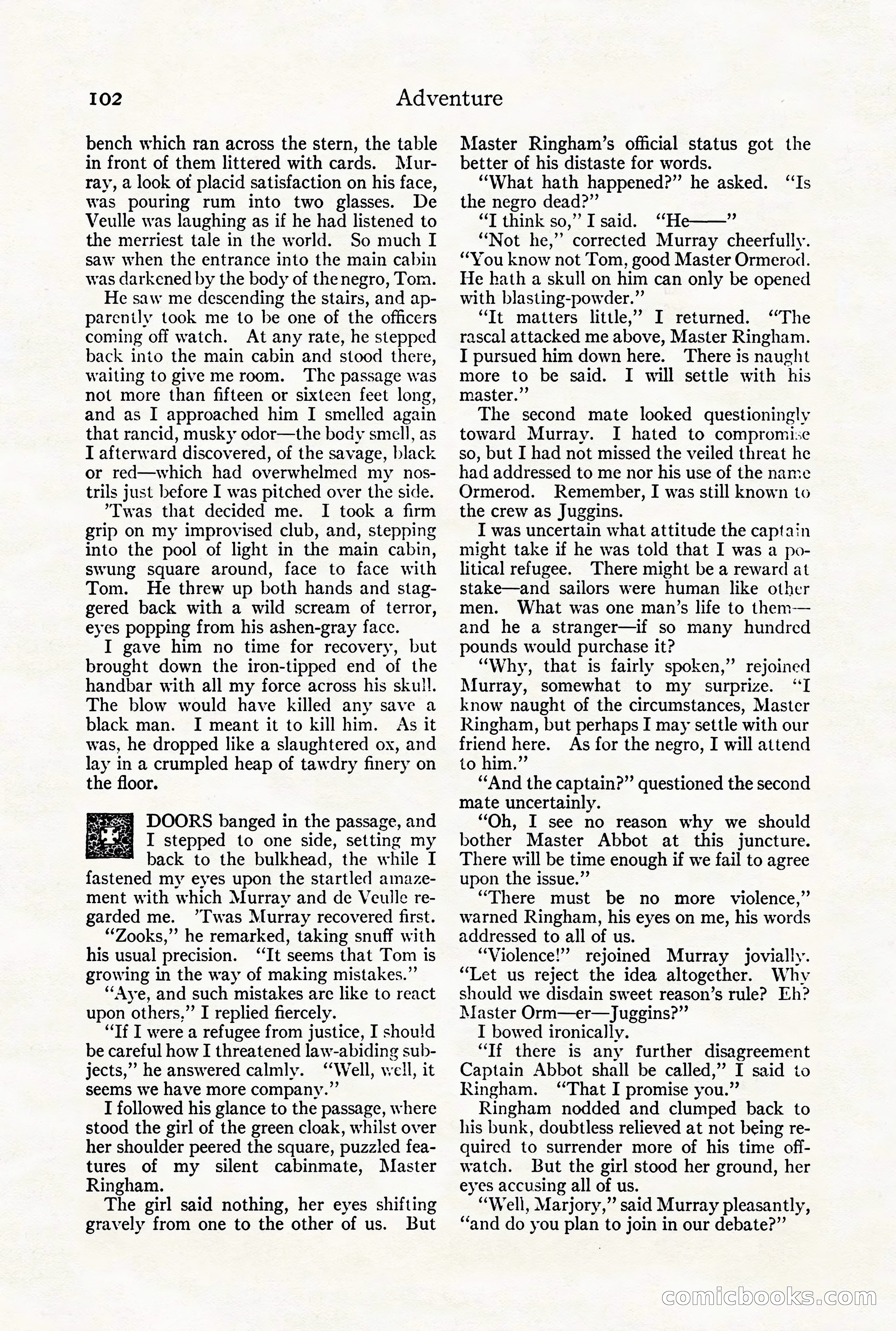
A restored page from Pulp Fiction, 1921. Page through the whole issue in the reader above.
📄 Transcribed text from this page (OCR, searchable)
Machine-transcribed from the original scan — historical spelling and the odd misread are preserved.
TO2 bench which ran across the stern, the table in front of them littered with cards. Mur- ray, 2 look of placid satisfaction on his face, was pouring rum into two glasses. De Veulle was laughing as if he had listened to the merriest tale in the world. So much I saw when the entrance into the main cabin was darkened by the body of the negro, Tom. He saw me descending the stairs, and ap- parently took me to be one of the officers coming off watch. At any rate, he stepped back into the main cabin and stood there, waiting to give me room. ‘The passage was not more than fifteen or sixteen feet long, and as I approached him I smelled again that rancid, musky odor—the body smell, as I afterward discovered, of the savage, black or red—which had overwhelmed my nos- trils just before I was pitched over the side. ’Twas that decided me. I took a firm grip on my improvised club, and, stepping into the pool of light in the main cabin, swung square around, face to face with Tom. He threw up both hands and stag- gered back with a wild scream of terror, eyes popping from his ashen-gray face. I gave him no time for recovery, but brought down the iron-tipped end of the handbar with all my force across his skull. The blow would have killed any save a black man. I meant it to kill him. As it was, he dropped like a slaughtered ox, and lay in a crumpled heap of tawdry finery on the floor. DOORS banged in the passage, and I stepped to one side, setting my back to the bulkhead, the while I fastened my eyes upon the startled amaze- ment with which Murray and de Veulle re- garded me. “Iwas Murray recovered first. “*Zooks,”’ he remarked, taking snuff with his usual precision. “It seems that Tom is growing in the way of making mistakes.”’ ‘‘Aye, and such mistakes are like to react upon others,” I replied fiercely. “Tf I were a refugee from justice, I should be careful how I threatened law-abiding sub- jects,” he answered calmly. ‘‘Well, well, it seems we have more company.” I followed his glance to the passage, where stood the girl of the green cloak, whilst over her shoulder peered the square, puzzled fea- tures of my silent cabinmate, Master Ringham. The girl said nothing, her eyes shifting gravely from one to the other of us. But Adventure Master Ringham’s official status got the better of his distaste for words. ‘“‘What hath happened?” he asked. the negro dead?” “T think so,” Isaid. “He——” “Not he,” corrected Murray cheerfully. “You know not Tom, good Master Ormerod. He hath a skull on him can only be opened with blasting-powder.”’ “It matters little,’ I returned. ‘“The rascal attacked me above, Master Ringham. I pursued him down here. There is naught more to be said. I will settle with his master.” The second mate looked questioningly toward Murray. I hated to compromise so, but I had not missed the veiled threat he had addressed to me nor his use of the name Ormerod. Remember, I was still known to the crew as Juggins. I was uncertain what attitude the captain might take if he was told that I was a po- litical refugee. ‘There might be a reward at stake—and sailors were human like other men. What was one man’s life to them— and he a stranger—if so many hundred pounds would purchase it? “Why, that is fairly spoken,” rejoined Murray, somewhat to my surprize. “I know naught of the circumstances, Master Ringham, but perhaps I may settle with our friend here. As for the negro, I will attend to him.” ‘“‘And the captain?” questioned the second mate uncertainly. “Oh, I see no reason why we should bother Master Abbot at this juncture. There will be time enough if we fail to agree upon the issue.” “There must be no more violence,” warned Ringham, his eyes on me, his words addressed to all of us. “Violence!” rejoined Murray jovially. “Let us reject the idea altogether. Why should we disdain sweet reason’s rule? Eh? Master Orm—er—Juggins?”’ I bowed ironically. “Tf there is any further disagreement Captain Abbot shall be called,” I said to Ringham. “That I promise you.” Ringham nodded and clumped back to his bunk, doubtless relieved at not being re- quired to surrender more of his time ofi- watch. But the girl stood her ground, her eyes accusing all of us. “Well, Marjory,” said Murray pleasantly, “and do you plan to join in our debate?”’ “Te (© MICLOOKS C© 5}