
Pulp Fiction, 1921 · page 121 of 200
Adventure Magazine Cover, August 18, 1921 — page 121: what you’re looking at
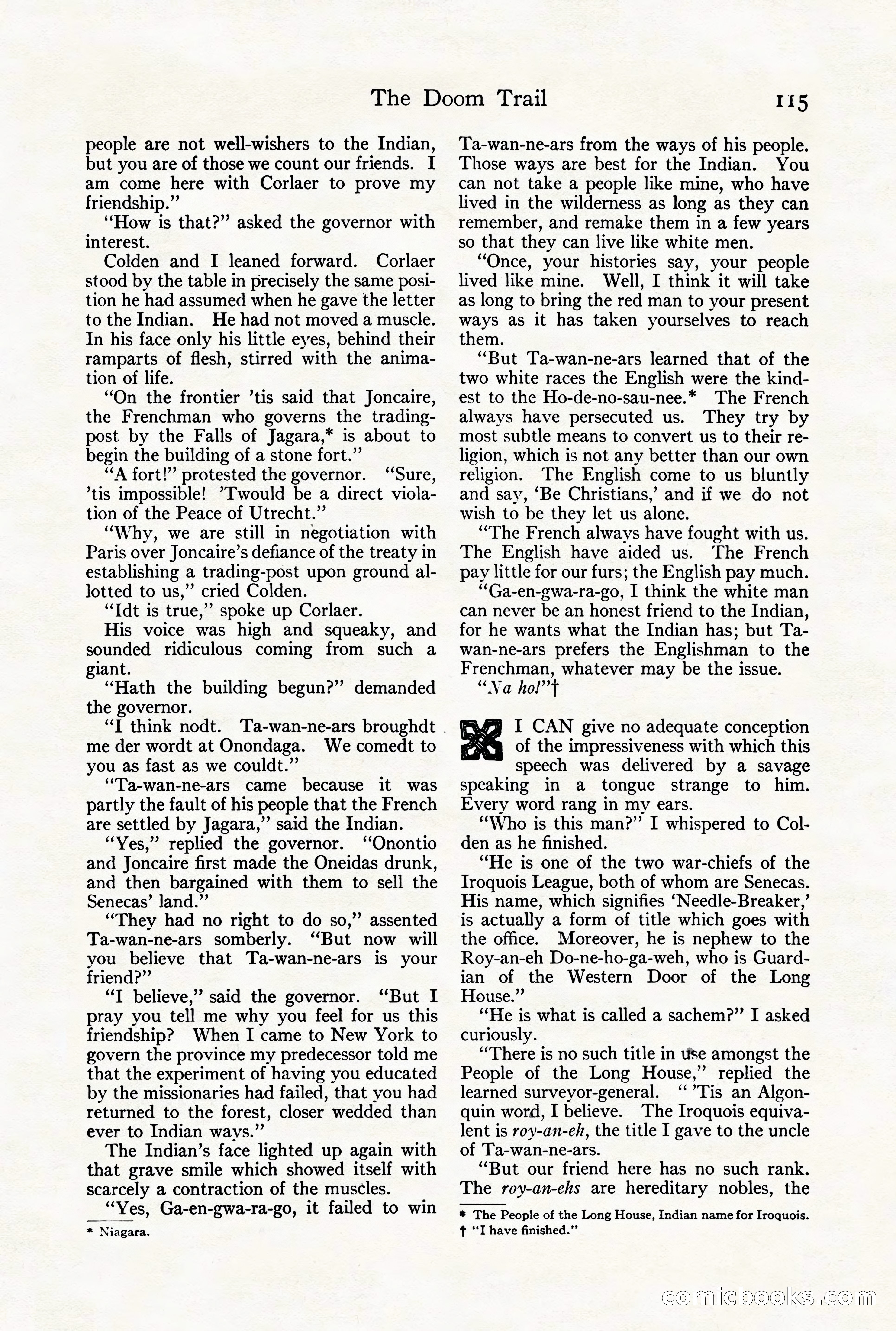
A restored page from Pulp Fiction, 1921. Page through the whole issue in the reader above.
📄 Transcribed text from this page (OCR, searchable)
Machine-transcribed from the original scan — historical spelling and the odd misread are preserved.
The Doom Trail people are not well-wishers to the Indian, but you are of those we count our friends. I am come here with Corlaer to prove my friendship.” ‘How is that?” asked the governor with interest. Colden and I leaned forward. Corlaer stood by the table in precisely the same posi- tion he had assumed when he gave the letter to the Indian. He had not moved a muscle. In his face only his little eyes, behind their ramparts of flesh, stirred with the anima- tion of life. “On the frontier ’tis said that Joncaire, the Frenchman who governs the trading- post by the Falls of Jagara,* is about to begin the building of a stone fort.” “A fort!” protested the governor. ‘“‘Sure, tis impossible! *"IT'would be a direct viola- tion of the Peace of Utrecht.” “Why, we are still in negotiation with Paris over Joncaire’s defiance of the treaty in establishing a trading-post upon ground al- lotted to us,” cried Colden. “Tdt is true,’ spoke up Corlaer. His voice was high and squeaky, and sounded ridiculous coming from such a giant. “Hath the building begun?” demanded the governor. “T think nodt. me der wordt at Onondaga. you as fast as we couldt.”’ ‘“‘Ta-wan-ne-ars came because it was partly the fault of his people that the French are settled by Jagara,”’ said the Indian. “Yes,” replied the governor. ‘“Onontio and Joncaire first made the Oneidas drunk, and then bargained with them to sell the Senecas’ land.” “They had no right to do so,” assented Ta-wan-ne-ars somberly. ‘But now will you believe that Ta-wan-ne-ars is your friend?” “TI believe,” said the governor. “But I pray you tell me why you feel for us this friendship? When I came to New York to govern the province my predecessor told me that the experiment of having you educated by the missionaries had failed, that you had returned to the forest, closer wedded than ever to Indian ways.” The Indian’s face lighted up again with that grave smile which showed itself with scarcely a contraction of the muscles. “Yes, Ga-en-gwa-ra-go, it failed to win * Niagara. We comedt to Ta-wan-ne-ars broughdt . I15 Ta-wan-ne-ars from the ways of his people. Those ways are best for the Indian. You can not take a people like mine, who have lived in the wilderness as long as they can remember, and remake them in a few years so that they can live like white men. “Once, your histories say, your people lived like mine. Well, I think it will take as long to bring the red man to your present ways as it has taken yourselves to reach them. “But Ta-wan-ne-ars learned that of the two white races the English were the kind- est to the Ho-de-no-sau-nee.* The French always have persecuted us. They try by most subtle means to convert us to their re- ligion, which is not any better than our own religion. The English come to us bluntly and sav, ‘Be Christians,’ and if we do not wish to be they let us alone. ‘The French always have fought with us. The English have aided us. The French pay little for our furs; the English pay much. “‘Ga-en-gwa-ra-go, I think the white man can never be an honest friend to the Indian, for he wants what the Indian has; but Ta- wan-ne-ars prefers the Englishman to the Frenchman, whatever may be the issue. “Na ho!l”+ regy I CAN give no adequate conception exe of the impressiveness with which this "speech was delivered by a savage speaking in a tongue strange to him. Every word rang in my ears. “Who is this man?” I whispered to Col- den as he finished. “He is one of the two war-chiefs of the Iroquois League, both of whom are Senecas. His name, which signifies ‘Needle-Breaker,’ is actually a form of title which goes with the office. Moreover, he is nephew to the Roy-an-eh Do-ne-ho-ga-weh, who is Guard- ian of the Western Door of the Long House.” “He is what is called a sachem?”’ I asked curiously. 7 ‘There is no such title in use amongst the People of the Long House,” replied the learned surveyor-general. “’Tis an Algon- quin word, I believe. The Iroquois equiva- lent is roy-an-eh, the title I gave to the uncle of Ta-wan-ne-ars. “But our friend here has no such rank. The roy-an-ehs are hereditary nobles, the * The People of the Long House, Indian name for Iroquois. ¢ ‘I have finished.” C© MICLOOKS CO