
Pulp Fiction, 1921 · page 127 of 200
Adventure Magazine Cover, August 18, 1921 — page 127: what you’re looking at
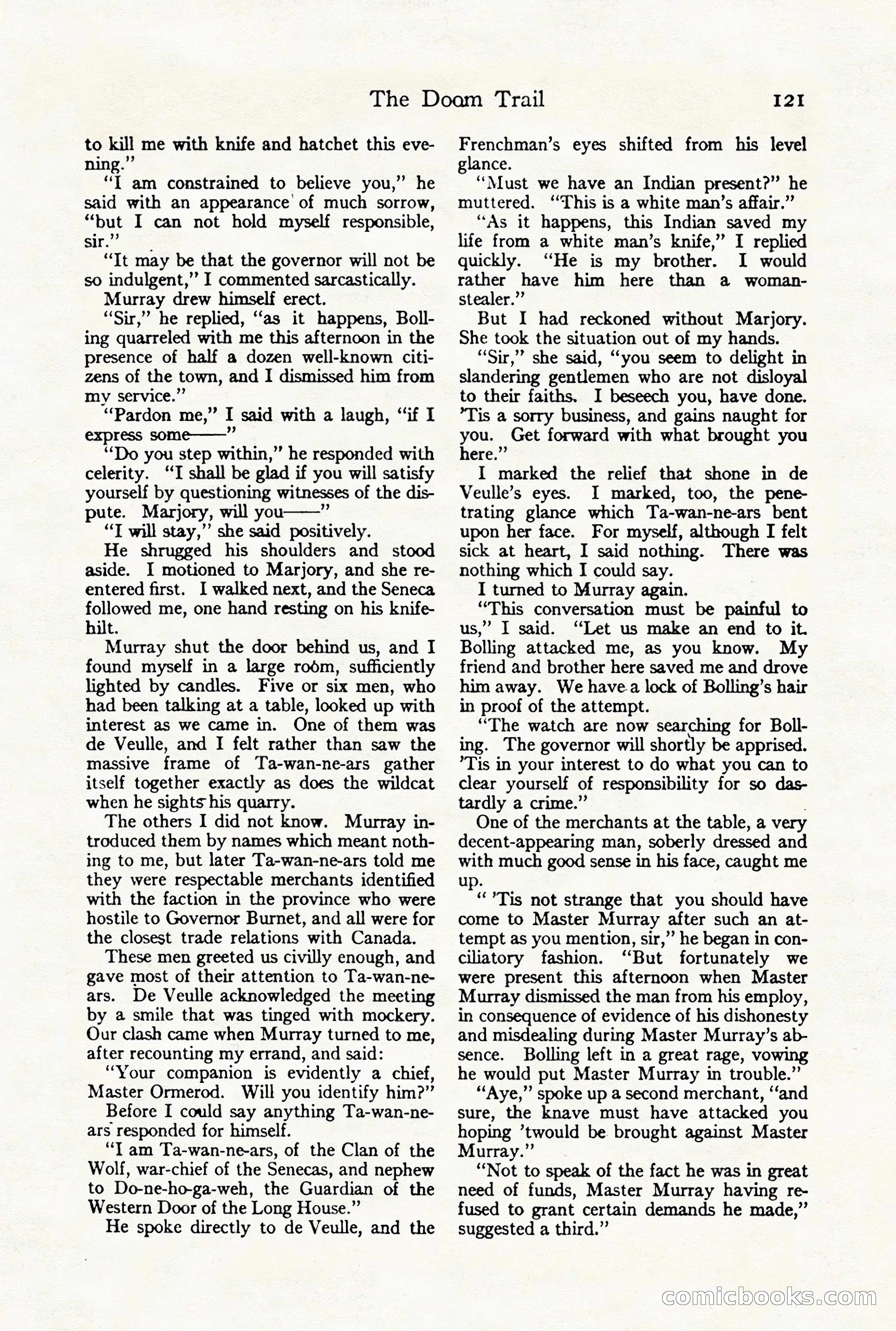
A restored page from Pulp Fiction, 1921. Page through the whole issue in the reader above.
📄 Transcribed text from this page (OCR, searchable)
Machine-transcribed from the original scan — historical spelling and the odd misread are preserved.
The Doam Trail to kill me with knife and hatchet this eve- ning.” “T am constrained to believe you,’ he said with an appearance of much sorrow, “but I can not hold myself responsible, sir,” “Tt may be that the governor will not be so indulgent,’’ I commented sarcastically. Murray drew himself erect. “Sir,” he replied, ‘as it happens, Boll- ing quarreled with me this afternoon in the presence of half a dozen well-known citi- zens of the town, and I dismissed him from my service.” “Pardon me,” I said with a laugh, “‘if I ress some——’”’ “Do you step within,” he responded with celerity. “I shall be glad if you will satisfy yourself by questioning witnesses of the dis- pute. Marjory, will you——” “‘T will stay,’ she said positively. He shrugged his shoulders and stood aside. I motioned to Marjory, and she re- entered first. I walked next, and the Seneca followed me, one hand resting on his knife- hilt. Murray shut the door behind us, and I found myself in a large room, sufficiently lighted by candles. Five or six men, who had been talking at a table, looked up with interest as we came in. One of them was de Veulle, and I felt rather than saw the massive frame of Ta-wan-ne-ars gather itself together exactly as does the wildcat when he sights his quarry. The others I did not know. Murray in- troduced them by names which meant noth- ing to me, but later Ta-wan-ne-ars told me they were respectable merchants identified with the faction in the province who were hostile to Governor Burnet, and all were for the closest trade relations with Canada. These men greeted us civilly enough, and gave most of their attention to Ta-wan-ne- ars. De Veulle acknowledged the meeting by a smile that was tinged with mockery. Our clash came when Murray turned to me, after recounting my errand, and said: “Your companion is evidently a chief, Master Ormerod. Will you identify him?” Before I could say anything Ta-wan-ne- ars responded for himself. “Tam Ta-wan-ne-ars, of the Clan of the Wolf, war-chief of the Senecas, and nephew to Do-ne-ho-ga-weh, the Guardian of the Western Door of the Long House.” He spoke directly to de Veulle, and the I2I Frenchman’s eyes shifted from his level glance. ‘Must we have an Indian present?” he muttered. ‘This is a white man’s affair.” ‘As it happens, this Indian saved my life from a white man’s knife,” I replied quickly. “He is my brother. I would rather have him here than a woman- stealer.” But I had reckoned without Marjory. She took the situation out of my hands. “Sir,” she said, “‘you seem to delight in slandering gentlemen who are not disloyal to their faiths. I beseech you, have done. *Tis a sorry business, and gains naught for you. Get forward with what brought you here.” I marked the relief that shone in de Veulle’s eyes. I marked, too, the pene- trating glance which Ta-wan-ne-ars bent upon her face. For myself, although I felt sick at heart, I said nothing. There was nothing which I could say. I turned to Murray again. “This conversation must be painful to us,’ I said. ‘‘Let us make an end to it. Bolling attacked me, as you know. My friend and brother here saved me and drove him away. We have.a lock of Bolling’s hair in proof of the attempt. “The watch are now searching for Boll- ing. The governor will shortly be apprised. ’Tis in your interest to do what you can to clear yourself of responsibility for so das- tardly a crime.” : One of the merchants at the table, a very decent-appearing man, soberly dressed and with much good sense in his face, caught me up. “?Tis not strange that you should have come to Master Murray after such an at- tempt as you mention, sir,” he began in con- ciliatory fashion. ‘‘But fortunately we were present this afternoon when Master Murray dismissed the man from his employ, in consequence of evidence of his dishonesty and misdealing during Master Murray’s ab- sence. Bolling left in a great rage, vowing he would put Master Murray in trouble.”’ “Aye,” spoke up a second merchant, “‘and sure, the knave must have attacked you hoping ’twould be. brought against Master Murray.” “Not to speak of the fact he was in great need of funds, Master Murray having re- fused to grant certain demands he made,” suggested a third.” COmiclbook CO