
Pulp Fiction, 1921 · page 133 of 200
Adventure Magazine Cover, August 18, 1921 — page 133: what you’re looking at
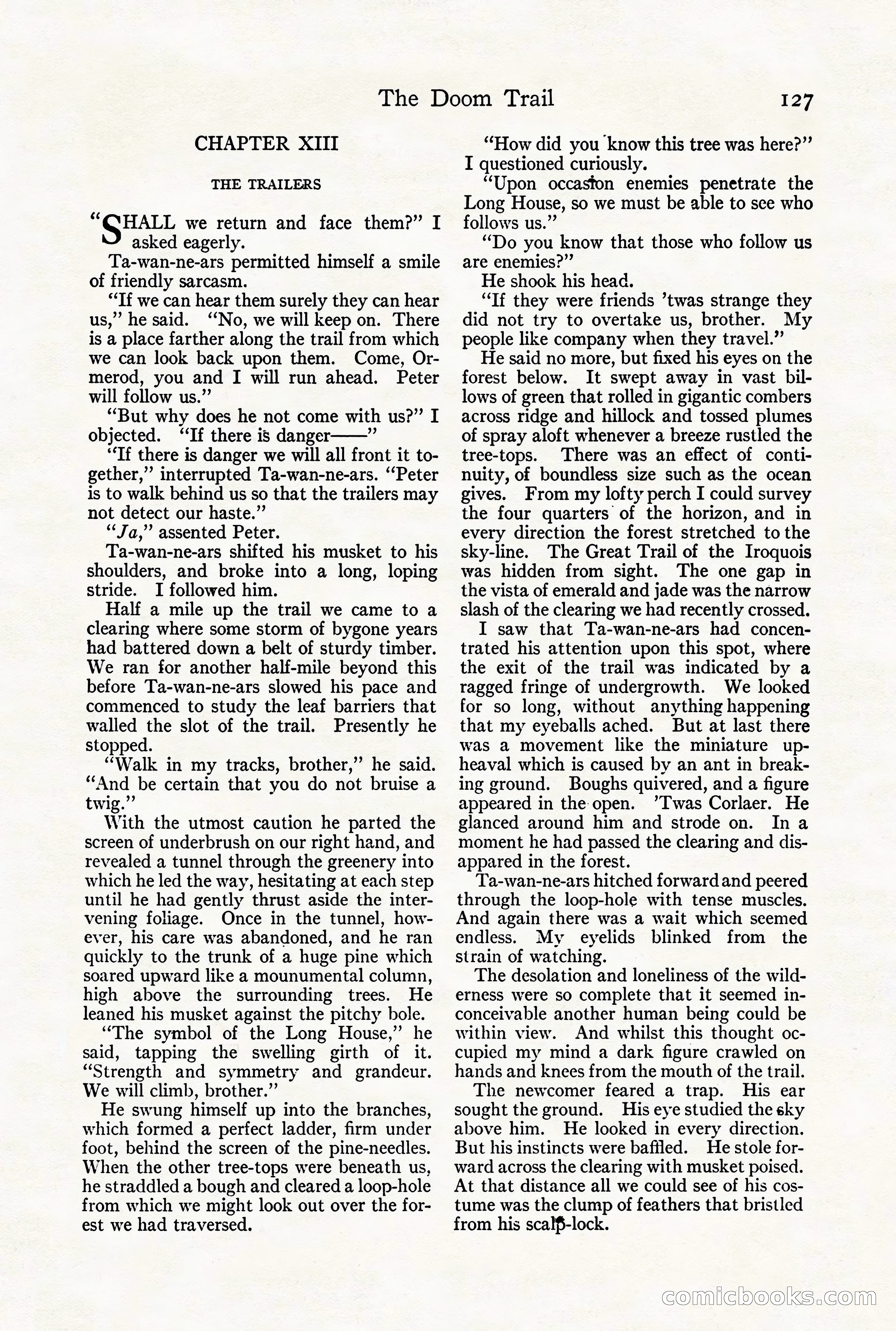
A restored page from Pulp Fiction, 1921. Page through the whole issue in the reader above.
📄 Transcribed text from this page (OCR, searchable)
Machine-transcribed from the original scan — historical spelling and the odd misread are preserved.
The Doom Trail CHAPTER XIII THE TRAILERS “GHALL we return and face them?” I asked eagerly. Ta-wan-ne-ars permitted himself a smile of friendly sarcasm. “Tf we can hear them surely they can hear us,’ he said. ‘‘No, we will keep on. There is a place farther along the trail from which we can look back upon them. Come, Or- merod, you and I will run ahead. Peter will follow us.” “But why does he not come with us?” I objected. ‘If there is danger——” ‘Tf there is danger we will all front it to- gether,” interrupted Ta-wan-ne-ars. “Peter is to walk behind us so that the trailers may not detect our haste.” ‘Ja,’ assented Peter. Ta-wan-ne-ars shifted his musket to his shoulders, and broke into a long, loping stride. I followed him. Half a mile up the trail we came to a clearing where some storm of bygone years had battered down a belt of sturdy timber. We ran for another half-mile beyond this before Ta-wan-ne-ars slowed his pace and commenced to study the leaf barriers that walled the slot of the trail. Presently he stopped. ‘Walk in my tracks, brother,’ he said. ‘“‘And be certain that you do not bruise a twig.” With the utmost caution he parted the screen of underbrush on our right hand, and revealed a tunnel through the greenery into which he led the way, hesitating at each step until he had gently thrust aside the inter- vening foliage. Once in the tunnel, how- ever, his care was abandoned, and he ran quickly to the trunk of a huge pine which soared upward like a mounumental column, high above the surrounding trees. He leaned his musket against the pitchy bole. “The symbol of the Long House,” he said, tapping the swelling girth of it. “Strength and symmetry and grandeur. We will climb, brother.” He swung himself up into the branches, which formed a perfect ladder, firm under foot, behind the screen of the pine-needles. When the other tree-tops were beneath us, he straddled a bough and cleared a loop-hole from which we might look out over the for- est we had traversed. 127 “How did you know this tree was here?”’ I questioned curiously. “Upon occaston enemies penetrate the Long House, so we must be able to sce who follows us.” “Do you know that those who follow us are enemies?” He shook his head. “Tf they were friends ’twas strange they did not try to overtake us, brother. My people like company when they travel.” He said no more, but fixed his eyes on the forest below. It swept away in vast bil- lows of green that rolled in gigantic combers across ridge and hillock and tossed plumes of spray aloft whenever a breeze rustled the tree-tops. There was an effect of conti- nuity, of boundless size such as the ocean gives. From my lofty perch I could survey the four quarters of the horizon, and in every direction the forest stretched tothe sky-line. The Great Trail of the Iroquois was hidden from sight. The one gap in the vista of emerald and jade was the narrow slash of the clearing we had recently crossed. I saw that Ta-wan-ne-ars had concen- trated his attention upon this spot, where the exit of the trail was indicated by a ragged fringe of undergrowth. We looked for so long, without anything happening that my eyeballs ached. But at last there was a movement like the miniature up- heaval which is caused by an ant in break- ing ground. Boughs quivered, and a figure appeared in the open. Twas Corlaer. He glanced around him and strode on. Ina moment he had passed the clearing and dis- appared in the forest. Ta-wan-ne-ars hitched forward and peered through the loop-hole with tense muscles. And again there was a wait which seemed endless. My eyelids blinked from the strain of watching. The desolation and loneliness of the wild- erness were so complete that it seemed in- conceivable another human being could be within view. And whilst this thought oc- cupied my mind a dark figure crawled on hands and knees from the mouth of the trail. The newcomer feared a trap. His ear sought the ground. His eye studied the sky above him. He looked in every direction. But his instincts were baftled. He stole for- ward across the clearing with musket poised. At that distance all we could see of his cos- tume was the clump of feathers that bristled from his scal-lock. COmiclbook C©