
Pulp Fiction, 1921 · page 17 of 200
Adventure Magazine Cover, August 18, 1921 — page 17: what you’re looking at
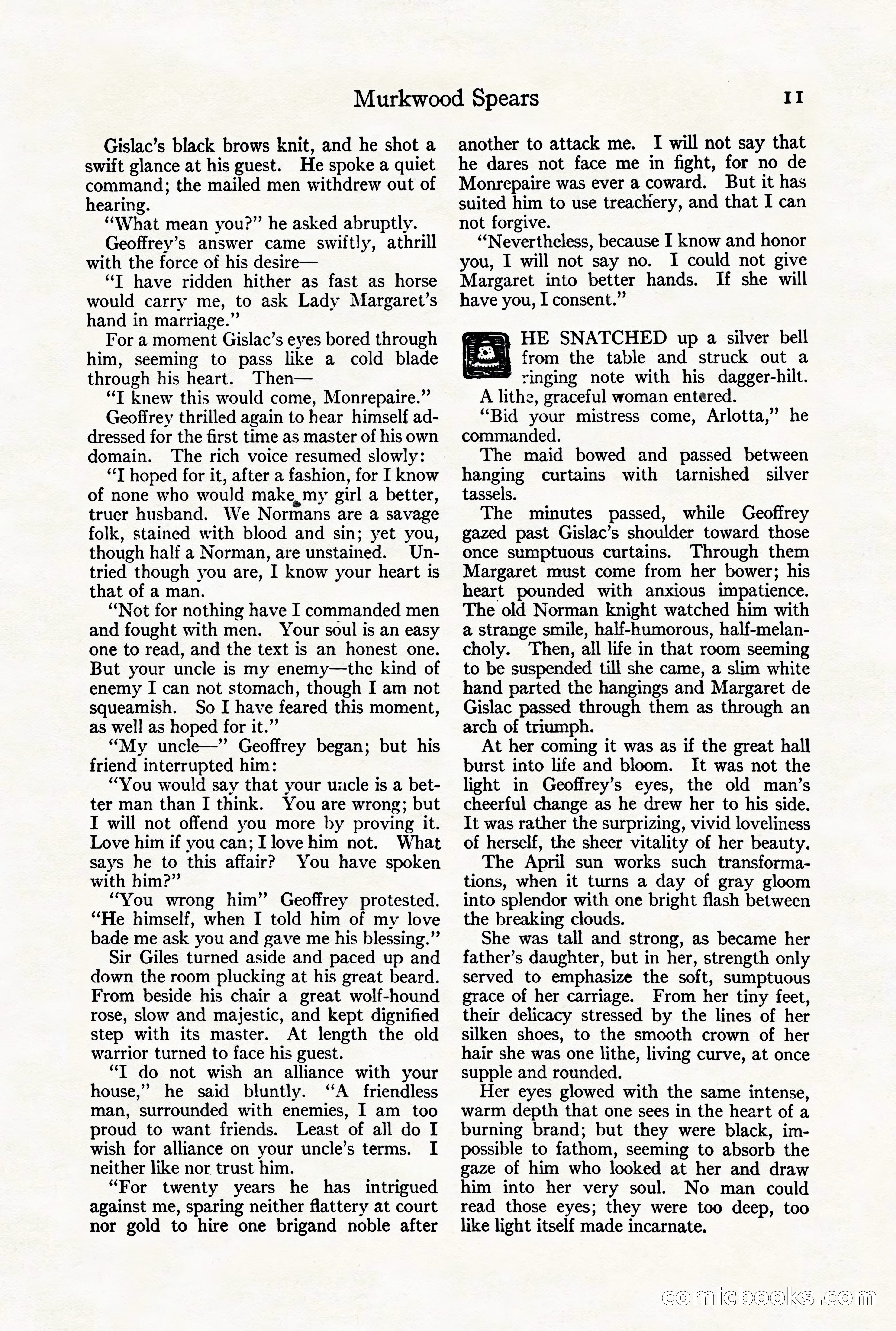
A restored page from Pulp Fiction, 1921. Page through the whole issue in the reader above.
📄 Transcribed text from this page (OCR, searchable)
Machine-transcribed from the original scan — historical spelling and the odd misread are preserved.
Murkwood Spears Gislac’s black brows knit, and he shot a swift glance at his guest. He spoke a quiet command; the mailed men withdrew out of hearing. “What mean you?” he asked abruptly. Geoffrey’s answer came swiftly, athrill with the force of his desire— “T have ridden hither as fast as horse would carry me, to ask Lady Margaret’s hand in marriage.” For a moment Gislac’s eyes bored through him, seeming to pass like a cold blade through his heart. Then— “T knew this would come, Monrepaire.” Geoffrey thrilled again to hear himself ad- dressed for the first time as master of his own domain. The rich voice resumed slowly: “T hoped for it, after a fashion, for I know of none who would make, my girl a better, truer husband. We Normans are a savage folk, stained with blood and sin; yet you, though half a Norman, are unstained. Un- tried though you are, I know your heart is that of a man. “Not for nothing have I commanded men and fought with men. Your soul is an easy one to read, and the text is an honest one. But your uncle is my enemy—the kind of enemy I can not stomach, though I am not squeamish. So I have feared this moment, as well as hoped for it.” “My uncle—” Geoffrey began; but his friend interrupted him: “You would say that your uicle is a bet- ter man than I think. You are wrong; but I will not offend you more by proving it. Love him if you can; I love him not. What says he to this affair? You have spoken with him?” “You wrong him” Geoffrey protested. ‘“‘He himself, when I told him of my love bade me ask you and gave me his blessing.” Sir Giles turned aside and paced up and down the room plucking at his great beard. From beside his chair a great wolf-hound rose, slow and majestic, and kept dignified step with its master. At length the old warrior turned to face his guest. “T do not wish an alliance with your house,” he said bluntly. “A friendless man, surrounded with enemies, I am too proud to want friends. Least of all do I wish for alliance on your uncle’s terms. I neither like nor trust him. “For twenty years he has intrigued against me, sparing neither flattery at court nor gold to hire one brigand noble after II another to attack me. I will not say that he dares not face me in fight, for no de Monrepaire was ever a coward. But it has suited him to use treachery, and that I can not forgive. “Nevertheless, because I know and honor you, I will not say no. I could not give Margaret into better hands. If she will have you, I consent.” HE SNATCHED up a silver bell t from the table and struck out a ringing note with his dagger-hilt. A lithe, graceful woman entered. “Bid your mistress come, Arlotta,” he commanded. The maid bowed and passed between hanging curtains with tarnished silver tassels. The minutes passed, while Geoffrey gazed past Gislac’s shoulder toward those once sumptuous curtains. Through them Margaret must come from her bower; his heart pounded with anxious impatience. The old Norman knight watched him with a strange smile, half-humorous, half-melan- choly. Then, all life in that room seeming to be suspended till she came, a slim white hand parted the hangings and Margaret de Gislac passed through them as through an arch of triumph. At her coming it was as if the great hall burst into life and bloom. It was not the light in Geoffrey’s eyes, the old man’s cheerful change as he drew her to his side. It was rather the surprizing, vivid loveliness of herself, the sheer vitality of her beauty. The April sun works such transforma- tions, when it turns a day of gray gloom into splendor with one bright flash between the breaking clouds. She was tall and strong, as became her father’s daughter, but in her, strength only served to emphasize the soft, sumptuous grace of her carriage. From her tiny feet, their delicacy stressed by the lines of her silken shoes, to the smooth crown of her hair she was one lithe, living curve, at once supple and rounded. Her eyes glowed with the same intense, warm depth that one sees in the heart of a burning brand; but they were black, im- possible to fathom, seeming to absorb the gaze of him who looked at her and draw him into her very soul. No man could read those eyes; they were too deep, too like light itself made incarnate. Comicbook (©