
Pulp Fiction, 1921 · page 179 of 200
Adventure Magazine Cover, August 18, 1921 — page 179: what you’re looking at
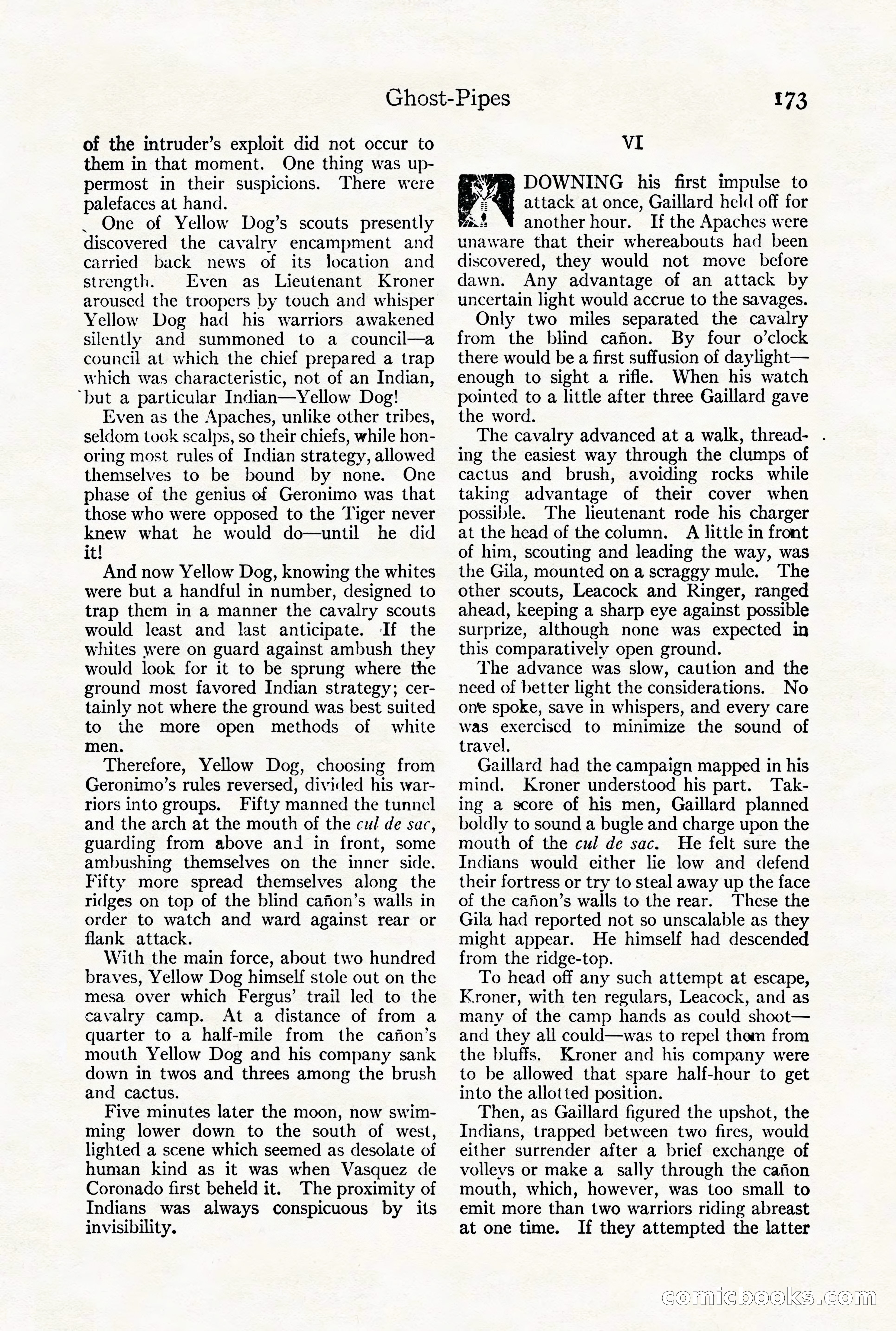
A restored page from Pulp Fiction, 1921. Page through the whole issue in the reader above.
📄 Transcribed text from this page (OCR, searchable)
Machine-transcribed from the original scan — historical spelling and the odd misread are preserved.
Ghost-Pipes of the intruder’s exploit did not occur to them in that moment. One thing was up- permost in their suspicions. There were palefaces at hand. One of Yellow Dog’s scouts presently discovered the cavalry encampment and carried back news of its location and strength. Even as Lieutenant Kroner aroused the troopers by touch and whisper Yellow Dog had his warriors awakened silently and summoned to a _ council—a council at which the chief prepared a trap which was characteristic, not of an Indian, ‘but a particular Indian—Yellow Dog! Even as the Apaches, unlike other tribes, seldom took scalps, so their chiefs, while hon- oring most rules of Indian strategy, allowed themselves to be bound by none. One phase of the genius of Geronimo was that those who were opposed to the Tiger never knew what he would do—until he did it! And now Yellow Dog, knowing the whites were but a handful in number, designed to trap them in a manner the cavalry scouts would least and last anticipate. If the whites were on guard against ambush they would look for it to be sprung where the ground most favored Indian strategy; cer- tainly not where the ground was best suited to the more open methods of white men. Therefore, Yellow Dog, choosing from Geronimo’s rules reversed, divided his war- riors into groups. Fifty manned the tunnel and the arch at the mouth of the cul de sac, guarding from above and in front, some ambushing themselves on the inner side. Fifty more spread themselves along the ridges on top of the blind cafion’s walls in order to watch and ward against rear or flank attack. With the main force, about two hundred braves, Yellow Dog himself stole out on the mesa over which Fergus’ trail led to the cavalry camp. At a distance of from a quarter to a half-mile from the cajfion’s mouth Yellow Dog and his company sank down in twos and threes among the brush and cactus. Five minutes later the moon, now swim- ming lower down to the south of west, lighted a scene which seemed as desolate of human kind as it was when Vasquez de Coronado first beheld it. The proximity of Indians was always conspicuous by its invisibility. 173 VI DOWNING his first impulse to attack at once, Gaillard held off for another hour. If the Apaches were unaware that their whereabouts had been discovered, they would not move before dawn. Any advantage of an attack by uncertain light would accrue to the savages. Only two miles separated the cavalry rom the blind cafion. By four o’clock there would be a first suffusion of daylight— enough to sight a rifle. When his watch pointed to a little after three Gaillard gave the word. The cavalry advanced at a walk, thread- . ing the easiest way through the clumps of cactus and brush, avoiding rocks while taking advantage of their cover when possible. The lieutenant rode his charger at the head of the column. A little in front of him, scouting and leading the way, was the Gila, mounted on a scraggy mule. The other scouts, Leacock and Ringer, ranged ahead, keeping a sharp eye against possible surprize, although none was expected in this comparatively open ground. The advance was slow, caution and the need of better light the considerations. No one spoke, save in whispers, and every care was exercised to minimize the sound of travel. Gaillard had the campaign mapped in his mind, Kroner understood his part. Tak- ing a score of his men, Gaillard planned boldly to sound a bugle and charge upon the mouth of the cul de sac. He felt sure the Indians would either lie low and defend their fortress or try to steal away up the face of the cafion’s walls to the rear. These the Gila had reported not so unscalable as they might appear. He himself had descended from the ridge-top. To head off any such attempt at escape, Kroner, with ten regulars, Leacock, and as many of the camp hands as could shoot— and they all could—was to repel them from the bluffs. Kroner and his company were to be allowed that spare half-hour to get into the allotted position. Then, as Gaillard figured the upshot, the Indians, trapped between two fires, would either surrender after a brief exchange of vollevs or make a sally through the canon mouth, which, however, was too small to emit more than two warriors riding abreast at one time. If they attempted the latter C© MICLOOKS (©