
Pulp Fiction, 1921 · page 196 of 200
Adventure Magazine Cover, August 18, 1921 — page 196: what you’re looking at
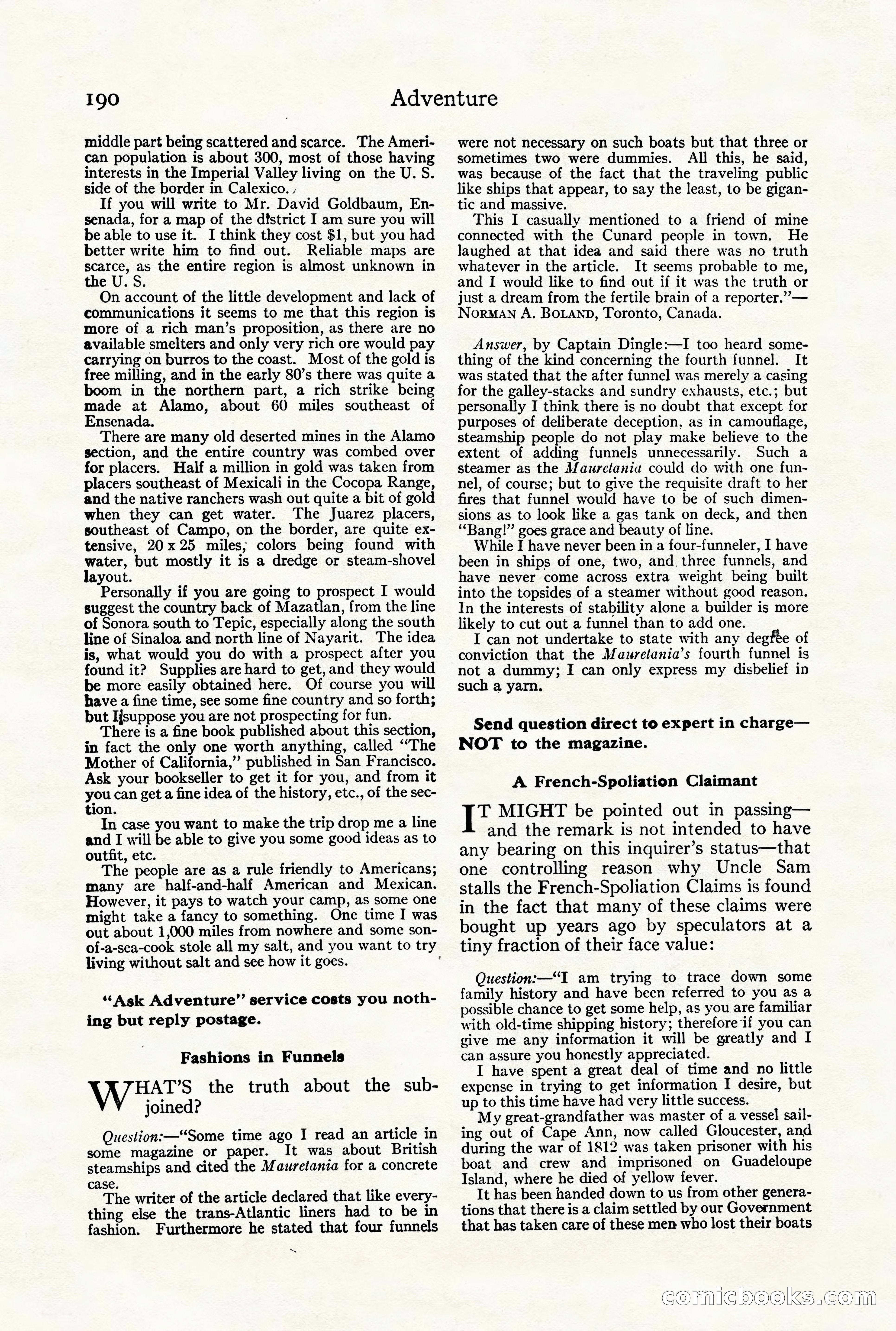
A restored page from Pulp Fiction, 1921. Page through the whole issue in the reader above.
📄 Transcribed text from this page (OCR, searchable)
Machine-transcribed from the original scan — historical spelling and the odd misread are preserved.
190 middle part being scattered and scarce. The Ameri- can population is about 300, most of those having interests in the Imperial Valley living on the U. S. side of the border in Calexico. ; If you will write to Mr. David Goldbaum, En- senada, for a map of the dfstrict I am sure you will be able to use it. I think they cost $1, but you had better write him to find out. Reliable maps are scarce, as the entire region is almost unknown in the U. S. On account of the little development and lack of communications it seems to me that this region is more of a rich man’s proposition, as there are no available smelters and only very rich ore would pay carrying on burros to the coast. Most of the gold is free milling, and in the early 80’s there was quite a boom in the northern part, a rich strike being made at Alamo, about 60 miles southeast of Ensenada. There are many old deserted mines in the Alamo section, and the entire country was combed over for placers. Half a million in gold was taken from placers southeast of Mexicali in the Cocopa Range, and the native ranchers wash out quite a bit of gold when they can get water. The Juarez placers, southeast of Campo, on the border, are quite ex- tensive, 20x25 miles; colors being found with water, but mostly it is a dredge or steam-shovel layout. Personally if you are going to prospect I would suggest the country back of Mazatlan, from the line of Sonora south to Tepic, especially along the south line of Sinaloa and north line of Nayarit. The idea is, what would you do with a prospect after you found it? Supplies are hard to get, and they would be more easily obtained here. Of course you will have a fine time, see some fine country and so forth; but Ijsuppose you are not prospecting for fun. There is a fine book published about this section, in fact the only one worth anything, called ‘““The Mother of California,’ published in San Francisco. Ask your bookseller to get it for you, and from it you can get a fine idea of the history, etc., of the sec- tion. In case you want to make the trip drop me a line and I will be able to give you some good ideas as to outfit, etc. The people are as a rule friendly to Americans; many are half-and-half American and Mexican. However, it pays to watch your camp, as some one might take a fancy to something. One time I was out about 1,000 miles from nowhere and some son- of-a-sea-cook stole all my salt, and you want to try living without salt and see how it goes. ‘“‘Agk Adventure’’ service costs you noth- ing but reply postage. Fashions in Funnels HAT’S the truth about the sub- joined? Question: —“Some time ago I read an article in some magazine or paper. It was about British steamships and cited the Mauretania for a concrete case. The writer of the article declared that like every- thing else the trans-Atlantic liners had to be in fashion. Furthermore he stated that four funnels “ Adventure were not necessary on such boats but that three or sometimes two were dummies. All this, he said, was because of the fact that the traveling public like ships that appear, to say the least, to be gigan- tic and massive. This I casually mentioned to a friend of mine connected with the Cunard people in town. He laughed at that idea and said there was no truth whatever in the article. It seems probable to me, and I would like to find out if it was the truth or just a dream from the fertile brain of a reporter.” — Norman A. BOLAND, Toronto, Canada. Answer, by Captain Dingle:—I too heard some- thing of the kind concerning the fourth funnel. It was stated that the after funnel was merely a casing for the galley-stacks and sundry exhausts, etc.; but personally I think there is no doubt that except for purposes of deliberate deception, as in camouflage, steamship people do not play make believe to the extent of adding funnels unnecessarily. Such a steamer as the Maurctania could do with one fun- nel, of course; but to give the requisite draft to her fires that funnel would have to be of such dimen- sions as to look like a gas tank on deck, and then “Bang!” goes grace and beauty of line. While I have never been in a four-funneler, I have been in ships of one, two, and. three funnels, and have never come across extra weight being built into the topsides of a steamer without good reason. In the interests of stability alone a builder is more likely to cut out a funnel than to add one. I can not undertake to state with any degfee of conviction that the Mauretania’s fourth funnel is not a dummy; I can only express my disbelief in such a yarn. Send question direct to expert in charge— NOT to the magazine. A French-Spoliation Claimant ig MIGHT be pointed out in passing— and the remark is not intended to have any bearing on this inquirer’s status—that one controlling reason why Uncle Sam stalls the French-Spoliation Claims is found in the fact that many of these claims were bought up years ago by speculators at a tiny fraction of their face value: Question:—“I am trying to trace down some family history and have been referred to you as a possible chance to get some help, as you are familiar with old-time shipping history; therefore if you can give me any information it will be greatly and I can assure you honestly appreciated. I have spent a great deal of time and no little expense in trying to get information I desire, but up to this time have had very little success. My great-grandfather was master of a vessel sail- ing out of Cape Ann, now called Gloucester, and during the war of 1812 was taken prisoner with his boat and crew and imprisoned on Guadeloupe Island, where he died of yellow fever. It has been handed down to us from other genera- tions that there is a claim settled by our Government that has taken care of these men who lost their boats CloOOLkKS S|