
Pulp Fiction, 1921 · page 27 of 200
Adventure Magazine Cover, August 18, 1921 — page 27: what you’re looking at
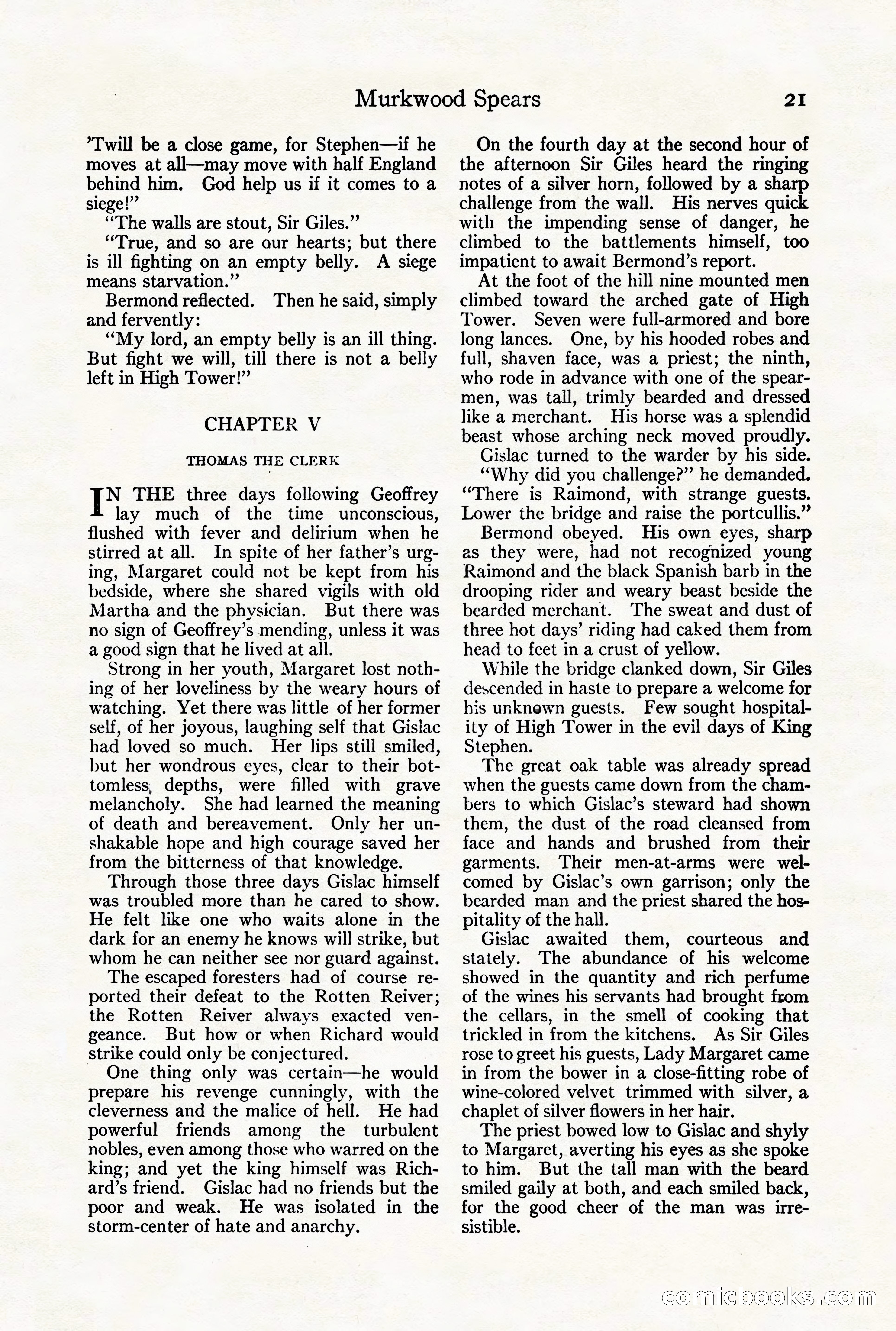
A restored page from Pulp Fiction, 1921. Page through the whole issue in the reader above.
📄 Transcribed text from this page (OCR, searchable)
Machine-transcribed from the original scan — historical spelling and the odd misread are preserved.
Murkwood Spears Twill be a close game, for Stephen—if he moves at all—may move with half England behind him. God help us if it comes to a siege!’ “The walls are stout, Sir Giles.”’ “True, and so are our hearts; but there is ill fighting on an empty belly. A siege means starvation.” Bermond reflected. Then he said, simply and fervently: “My lord, an empty belly is an ill thing. But fight we will, till there is not a belly left in High Tower!” CHAPTER V THOMAS THE CLERK THE three days following Geoffrey lay much of the time _ unconscious, flushed with fever and delirium when he stirred at all. In spite of her father’s urg- ing, Margaret could not be kept from his bedside, where she shared vigils with old Martha and the physician. But there was no sign of Geoffrey’s mending, unless it was a good sign that he lived at all. Strong in her youth, Margaret lost noth- ing of her loveliness by the weary hours of watching. Yet there was little of her former self, of her joyous, laughing self that Gislac had loved so much. Her lips still smiled, but her wondrous eyes, clear to their bot- tomless, depths, were filled with grave melancholy. She had learned the meaning of death and bereavement. Only her un- shakable hope and high courage saved her from the bitterness of that knowledge. Through those three days Gislac himself was troubled more than he cared to show. He felt like one who waits alone in the dark for an enemy he knows will strike, but whom he can neither see nor guard against. The escaped foresters had of course re- ported their defeat to the Rotten Reiver; the Rotten Reiver always exacted ven- geance. But how or when Richard would strike could only be conjectured. One thing only was certain—he would prepare his revenge cunningly, with the cleverness and the malice of hell. He had powerful friends among the turbulent nobles, even among those who warred on the king; and yet the king himself was Rich- ard’s friend. Gislac had no friends but the poor and weak. He was isolated in the storm-center of hate and anarchy. 21 On the fourth day at the second hour of the afternoon Sir Giles heard the ringing notes of a silver horn, followed by a sharp challenge from the wall. His nerves quick with the impending sense of danger, he climbed to the battlements himself, too impatient to await Bermond’s report. At the foot of the hill nine mounted men climbed toward the arched gate of High Tower. Seven were full-armored and bore long lances. One, by his hooded robes and full, shaven face, was a priest; the ninth, who rode in advance with one of the spear- men, was tall, trimly bearded and dressed like a merchant. His horse was a splendid beast whose arching neck moved proudly. Gislac turned to the warder by his side. “Why did you challenge?” he demanded. “There is Raimond, with strange guests. Lower the bridge and raise the portcullis.” Bermond obeyed. His own eyes, sharp as they were, had not recognized young Raimond and the black Spanish barb in the drooping rider and weary beast beside the bearded merchant. The sweat and dust of three hot days’ riding had caked them from head to fcet in a crust of yellow. While the bridge clanked down, Sir Giles descended in haste to prepare a welcome for his unknewn guests. Few sought hospital- ity of High Tower in the evil days of King Stephen. The great oak table was already spread when the guests came down from the cham- bers to which Gislac’s steward had shown them, the dust of the road cleansed from face and hands and brushed from their garments. Their men-at-arms were wel- comed by Gislac’s own garrison; only the bearded man and the priest shared the hos- pitality of the hall. Gislac awaited them, courteous and stately. The abundance of his welcome showed in the quantity and rich perfume of the wines his servants had brought from the cellars, in the smell of cooking that trickled in from the kitchens. As Sir Giles rose to greet his guests, Lady Margaret came in from the bower in a close-fitting robe of wine-colored velvet trimmed with silver, a chaplet of silver flowers in her hair. The priest bowed low to Gislac and shyly to Margaret, averting his eyes as she spoke to him. But the tall man with the beard smiled gaily at both, and each smiled back, for the good cheer of the man was irre- sistible. CoMmicbook C©