
Pulp Fiction, 1921 · page 59 of 200
Adventure Magazine Cover, August 18, 1921 — page 59: what you’re looking at
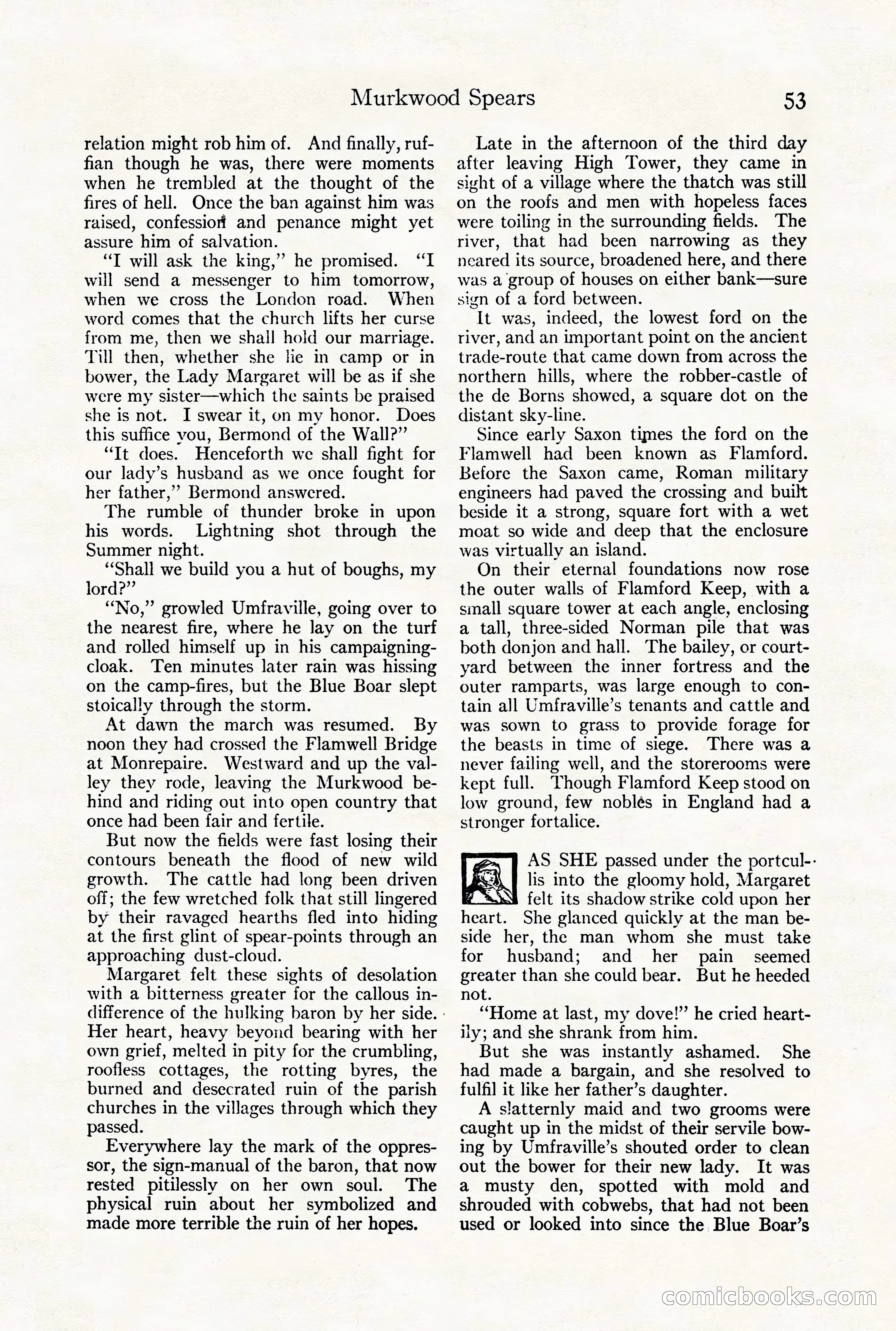
A restored page from Pulp Fiction, 1921. Page through the whole issue in the reader above.
📄 Transcribed text from this page (OCR, searchable)
Machine-transcribed from the original scan — historical spelling and the odd misread are preserved.
Murkwood Spears relation might rob him of. And finally, ruf- fian though he was, there were moments when he trembled at the thought of the fires of hell. Once the ban against him was raised, confessiort and penance might yet assure him of salvation. “T will ask the king,” he promised. “I will send a messenger to him tomorrow, when we cross the London road. When word comes that the church lifts her curse from me, then we shall hoid our marriage. Till then, whether she He in camp or in bower, the Lady Margaret will be as if she were my sister—which the saints be praised she is not. I swear it, on my honor. Does this suffice you, Bermond of the Wall?” “Tt does. Henceforth we shall fight for our lady’s husband as we once fought for her father,’ Bermond answered. The rumble of thunder broke in upon his words. Lightning shot through the Summer night. “Shall we build you a hut of boughs, my lord?” “No,” growled Umfraville, going over to the nearest fire, where he lay on the turf and rolled himself up in his campaigning- cloak. Ten minutes later rain was hissing on the camp-fires, but the Blue Boar slept stoically through the storm. At dawn the march was resumed. By noon they had crossed the Flamwell Bridge at Monrepaire. Westward and up the val- ley they rode, leaving the Murkwood be- hind and riding out into open country that once had been fair and fertile. But now the fields were fast losing their contours beneath the flood of new wild growth. The cattle had long been driven off; the few wretched folk that still lingered by their ravaged hearths fled into hiding at the first glint of spear-points through an approaching dust-cloud. Margaret felt these sights of desolation with a bitterness greater for the callous in- difference of the hulking baron by her side. - Her heart, heavy beyond bearing with her own grief, melted in pity for the crumbling, roofless cottages, the rotting byres, the burned and desecrated ruin of the parish churches in the villages through which they passed. Everywhere lay the mark of the oppres- sor, the sign-manual of the baron, that now rested pitilessly on her own soul. The physical ruin about her symbolized and made more terrible the ruin of her hopes. 93 Late in the afternoon of the third day after leaving High Tower, they came in sight of a village where the thatch was still on the roofs and men with hopeless faces were toiling in the surrounding fields. The river, that had been narrowing as they neared its source, broadened here, and there was a group of houses on either bank—sure sign of a ford between. It was, indeed, the lowest ford on the river, and an important point on the ancient trade-route that came down from across the northern hills, where the robber-castle of the de Borns showed, a square dot on the distant sky-line. Since early Saxon tiymes the ford on the Flamwell had been known as Flamford. Before the Saxon came, Roman military engineers had paved the crossing and built beside it a strong, square fort with a wet moat so wide and deep that the enclosure was virtually an island. On their eternal foundations now rose the outer walls of Flamford Keep, with a small square tower at each angle, enclosing a tall, three-sided Norman pile that was both donjon and hall. The bailey, or court- yard between the inner fortress and the outer ramparts, was large enough to con- tain a]l Umfraville’s tenants and cattle and was sown to grass to provide forage for the beasts in time of siege. There was a never failing well, and the storerooms were kept full. Though Flamford Keep stood on low ground, few noblés in England had a stronger fortalice. SCA\ | lis into the gloomy hold, Margaret felt its shadow strike cold upon her heart. She glanced quickly at the man be- side her, the man whom she must take for husband; and her pain _ seemed greater than she could bear. But he heeded not. ‘Home at last, my dove!” he cried heart- iy; and she shrank from him. But she was instantly ashamed. She had made a bargain, and she resolved to fulfil it like her father’s daughter. A slatternly maid and two grooms were caught up in the midst of their servile bow- ing by Umfraville’s shouted order to clean out the bower for their new lady. It was a musty den, spotted with mold and shrouded with cobwebs, that had not been used or looked into since the. Blue Boar’s © AS SHE passed under the portcul-- Ebooks CO