
Pulp Fiction, 1921 · page 63 of 200
Adventure Magazine Cover, August 18, 1921 — page 63: what you’re looking at
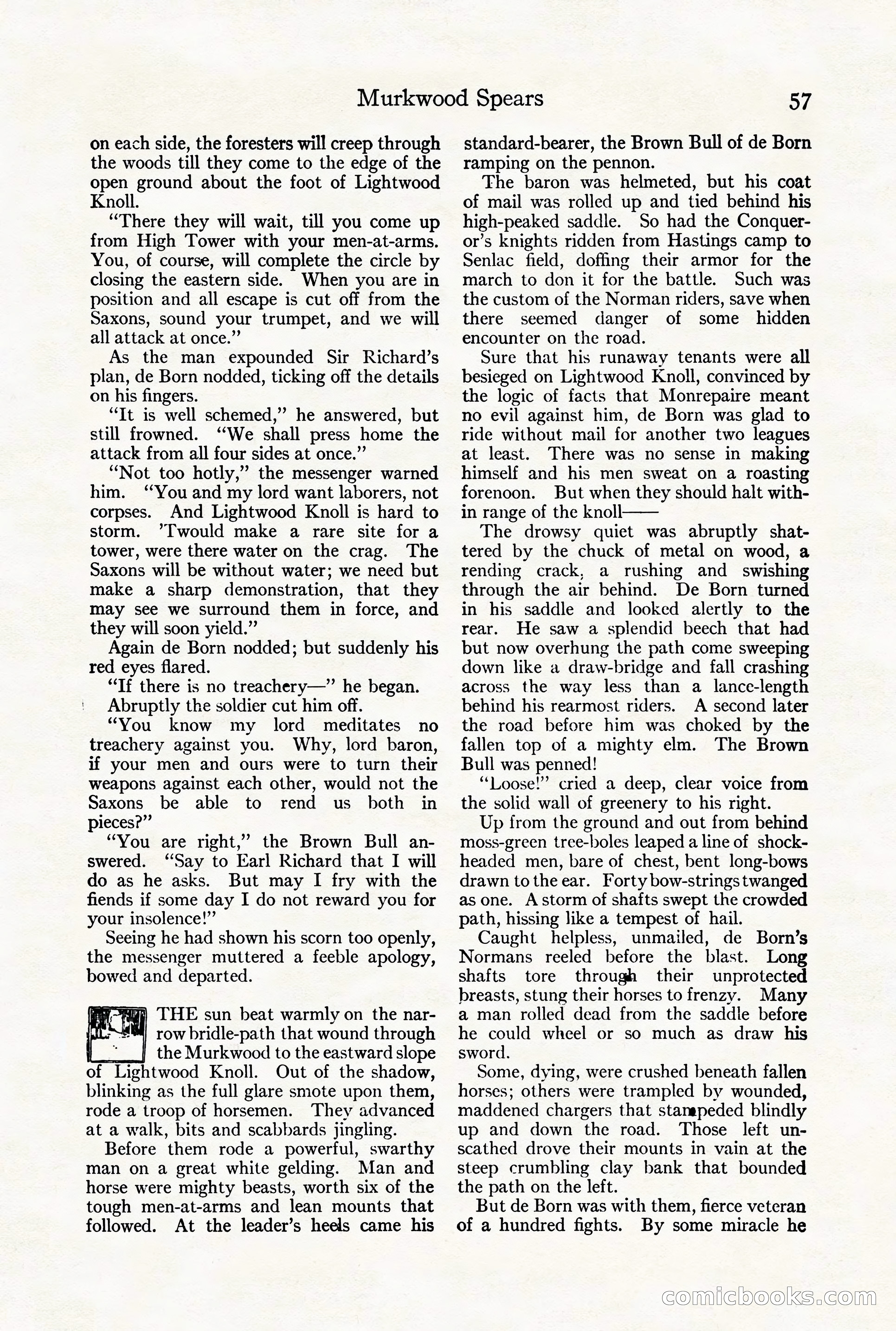
A restored page from Pulp Fiction, 1921. Page through the whole issue in the reader above.
📄 Transcribed text from this page (OCR, searchable)
Machine-transcribed from the original scan — historical spelling and the odd misread are preserved.
Murkwood Spears on each side, the foresters will creep through the woods till they come to the edge of the open ground about the foot of Lightwood Knoll. ‘There they will wait, till you come up from High Tower with your men-at-arms. You, of course, will complete the circle by closing the eastern side. When you are in position and all escape is cut off from the Saxons, sound your trumpet, and we will all attack at once.’ As the man expounded Sir Richard’s plan, de Born nodded, ticking off the details on his fingers. “It is well schemed,” he answered, but still frowned. ‘“‘We shall press home the attack from all four sides at once.” “Not too hotly,” the messenger warned him. ‘You and my lord want laborers, not corpses. And Lightwood Knoll is hard to storm. ’Twould make a rare site for a tower, were there water on the crag. The Saxons will be without water; we need but make a sharp demonstration, that they may see we surround them in force, and they will soon yield.” Again de Born nodded; but suddenly his red eyes flared. “Tf there is no treachery—” he began. Abruptly the soldier cut him off. “You know my lord meditates no treachery against you. Why, lord baron, if your men and ours were to turn their weapons against each other, would not the Saxons be able to rend us both in pieces?” “You are right,” the Brown Bull an- swered. “Say to Earl Richard that I will do as he asks. But may I fry with the fiends if some day I do not reward you for your insolence!”’ Seeing he had shown his scorn too openly, the messenger muttered a feeble apology, bowed and departed. Ag) THE sun beat warmly on the nar- row bridle-path that wound through 5 the Murkwood to the eastward slope af Lightwood Knoll. Out of the shadow, blinking as the full glare smote upon them, rode a troop of horsemen. They advanced at a walk, bits and scabbards jingling. Before them rode a powerful, swarthy man on a great white gelding. Man and horse were mighty beasts, worth six of the tough men-at-arms and lean mounts that followed. At the leader’s heels came his o7 standard-bearer, the Brown Bull of de Born ramping on the pennon. The baron was helmeted, but his coat of mail was rolled up and tied behind his high-peaked saddle. So had the Conquer- or’s knights ridden from Hastings camp to Senlac field, doffing their armor for the march to don it for the battle. Such was the custom of the Norman riders, save when there seemed danger of some _ hidden encounter on the road. Sure that his runaway tenants were all besieged on Lightwood Knoll, convinced by the logic of facts that Monrepaire meant no evil against him, de Born was glad to ride without mail for another two leagues at least. There was no sense in making himself and his men sweat on a roasting forenoon. But when they should halt with- in range of the knoll—— The drowsy quiet was abruptly shat- tered by the chuck of metal on wood, a rending crack, a rushing and_ swishing through the air behind. De Born turned in his saddle and looked alertly to the rear. He saw a splendid beech that had but now overhung the path come sweeping down like a draw-bridge and fall crashing across the way less than a lance-length behind his rearmost riders. A second later the road before him was choked by the fallen top of a mighty elm. The Brown Bull was penned! “Loose!” cried a deep, clear voice from the solid wall of greenery to his right. Up from the ground and out from behind moss-green tree-boles leaped a line of shock- headed men, bare of chest, bent long-bows drawn tothe ear. Forty bow-strings twanged as one. Astorm of shafts swept the crowded path, hissing like a tempest of hail. Caught helpless, unmailed, de Born’s Normans reeled before the blast. Long shafts tore through their unprotected breasts, stung their horses to frenzy. Many a man rolled dead from the saddle before he could wheel or so much as draw his sword. Some, dying, were crushed beneath fallen horses; others were trampled by wounded, maddened chargers that stanepeded blindly up and down the road. Those left un- scathed drove their mounts in vain at the steep crumbling clay bank that bounded the path on the left. But de Born was with them, fierce veteran of a hundred fights. By some miracle he COmiclbook ©