
Pulp Fiction, 1921 · page 84 of 200
Adventure Magazine Cover, August 18, 1921 — page 84: what you’re looking at
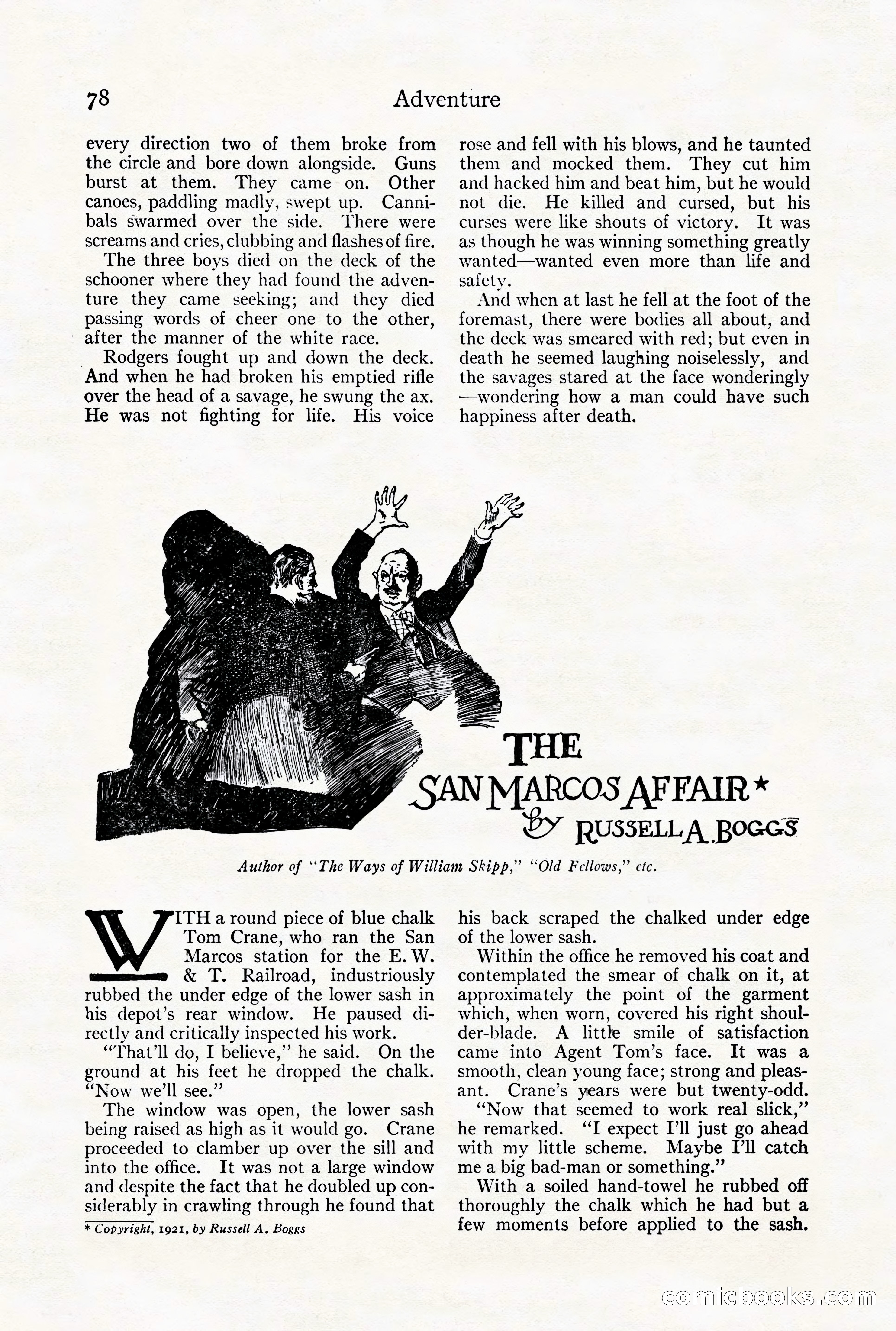
A restored page from Pulp Fiction, 1921. Page through the whole issue in the reader above.
📄 Transcribed text from this page (OCR, searchable)
Machine-transcribed from the original scan — historical spelling and the odd misread are preserved.
78 every direction two of them broke from the circle and bore down alongside. Guns burst at them. They came on. Other canoes, paddling madly, swept up. Canni- bals swarmed over the side. There were screams and cries, clubbing and flashes of fire. The three boys died on the deck of the schooner where they had found the adven- ture they came seeking; and they died passing words of cheer one to the other, - after the manner of the white race. _ Rodgers fought up and down the deck. And when he had broken his emptied rifle over the head of a savage, he swung the ax. He was not fighting for life. His voice Adventure rose and fell with his blows, and he taunted them and mocked them. They cut him and hacked him and beat him, but he would not die. He killed and cursed, but his curses were like shouts of victory. It was as though he was winning something greatly wanted—wanted even more than life and satiety. And when at last he fell at the foot of the foremast, there were bodies all about, and the deck was smeared with red; but even in death he seemed laughing noiselessly, and the savages stared at the face wonderingly —wondering how a man could have such happiness after death. Author of ‘‘The Ways of William Skipp,” ‘Old Fellows,” etc. ITH a round piece of blue chalk Tom Crane, who ran the San Marcos station for the E. W. om=mene & TT. Railroad, industriously rubbed the under edge of the lower sash in his depot’s rear window. He paused di- rectly and critically inspected his work. “That'll do, I believe,” he said. On the ground at his feet he dropped the chalk. “Now we'll see.” The window was open, the lower sash being raised as high as it would go. Crane proceeded to clamber up over the sill and into the office. It was not a large window and despite the fact that he doubled up con- siderably in crawling through he found that * Copyright, 1921, by Russell A. Boggs his back scraped the chalked under edge of the lower sash. Within the office he removed his coat and contemplated the smear of chalk on it, at approximately the point of the garment which, when worn, covered his right shoul- der-blade. A little smile of satisfaction came into Agent Tom’s face. It was a smooth, clean young face; strong and pleas- ant. Crane’s years were but twenty-odd. “Now that seemed to work real slick,” he remarked. ‘I expect I’ll just go ahead with my little scheme. Maybe I’ll catch me a big bad-man or something.” With a soiled hand-towel he rubbed off thoroughly the chalk which he had but a few moments before applied to the sash. MICLOOKS S|