
Pulp Fiction, 1921 · page 86 of 200
Adventure Magazine Cover, August 18, 1921 — page 86: what you’re looking at
A restored page from Pulp Fiction, 1921. Page through the whole issue in the reader above.
📄 Transcribed text from this page (OCR, searchable)
Machine-transcribed from the original scan — historical spelling and the odd misread are preserved.
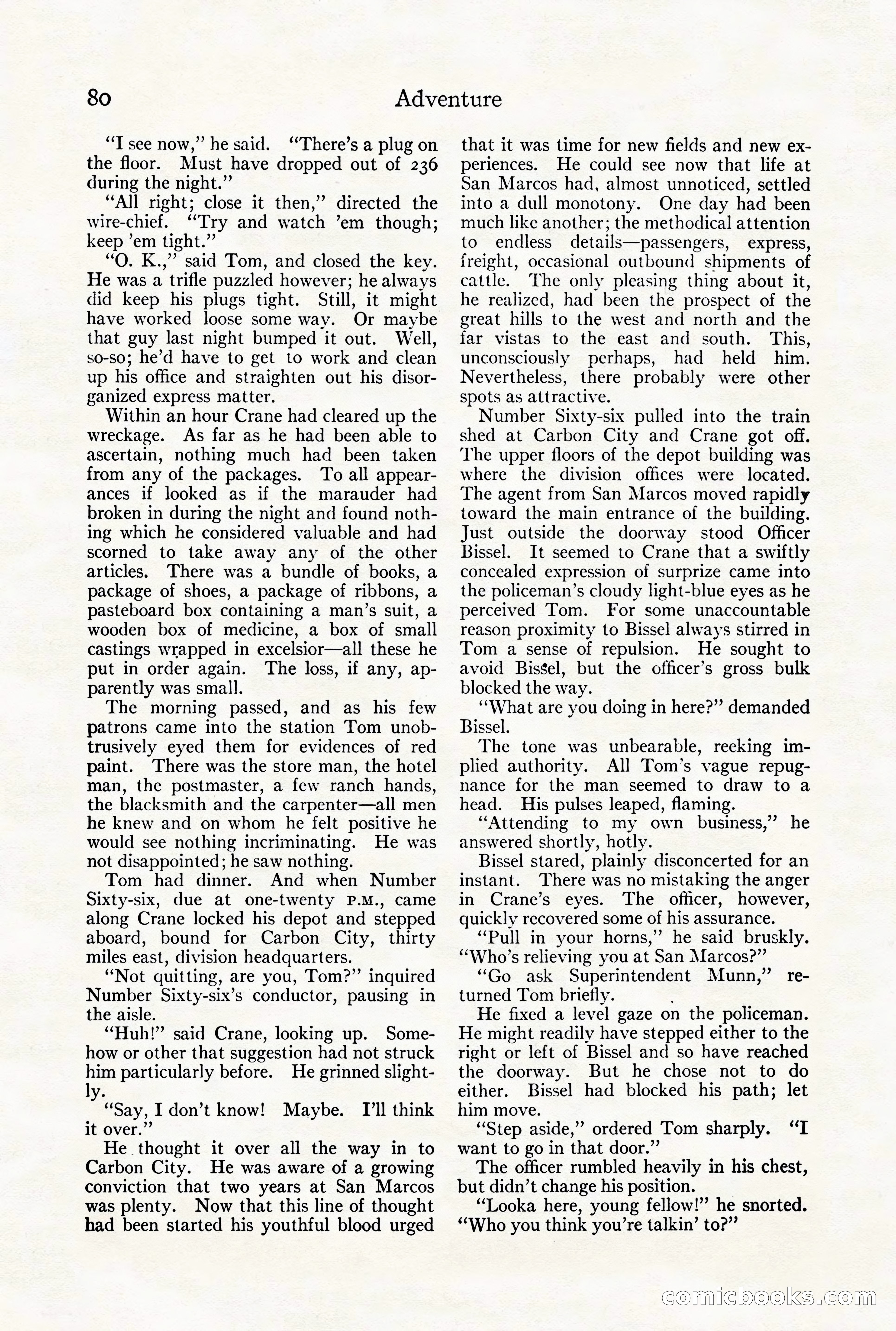
80 “T see now,” he said. ‘“There’s a plug on the floor. Must have dropped out of 236 during the night.” “All right; close it then,” directed the wire-chief. ‘Try and watch ’em though; keep ’em tight.” “OQ. K.,”’ said Tom, and closed the key. He was a trifle puzzled however; he always did keep his plugs tight. have worked loose some way. Or maybe that guy last night bumped it out. Well, so-so; he’d have to get to work and clean up his office and straighten out his disor- ganized express matter. Within an hour Crane had cleared up the wreckage. As far as he had been able to ascertain, nothing much had been taken from any of the packages. To all appear- ances if looked as if the marauder had broken in during the night and found noth- ing which he considered valuable and had scorned to take away any of the other articles. There was a bundle of books, a package of shoes, a package of ribbons, a pasteboard box containing a man’s suit, a wooden box of medicine, a box of small castings wrapped in excelsior—all these he put in order again. The loss, if any, ap- parently was small. The morning passed, and as his few patrons came into the station Tom unob- trusively eyed them for evidences of red paint. There was the store man, the hotel man, the postmaster, a few ranch hands, the blacksmith and the carpenter—all men he knew and on whom he felt positive he would see nothing incriminating. He was not disappointed; he saw nothing. Tom had dinner. And when Number Sixty-six, due at one-twenty P.M., came along Crane locked his depot and stepped aboard, bound for Carbon City, thirty miles east, division headquarters. “Not quitting, are you, Tom?” inquired Number Sixty-six’s conductor, pausing in the aisle. “Huh!” said Crane, looking up. Some- how or other that suggestion had not struck him particularly before. He grinned slight- y. “Say, I don’t know! Maybe. I'll think it Over.” He thought it over all the way in to Carbon City. He was aware of a growing conviction that two years at San Marcos was plenty. Now that this line of thought had been started his youthful blood urged Still, it might Adventure that it was time for new fields and new ex- periences. He could see now that life at San Marcos had, almost unnoticed, settled into a dull monotony. One day had been much like another; the methodical attention to endless details—passengers, express, freight, occasional outbound shipments of cattle. The only pleasing thing about it, he realized, had been the prospect of the great hills to the west and north and the far vistas to the east and south. This, unconsciously perhaps, had held him. Nevertheless, there probably were other spots as attractive. Number Sixty-six pulled into the train shed at Carbon City and Crane got off. The upper floors of the depot building was where the division offices were located. The agent from San Marcos moved rapidly toward the main entrance of the building. Just outside the doorway stood Officer Bissel. It seemed to Crane that a swiftly concealed expression of surprize came into the policeman’s cloudy light-blue eyes as he perceived Tom. For some unaccountable reason proximity to Bissel always stirred in Tom a sense of repulsion. He sought to avoid Bissel, but the officer’s gross bulk blocked the way. ‘‘What are you doing in here?” demanded Bissel. The tone was unbearable, reeking im- plied authority. All Tom’s vague repug- nance for the man seemed to draw to a head. His pulses leaped, flaming. “Attending to my own business,” he answered shortly, hotly. Bissel stared, plainly disconcerted for an instant. There was no mistaking the anger in Crane’s eyes. The officer, however, quickly recovered some of his assurance. “Pull in your horns,” he said bruskly. “Who's relieving you at San Marcos?” “Go ask Superintendent Munn,” re- turned Tom briefly. He fixed a level gaze on the policeman. He might readily have stepped either to the right or left of Bissel and so have reached the doorway. But he chose not to do either. Bissel had blocked his path; let him move. “Step aside,” ordered Tom sharply. “TI want to go in that door.” The officer rumbled heavily in his chest, but didn’t change his position. “Looka here, young fellow!” he snorted. “Who you think you’re talkin’ to?” © MICLOOKS (©