
Pulp Fiction, 1921 · page 97 of 200
Adventure Magazine Cover, August 18, 1921 — page 97: what you’re looking at
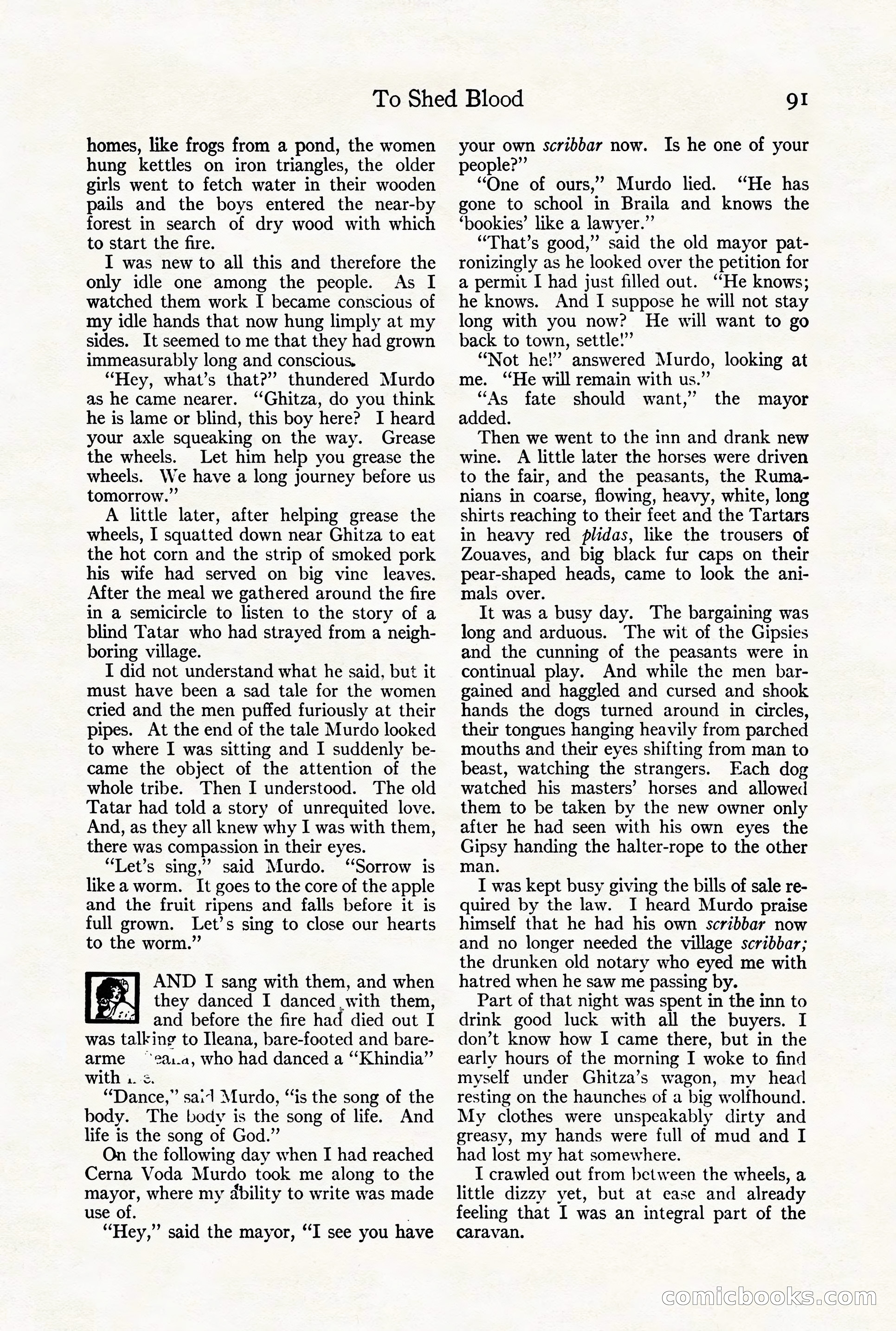
A restored page from Pulp Fiction, 1921. Page through the whole issue in the reader above.
📄 Transcribed text from this page (OCR, searchable)
Machine-transcribed from the original scan — historical spelling and the odd misread are preserved.
To Shed Blood homes, like frogs from a pond, the women hung kettles on iron triangles, the older girls went to fetch water in their wooden pails and the boys entered the near-by forest in search of dry wood with which to start the fire. I was new to all this and therefore the only idle one among the people. As I watched them work I became conscious of my idle hands that now hung limply at my sides. It seemed to me that they had grown immeasurably long and conscious, “Hey, what’s that?’ thundered Murdo as he came nearer. ‘‘Ghitza, do you think he is lame or blind, this boy here? I heard your axle squeaking on the way. Grease the wheels. Let him help you grease the wheels. We have a long journey before us tomorrow.” A little later, after helping grease the wheels, I squatted down near Ghitza to eat the hot corn and the strip of smoked pork his wife had served on big vine leaves. After the meal we gathered around the fire in a semicircle to listen to the story of a blind Tatar who had strayed from a neigh- boring village. I did not understand what he said, but it must have been a sad tale for the women cried and the men puffed furiously at their pipes. At the end of the tale Murdo looked to where I was sitting and I suddenly be- came the object of the attention of the whole tribe. Then I understood. The old Tatar had told a story of unrequited love. And, as they all knew why I was with them, there was compassion in their eyes. “Let’s sing,” said Murdo. “Sorrow is like a worm. It goes to the core of the apple and the fruit ripens and falls before it is full grown. Let’s sing to close our hearts to the worm.” AND I sang with them, and when they danced I danced with them, and before the fire had died out I was s talk ing to Ileana, bare-footed and bare- arme “2a:.a, who had danced a “Khindia” ‘Dance, ” body. The body is the song of life. life is the song of God.” On the following day when I had reached Cerna Voda Murdo took me along to the mayor, where my dbility to write was made use of. “Hey,” sail Murdo, “is the song of the And said the mayor, “I see you have OI your own scribbar now. Is he one of your people?” “One of ours,” Murdo lied. “He has gone to school in Braila and knows the ‘bookies’ like a lawyer.” “That’s good,” said the old mayor pat- ronizingly as he looked over the petition for a permit I had just filled out. “He knows; he knows. And I suppose he will not stay long with you now? He will want to go back to town, settle!” “Not he!” answered Murdo, looking at me. ‘He will remain with us.” ‘““As fate should want,” added. Then we went to the inn and drank new wine. A little later the horses were driven to the fair, and the peasants, the Ruma- nians in coarse, flowing, heavy, white, long shirts reaching to their feet and the Tartars in heavy red pflidas, like the trousers of Zouaves, and big black fur caps on their pear-shaped heads, came to look the ani- mals over. It was a busy day. The bargaining was long and arduous. The wit of the Gipsies and the cunning of the peasants were in continual play. And while the men bar- gained and haggled and cursed and shook hands the dogs turned around in circles, their tongues hanging heavily from parched mouths and their eyes shifting from man to beast, watching the strangers. Each dog watched his masters’ horses and allowed them to be taken by the new owner only after he had seen with his own eyes the Gipsy handing the halter-rope to the other man. I was kept busy giving the bills of sale re- quired by the law. I heard Murdo praise himself that he had his own scribbar now and no longer needed the village scribbar; the drunken old notary who eyed me with hatred when he saw me passing by. Part of that night was spent in the inn to drink good luck with all the buyers. I don’t know how I came there, but in the early hours of the morning I woke to find myself under Ghitza’s wagon, my head resting on the haunches of a big wolfhound. My clothes were unspeakably dirty and greasy, my hands were full of mud and I had lost my hat somewhere. I crawled out from between the wheels, a little dizzy yet, but at ease and already feeling that I was an integral part of the caravan. the mayor Comichook C©