
Pulp Fiction, 1921 · page 110 of 200
Adventure Magazine Cover — page 110: what you’re looking at
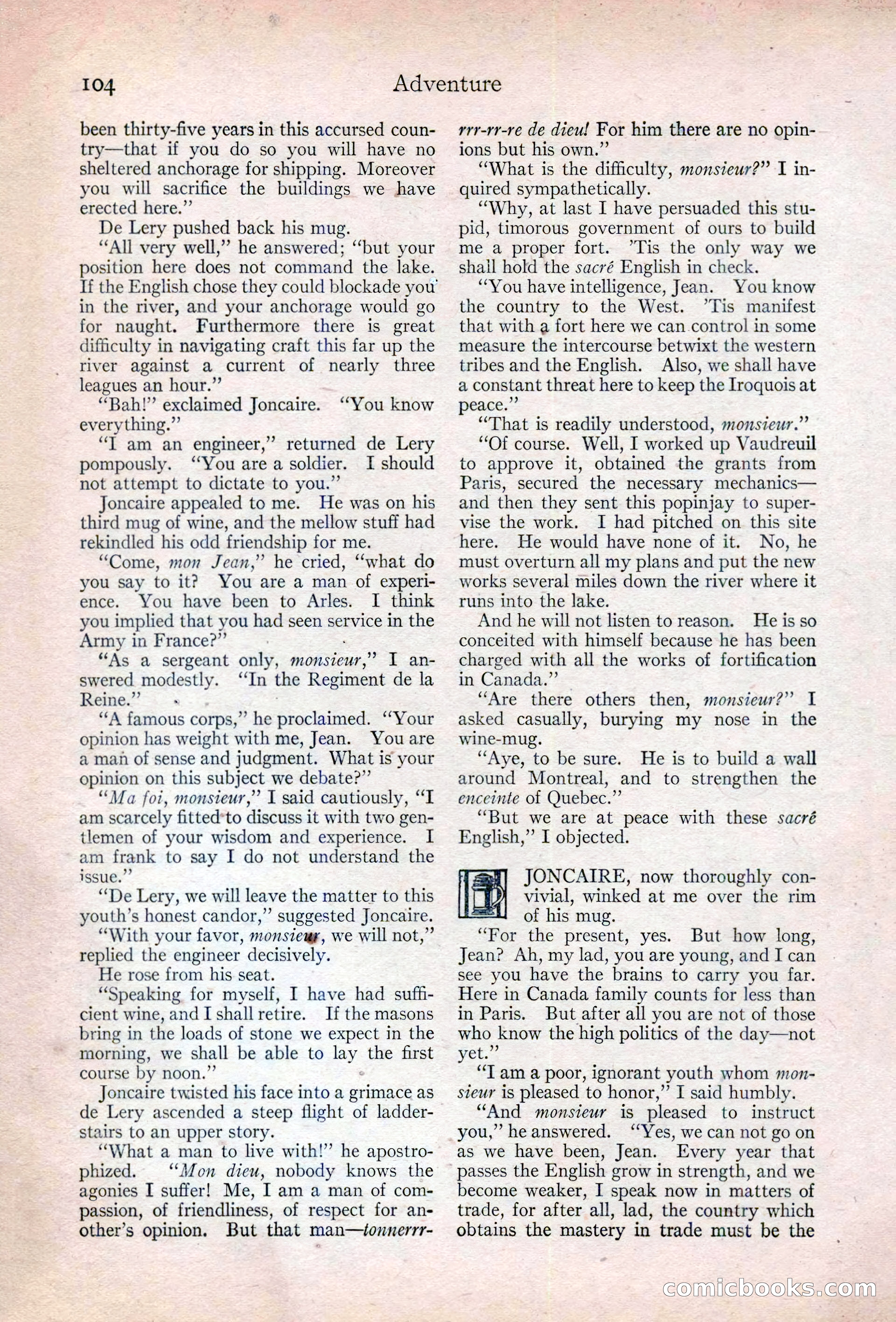
A restored page from Pulp Fiction, 1921. Page through the whole issue in the reader above.
📄 Transcribed text from this page (OCR, searchable)
Machine-transcribed from the original scan — historical spelling and the odd misread are preserved.
104 been thirty-five years in this accursed coun- try—that if you do so you will have no sheltered anchorage for shipping. Moreover you will sacrifice the buildings we have erected here.” De Lery pushed back his mug. ““All very well,” he answered; “but your position here does not command the lake. If the English chose they could blockade you’ in the river, and your anchorage would go for naught. Furthermore there is great difficulty in navigating craft this far up the river against a current of nearly three leagues an hour.” “Bah!” exclaimed Joncaire. everything.” “T am an engineer,” pompously. ‘You are a soldier. not attempt to dictate to you.” Joncaire appealed to me. He was on his third mug of wine, and the mellow stuff had rekindled his odd friendship for me. “Come, mon Jean,” he cried, “what do you say to it? You are a man of experi- ence. You have been to Arles. I think you implied that you had seen eres in the Army in F rance?” “As a sergeant only, monsieur,” I an- swered modestly. “In the Regiment de la Reine.”’ : ‘““A famous corps,” he proclaimed. “Your opinion has weight with me, Jean. You are a man of sense and judgment. What is your opinion on this subject we debate?” “Ma foi, monsteur,”’ I said cautiously, “TI am scarcely fitted*to discuss it with two gen- tlemen of your wisdom and experience. I am frank to say I do not understand the issue.” “De Lery, we will leave the matter to this youth’s hanest candor,” suggested Joncaire. “With your favor, monsieug, we will not,” replied the engineer decisively. He rose from his seat. “Speaking for myself, I have had suff- cient wine, and I shallretire. If the masons bring in the loads of stone we expect in the morning, we shall be able to ey the first course by noon.’ Joncaire twisted his face into a grimace as de Lery ascended a steep flight of ladder- stairs to an upper story. “What a man to live with!” he apostro- phized. ‘Mon dieu, nobody knows the agonies I suffer! Me, I am a man of com- passion, of friendliness, of respect for an- other’s opinion. But that man—fonnerrr- “Vou know returned de Lery I should Adventure rrr-rr-re de dieu! For him there are no opin- ions but his own.” “What is the difficulty, monsieur?” I in- quired sympathetically. “Why, at last I have persuaded this stu- pid, timorous government of ours to build me a proper fort. ’Tis the only way we shall hold the sacré English in check. “You have intelligence, Jean. You know the country to the West. °’Tis manifest that with a fort here we can control in some measure the intercourse betwixt the western tribes and the English. Also, we shall have a constant threat here to keep the Iroquois at peace.” “That is readily understood, monsieur.” “Of course. Well, I worked up Vaudreuil to approve it, obtained the grants from Paris, secured the necessary mechanics— and then they sent this popinjay to super- vise the work. I had pitched on this site here. He would have none of it. No, he must overturn all my plans and put the new works several miles down the river where it runs into the lake. And he will not listen to reason. He is so conceited with himself because he has been charged with all the works of fortification in Canada.” “Are there others then, monsieur?’”’ I asked casually, burying my nose in the wine-mug. “Aye, to be sure. He is to build a wall around Montreal, and to strengthen the enceinte of Quebec.”’ “But we are at peace with these sacré English,” I objected. a] JONCAIRE, now thoroughly con- y vivial, winked at me over the rim 4 of his mug. “For the present, yes. But how long, Jean? Ah, my lad, you are young, and I can see you have the brains to carry you far. Here in Canada family counts for less than in Paris. But after all you are not of those who know the high politics of the day—not yet.” “T am a poor, ignorant youth whom mon- steur is pleased to honor,” I said humbly. “And monsieur is pleased to instruct you,” he answered. ‘Yes, we can not go on as we have been, Jean. Every year that passes the English grow in strength, and we become weaker, I speak now in matters of trade, for after all, lad, the country which obtains the mastery in trade must be the CORMMICOOokKs (E@