
Pulp Fiction, 1921 · page 154 of 200
Adventure Magazine Cover — page 154: what you’re looking at
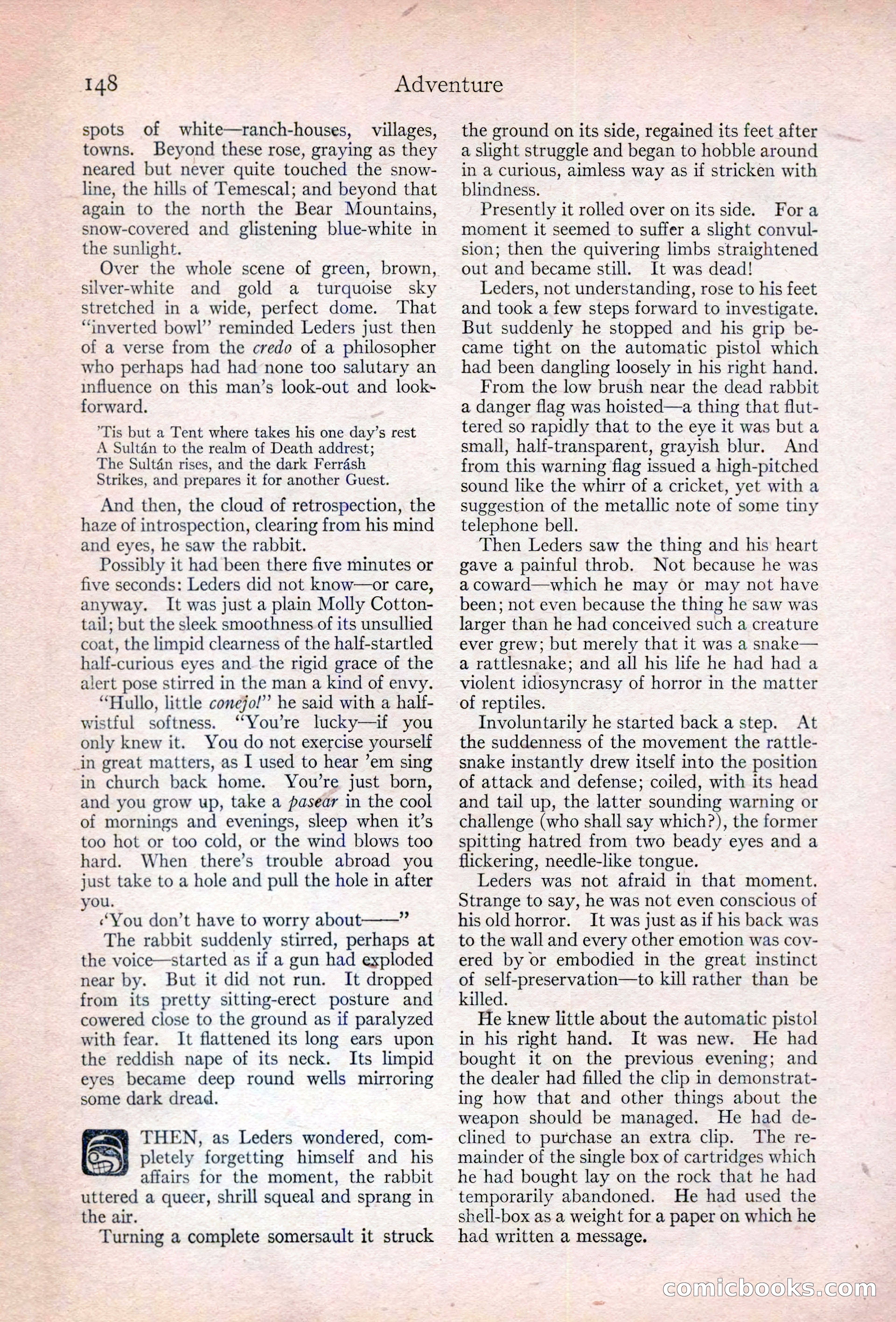
A restored page from Pulp Fiction, 1921. Page through the whole issue in the reader above.
📄 Transcribed text from this page (OCR, searchable)
Machine-transcribed from the original scan — historical spelling and the odd misread are preserved.
148 spots of white—ranch-houses, villages, towns. Beyond these rose, graying as they neared but never quite touched the snow- line, the hills of Temescal; and beyond that again to the north the Bear Mountains, snow-covered and glistening blue-white in the sunlight. Over the whole scene of green, brown, silver-white and gold a turquoise sky stretched in a wide, perfect dome. That “inverted bowl” reminded Leders just then of a verse from the credo of a philosopher who perhaps had had none too salutary an influence on this man’s look-out and look- forward. "Tis but a Tent where takes his one day’s rest A Sultén to the realm of Death addrest; The Sult4n rises, and the dark Ferrésh Strikes, and prepares it for another Guest. And then, the cloud of retrospection, the haze of introspection, clearing from his mind and eyes, he saw the rabbit. Possibly it had been there five minutes or five seconds: Leders did not know—or care, anyway. It was just a plain Molly Cotton- tail; but the sleek smoothness of its unsullied coat, the limpid clearness of the half-startled half-curious eyes and. the rigid grace of the alert pose stirred in the man a kind of envy. “Ftullo, little conejol’’ he said with a half- wistful softness. ‘“‘You’re lucky—if you only knew it. You do not exercise yourself _in great matters, as I used to hear ’em sing in church back home. You’re just born, and you grow up, take a pasear in the cool of mornings and evenings, sleep when it’s too hot or too cold, or the wind blows too hard. When there’s trouble abroad you just take to a hole and pull the hole in after you. “You don’t have to worry about The rabbit suddenly stirred, perhaps at the voice—started as if a gun had exploded near by. But it did not run. It dropped from its pretty sitting-erect posture and cowered close to the ground as if paralyzed with fear. It flattened its long ears upon the reddish nape of its neck. Its limpid eyes became deep round wells mirroring some dark dread. yj pletely forgetting himself and his affairs for the moment, the rabbit uttered a queer, shrill squeal and sprang in the air. Turning a complete somersault it struck THEN, as Leders wondered, com- Adventure the ground on its side, regained its feet after a slight struggle and began to hobble around in a curious, aimless way as if stricken with blindness. Presently it rolled over on its side. Fora moment it seemed to suffer a slight convul- sion; then the quivering limbs straightened out and became still. It was dead! Leders, not understanding, rose to his feet and took a few steps forward to investigate. But suddenly he stopped and his grip be- came tight on the automatic pistol which had been dangling loosely in his right hand. From the low brush near the dead rabbit a danger flag was hoisted—a thing that flut- tered so rapidly that to the eye it was but a small, half-transparent, grayish blur. And from this warning flag issued a high-pitched sound like the whirr of a cricket, yet with a suggestion of the metallic note of some tiny telephone bell. Then Leders saw the thing and his heart gave a painful throb. Not because he was a coward—which he may or may not have been; not even because the thing he saw was larger than he had conceived such a creature ever grew; but merely that it was a snake— a rattlesnake; and all his life he had had a violent idiosyncrasy of horror in the matter of reptiles. Involuntarily he started back a step. At the suddenness of the movement the rattle- snake instantly drew itself into the position of attack and defense; coiled, with its head and tail up, the latter sounding warning or challenge (who shall say which?), the former spitting hatred from two beady eyes and a flickering, needle-like tongue. Leders was not afraid in that moment. Strange to say, he was not even conscious of his old horror. It was just as if his back was to the wall and every other emotion was cov- ered by or embodied in the great instinct of self-preservation—to kill rather than be killed. He knew little about the automatic pistol in his right hand. It was new. He had bought it on the previous evening; and the dealer had filled the clip in demonstrat- ing how that and other things about the weapon should be managed. He had de- clined to purchase an extra clip. The re- mainder of the single box of cartridges which he had bought lay on the rock that he had temporarily abandoned. He had used the shell-box as a weight for a paper on which he had written a message. COMMICLOoOokKs Con