
Pulp Fiction, 1921 · page 20 of 200
Adventure Magazine Cover — page 20: what you’re looking at
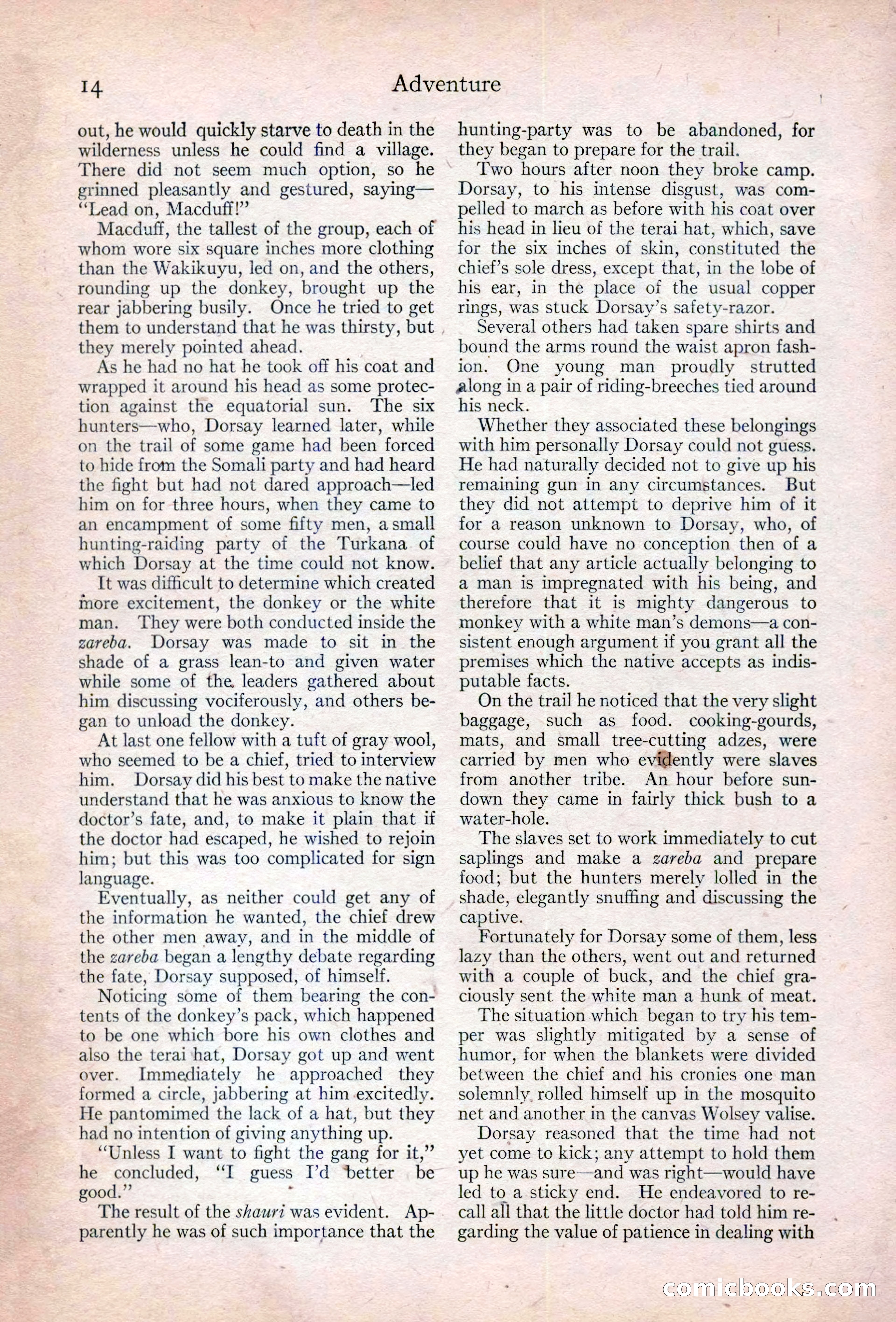
A restored page from Pulp Fiction, 1921. Page through the whole issue in the reader above.
📄 Transcribed text from this page (OCR, searchable)
Machine-transcribed from the original scan — historical spelling and the odd misread are preserved.
14 out, he would quickly starve to death in the wilderness unless he could find a village. There did not seem much option, so he grinned pleasantly and gestured, saying— “Lead on, Macduff!” Macduff, the tallest of the group, each of whom wore six square inches more clothing than the Wakikuyu, led on, and the others, rounding up the donkey, brought up the rear jabbering busily. Once he tried to get them to understand that he was thirsty, but they merely pointed ahead. As he had no hat he took off his coat and wrapped it around his head as some protec- tion against the equatorial sun. The six hunters—who, Dorsay learned later, while on the trail of some game had been forced to hide from the Somali party and had heard the fight but had not dared approach—led him on for three hours, when they came to an encampment of some fifty men, a small hunting-raiding party of the Turkana. of which Dorsay at the time could not know. It was difficult to determine which created more excitement, the donkey or the white man. ‘They were both conducted inside the gareba. Dorsay was made to sit in the shade of a grass lean-to and given water while some of the leaders gathered about him discussing vociferously, and others be- gan to unload the donkey. At last one fellow with a tuft of gray wool, who seemed to be a chief, tried to interview him. Dorsay did his best to make the native understand that he was anxious to know the doctor’s fate, and, to make it plain that if the doctor had escaped, he wished to rejoin him; but this was too complicated for sign language. Eventually, as neither could get any of the information he wanted, the chief drew the other men away, and in the middle of the zareba began a lengthy debate regarding the fate, Dorsay supposed, of himself. Noticing some of them bearing the con- tents of the donkey’s pack, which happened to be one which bore his own clothes and also the terai hat, Dorsay got up and went over. Immediately he approached they formed a circle, jabbering at him-excitedly. He pantomimed the lack of a hat, but they had no intention of giving anything up. “Unless I want to fight the gang for it,” he concluded, “I guess I’d better be good.” . The result of the shauri was evident. Ap- parently he was of such importance that the Adventure hunting-party was to be abandoned, for they began to prepare for the trail. Two hours after noon they broke camp. Dorsay, to his intense disgust, was com- pelled to march as before with his coat over his head in lieu of the terai hat, which, save for the six inches of skin, constituted the chief’s sole dress, except that, in the lobe of his ear, in the place of the usual copper rings, was stuck Dorsay’s safety-razor. Several others had taken spare shirts and bound the arms round the waist apron fash- ion. One young man proudly strutted along in a pair of riding-breeches tied around his neck. Whether they associated these belongings with him personally Dorsay could not guess. He had naturally decided not to give up his remaining gun in any circumstances. But they did not attempt to deprive him of it for a reason unknown to Dorsay, who, of course could have no conception then of a belief that any article actually belonging to a man is impregnated with his being, and therefore that it is mighty dangerous to monkey with a white man’s demons—a con- sistent enough argument if you grant all the premises which the native accepts as indis- putable facts. On the trail he noticed that the very slight baggage, such as food. cooking-gourds, mats, and small tree-cutting adzes, were carried by men who evidently were slaves from another tribe. An hour before sun- down they came in fairly thick bush to a water-hole. The slaves set to work immediately to cut saplings and make a gareba and prepare food; but the hunters merely lolled in the shade, elegantly snuffing and discussing the captive. Fortunately for Dorsay some of them, less lazy than the others, went out and returned with a couple of buck, and the chief gra- ciously sent the white man a hunk of meat. The situation which began to try his tem- per was slightly mitigated by a sense of humor, for when the blankets were divided between the chief and his cronies one man solemnly, rolled himself up in the mosquito net and another in the canvas Wolsey valise. Dorsay reasoned that the time had not yet come to kick; any attempt to hold them up he was sure—and was right—would have led to a sticky end. He endeavored to re- call all that the little doctor had told him re- garding the value of patience in dealing with eO) VNOOLKS AMUC (E@)