
Pulp Fiction, 1921 · page 27 of 200
Adventure Magazine Cover — page 27: what you’re looking at
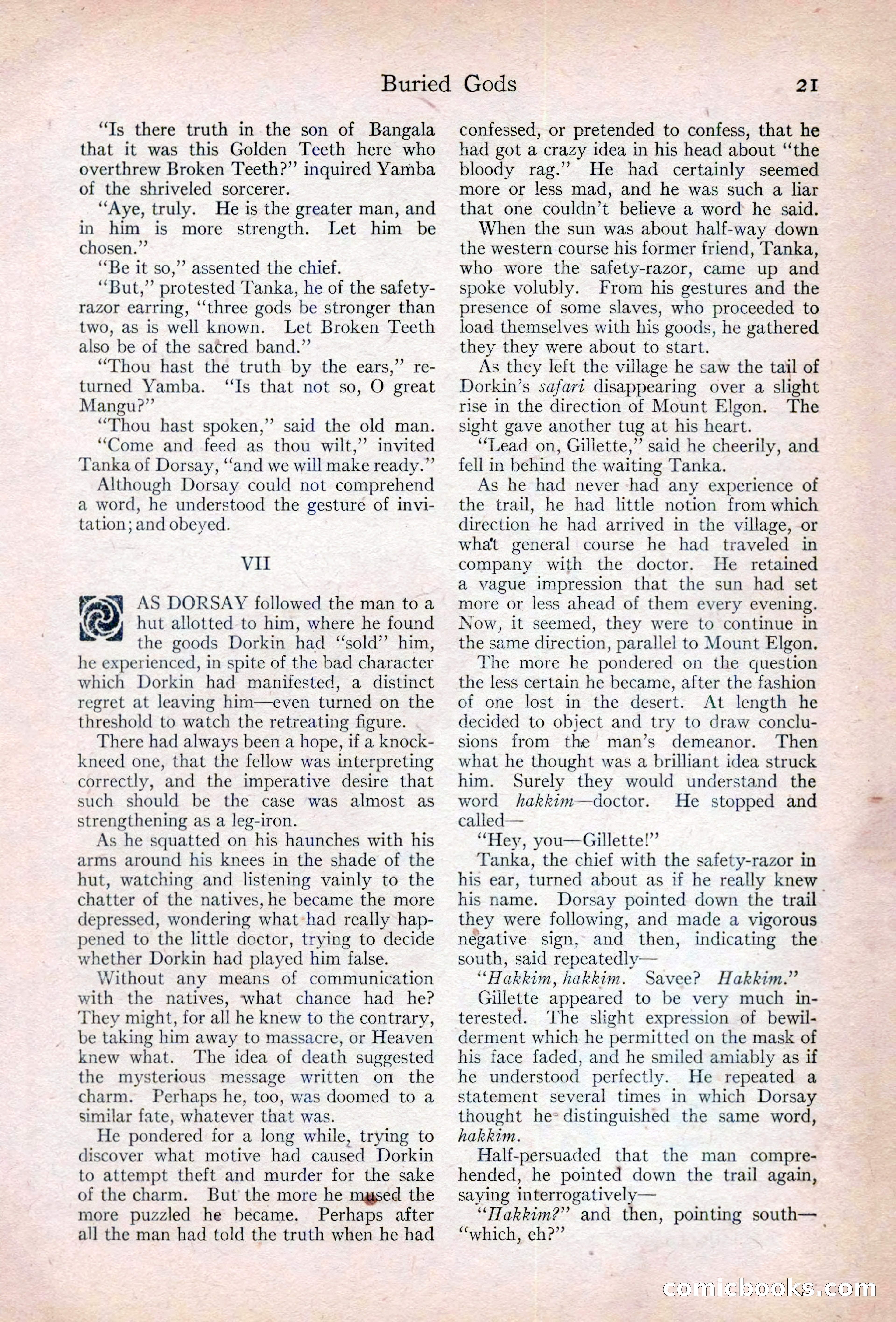
A restored page from Pulp Fiction, 1921. Page through the whole issue in the reader above.
📄 Transcribed text from this page (OCR, searchable)
Machine-transcribed from the original scan — historical spelling and the odd misread are preserved.
Buried Gods “Ts there truth in the son of Bangala that it was this Golden Teeth here who overthrew Broken Teeth?” inquired Yamba of the shriveled sorcerer. ‘Aye, truly. He is the greater man, and in him is more strength. Let him be chosen.” ‘Be it so,” assented the chief. “But,” protested Tanka, he of the safety- razor earring, ‘“‘three gods be stronger than two, as is well known. Let Broken Teeth also be of the sacred band.” “Thou hast the truth by the ears,” re- turned Yamba. “Is that not so, O great Mangue” “Thou hast spoken,” said the old man. “Come and feed as thou wilt,” invited Tanka of Dorsay, “and we will make ready.” Although Dorsay could not comprehend a word, he understood the gesture of invi- tation; and obeyed. ? VIl i) AS DORSAY followed the man to a NC w) hut allotted to him, where he found the goods Dorkin had ‘sold’? him, he experienced, in spite of the bad character which Dorkin had manifested, a distinct regret at leaving him—even turned on the threshold to watch the retreating figure. There had always been a hope, if a knock- kneed one, that the fellow was interpreting correctly, and the imperative desire that such should be the case was almost as strengthening as a leg-iron. As he squatted on his haunches with his arms around his knees in the shade of the hut, watching and listening vainly to the chatter of the natives, he became the more depressed, wondering what had really hap- pened to the little doctor, trying to decide whether Dorkin had played him false. Vithout any means of communication with the natives, what chance had he? They might, for all he knew to the contrary, be taking him away to massacre, or Heaven knew what. The idea of death suggested the mysterious message written on the charm. Perhaps he, too, was doomed to a similar fate, whatever that was. He pondered for a long while, trying to discover what motive had caused Dorkin to attempt theft and murder for the sake of the charm. But the more he mused the more puzzled he became. Perhaps after all the man had told the truth when he had ai confessed, or pretended to confess, that he had got a crazy idea in his head about “the bloody rag.” He had certainly seemed more or less mad, and he was such a liar that one couldn’t believe a word he said. When the sun was about half-way down the western course his former friend, Tanka, who wore the safety-razor, came up and spoke volubly. From his gestures and the presence of some slaves, who proceeded to load themselves with his goods, he gathered they they were about to start. As they left the village he saw the tail of Dorkin’s safari disappearing over a slight rise in the direction of Mount Elgon. The sight gave another tug at his heart. ‘Lead on, Gillette,” said he cheerily, and fell in behind the waiting Tanka. As he had never had any experience of the trail, he had little notion from which direction he had arrived in the village, or what general course he had traveled in company with the doctor. He retained a vague impression that the sun had set more or less ahead of them every evening. Now, it seemed, they were to continue in the same direction, parallel to Mount Elgon. The more he pondered on the question the less certain he became, after the fashion of one lost in the desert. At length he decided to object and try to draw conclu- sions from the man’s demeanor. Then what he thought was a brilliant idea struck him. Surely they would understand the word hakkim—doctor. He stopped and called— “Hey, you—Gillette!”’ Tanka, the chief with the safety-razor in his ear, turned about as if he really knew his name. Dorsay pointed down the trail they were following, and made a vigorous negative sign, and then, indicating the. south, said repeatedly— “Hakkim, hakkim. Savee? Hakkim.” Gillette appeared to be very much in- terested. The slight expression of bewil- derment which he permitted on the mask of his face faded, and he smiled amiably as if he understood perfectly. He repeated a statement several times in which Dorsay thought he» distinguished the same word, hakkim. Half-persuaded that the man compre- hended, he pointed down the trail again, saying interrogatively— “Hakkim?” and then, pointing south—_ “which, eh?” CORMICLOOOKS (E@)