
Pulp Fiction, 1921 · page 53 of 200
Adventure Magazine Cover — page 53: what you’re looking at
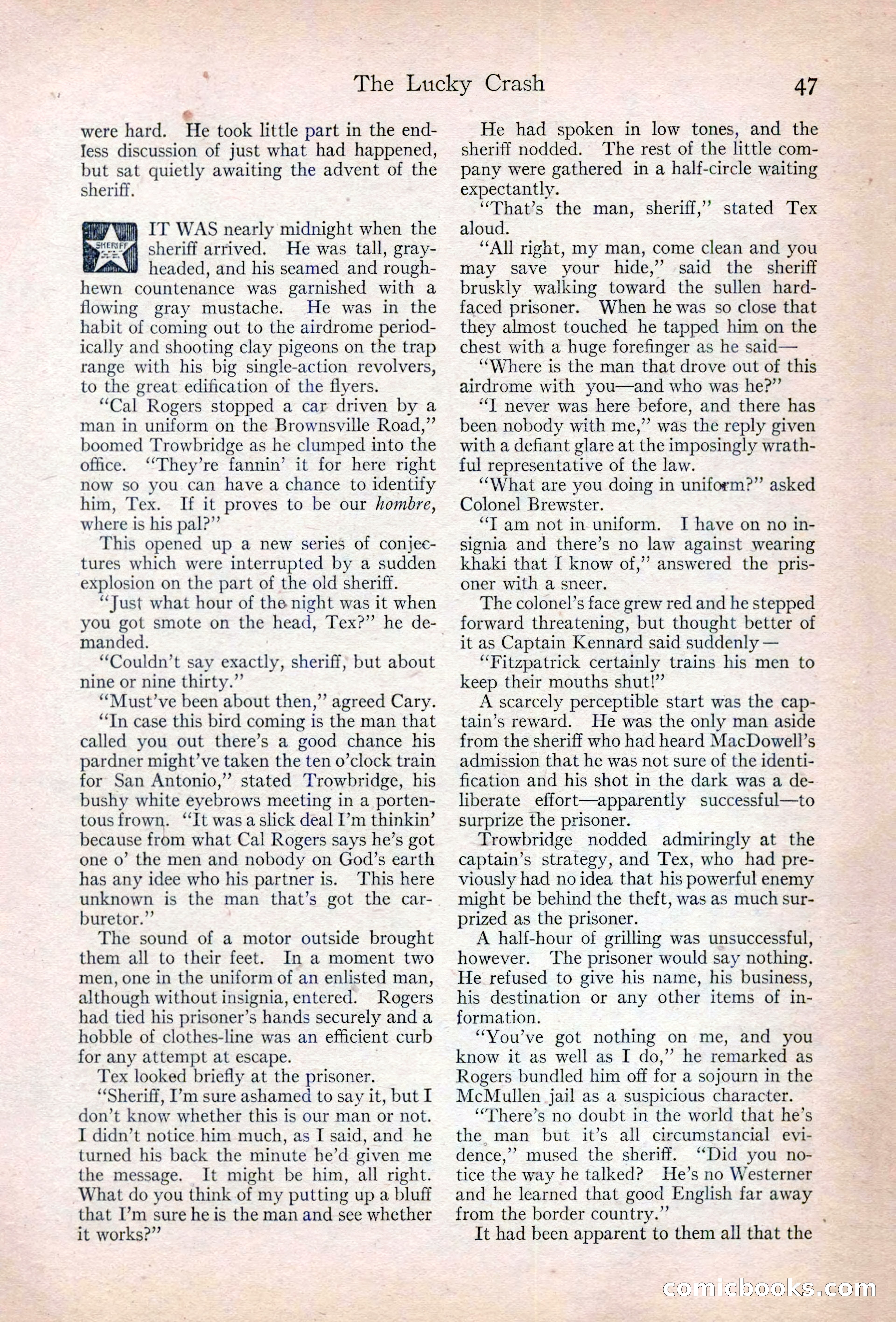
A restored page from Pulp Fiction, 1921. Page through the whole issue in the reader above.
📄 Transcribed text from this page (OCR, searchable)
Machine-transcribed from the original scan — historical spelling and the odd misread are preserved.
The Lucky Crash * were hard. He took little part in the end- Iess discussion of just what had happened, but sat quietly awaiting the advent of the sheriff. Ym IT WAS nearly midnight when the @ sheriff arrived. He was tall, gray- fm headed, and his seamed and rough- hewn countenance was garnished with a flowing gray mustache. He was in the habit of coming out to the airdrome period- ically and shooting clay pigeons on the trap range with his big single-action revolvers, to the great edification of the flyers. “Cal Rogers stopped a car driven by a man in uniform on the Brownsville Road,” boomed Trowbridge as he clumped into the office. ‘“‘They’re fannin’ it for here right now so you can have a chance to identify him, Tex. If it proves to be our hombre, where is his pal?” This opened up a new series of conjec- tures which were interrupted by a sudden explosion on the part of the old sheriff. ‘Just what hour of the night was it when you got smote on the head, Tex?” he de- manded. “Couldn’t say exactly, sheriff, but about nine or nine thirty.”’ ‘““Must’ve been about then,” agreed Cary. “In case this bird coming is the man that called you out there’s a good chance his pardner might’ve taken the ten o’clock train for San Antonio,” stated Trowbridge, his bushy white eyebrows meeting in a porten- tous frown. “It was a slick deal I’m thinkin’ because from what Cal Rogers says he’s got one 0’ the men and nobody on God’s earth has any idee who his partner is. This here unknown is the man that’s got the car- buretor.”’ The sound of a motor outside brought them all to their feet. In a moment two men, one in the uniform of an enlisted man, although without insignia, entered. Rogers had tied his prisoner’s hands securely and a hobble of clothes-line was an efficient curb for any attempt at escape. | Tex looked briefly at the prisoner. ‘Sheriff, I’m sure ashamed to say it, but I don’t know whether this is our man or not. I didn’t notice him much, as I said, and he turned his back the minute he’d given me the message. It might be him, all right. What do you think of my putting up a bluff that I’m sure he is the man and see whether it works?” He had spoken in low tones, and the sheriff nodded. The rest of the little com- pany were gathered in a half-circle waiting expectantly. “That’s the man, sheriff,’ stated Tex aloud. ‘All right, my man, come clean and you may save your hide,” said the sheriff bruskly walking toward the sullen hard- faced prisoner. When he was so close that they almost touched he tapped him on the chest with a huge forefinger as he said— ‘Where is the man that drove out of this airdrome with you—and who was he?” “T never was here before, and there has been nobody with me,” was the reply given with a defiant glare at the imposingly wrath- ful representative of the law. ‘What are you doing in uniform?” asked Colonel Brewster. “T am not in uniform. I have on no in- signia and there’s no law against wearing khaki that I know of,’’ answered the pris- oner with a sneer. The colonel’s face grew red and he stepped forward threatening, but thought better of it as Captain Kennard said suddenly — “Fitzpatrick certainly trains his men to keep their mouths shut!” A scarcely perceptible start was the cap- tain’s reward. He was the only man aside from the sheriff who had heard MacDowell’s admission that he was not sure of the identi- fication and his shot in the dark was a de- liberate effort—apparently successful—to surprize the prisoner. Trowbridge nodded admiringly at the captain’s strategy, and Tex, who had pre- viously had no idea that his powerful enemy might be behind the theft, was as much sur- prized as the prisoner. A half-hour of grilling was unsuccessful, however. ‘The prisoner would say nothing. He refused to give his name, his business, his destination or any other items of in- formation. “VYou’ve got nothing on me, and you know it as well as I do,” he remarked as Rogers bundled him off for a sojourn in the McMullen jail as a suspicious character. “‘There’s no doubt in the world that he’s the man but it’s all circumstancial evi- dence,’ mused the sheriff. ‘Did you no- tice the way he talked? He’s no Westerner and he learned that good English far away from the border country.” 47 It had been apparent to them all that the . GOmicbooks (E@)