
Pulp Fiction, 1921 · page 68 of 200
Adventure Magazine Cover — page 68: what you’re looking at
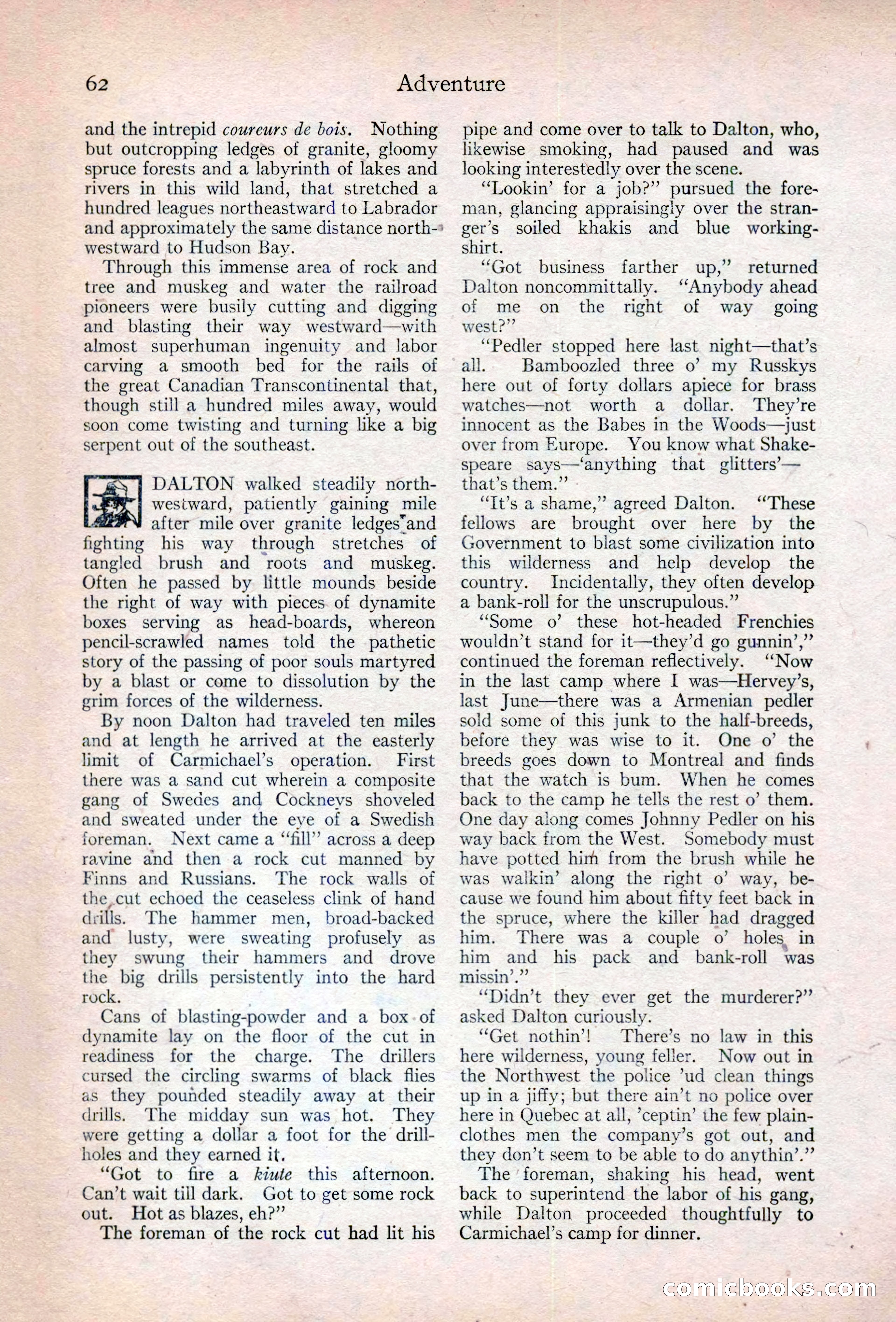
A restored page from Pulp Fiction, 1921. Page through the whole issue in the reader above.
📄 Transcribed text from this page (OCR, searchable)
Machine-transcribed from the original scan — historical spelling and the odd misread are preserved.
62 and the intrepid coureurs de bois. Nothing but outcropping ledges of granite, gloomy spruce forests and a labyrinth of lakes and rivers in this wild land, that stretched a hundred leagues northeastward to Labrador and approximately the same distance north-* westward to Hudson Bay. Through this immense area of rock and tree and muskeg and water the railroad pioneers were busily cutting and digging and blasting their way westward—with almost superhuman ingenuity and labor carving a smooth bed for the rails of the great Canadian Transcontinental that, though still a hundred miles away, would soon come twisting and turning like a big serpent out of the southeast. DALTON walked steadily north- westward, patiently gaining mile YN after mile over granite ledgesand see his way through stretches of tangled brush and roots and muskeg. Often he passed by little mounds beside the right of way with pieces. of dynamite boxes serving as head-boards, whereon pencil-scrawled names told the pathetic story of the passing of poor souls martyred by a blast or come to dissolution by the grim forces of the wilderness. By noon Dalton had traveled ten miles and at length he arrived at the easterly limit of Carmichael’s operation. First there was a sand cut wherein a composite gang of Swedes and Cockneys shoveled and sweated under the eye of a Swedish foreman. Next came a “‘fill” across a deep ravine and then a rock cut manned by Finns and Russians. The rock walls of the.cut echoed the ceaseless clink of hand drills. The hammer men, broad-backed and lusty, were sweating profusely as they swung their hammers and drove the big drills persistently into the hard rock, Cans of blasting-powder and a box. of dynamite lay on the floor of the cut in readiness for the charge. The drillers cursed the circling swarms of black flies as they pounded steadily away at their drills. The midday sun was hot. They were getting a dollar a foot for the drill- holes and they earned it, “Got to fire a kiwte this afternoon. Can’t wait till dark. Got to get some rock out. Hot as blazes, eh?” The foreman of the rock cut had lit his Adventure pipe and come over to talk to Dalton, who, hkewise smoking, had paused and was looking interestedly over the scene. “Lookin’ for a job?” pursued the fore- man, glancing appraisingly over the stran- ger’s soiled khakis and blue _ working- shirt. “Got business farther up,” returned Dalton noncommittally. “Anybody ahead of me on the right of way going west?” “Pedler stopped here last night—that’s all. Bamboozled three o’ my Russkys here out of forty dollars apiece for brass watches—not worth a dollar. They’re innocent as the Babes in the Woods—just over from Europe. You know what Shake- speare says—‘anything that glitters’— that’s them.” “Tt’s a shame,” agreed Dalton. ‘‘These fellows are brought over here by the Government to blast some civilization into this wilderness and help develop the country. Incidentally, they often develop a bank-roll for the unscrupulous.” “Some o’ these hot-headed Frenchies wouldn’t stand for it—they’d go gunnin’,” continued the foreman reflectively. ‘Now in the last camp where I was—Hervey’s, last June—there was a Armenian pedler sold some of this junk to the half-breeds, before they was wise to it. One o’ the breeds goes down to Montreal and finds that the watch is bum. When he comes back to the camp he tells the rest o’ them. One day along comes Johnny Pedler on his way back from the West. Somebody must have potted him from the brush while he was walkin’ along the right o’ way, be- cause we found him about fifty feet back in the spruce, where the killer had dragged him. There was a couple o’ holes in him and his pack and bank-roll was missin’.”’ “Didn’t they ever get the murderer?” asked Dalton curiously. “Get nothin’! There’s no law in this here wilderness, young feller. Now out in the Northwest the police ’ud clean things up in a jiffy; but there ain’t no police over here in Quebec at all, ’ceptin’ the few plain- clothes men the company’s got out, and they don’t seem to be able to do anythin’.”’ The ‘foreman, shaking his head, went back to superintend the labor of his gang, while Dalton proceeded thoughtfully to Carmichael’s camp for dinner. COMMICLOOOKS (C@