
Pulp Fiction, 1921 · page 76 of 200
Adventure Magazine Cover — page 76: what you’re looking at
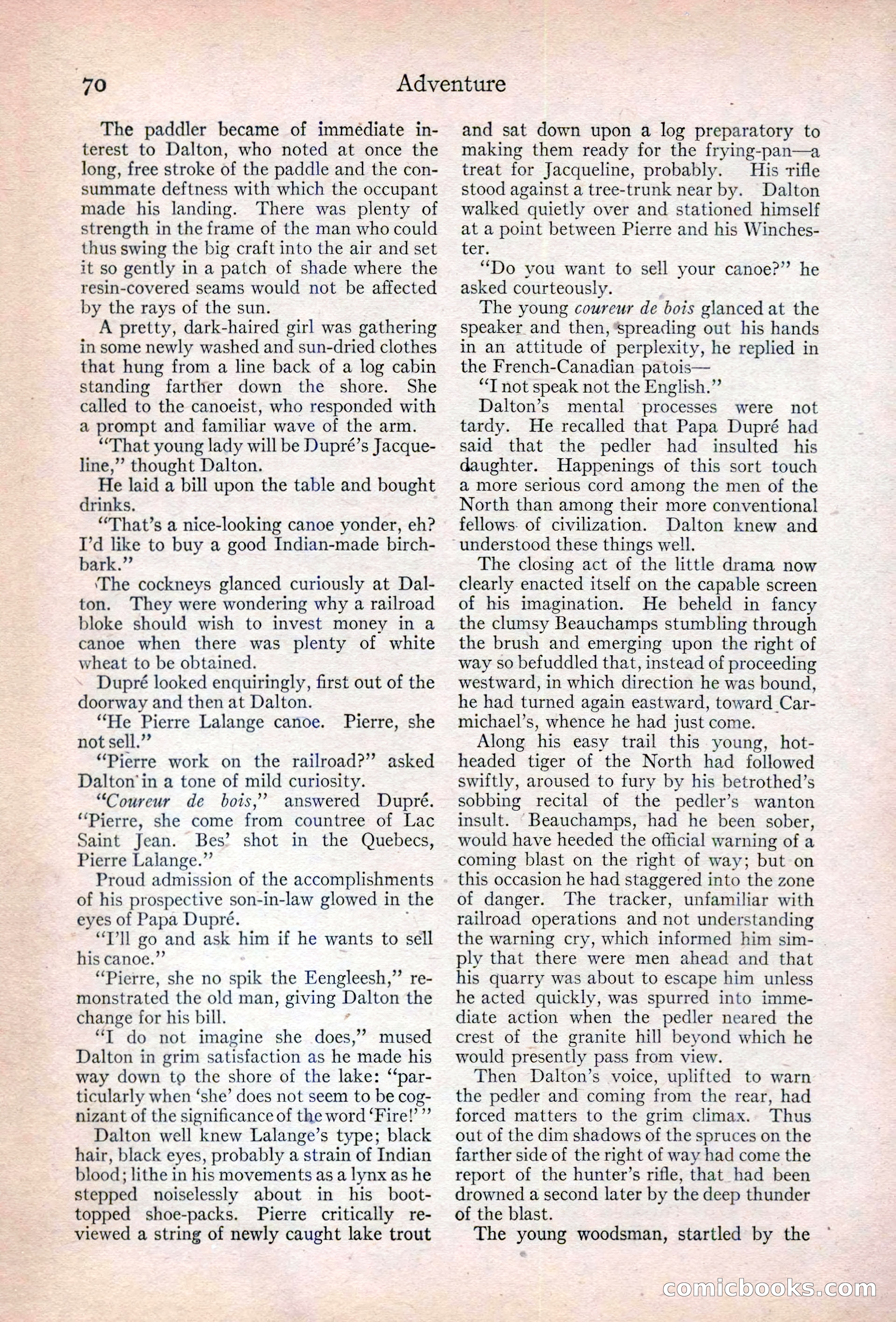
A restored page from Pulp Fiction, 1921. Page through the whole issue in the reader above.
📄 Transcribed text from this page (OCR, searchable)
Machine-transcribed from the original scan — historical spelling and the odd misread are preserved.
56 The paddler became of immédiate in- terest to Dalton, who noted at once the long, free stroke of the paddle and the con- summate deftness with which the occupant made his landing. There was plenty of strength in the frame of the man who could thus swing the big craft into the air and set it so gently in a patch of shade where the resin-covered seams would not be affected by the rays of the sun. A pretty, dark-haired girl was gathering in some newly washed and sun-dried clothes that hung from a line back of a log cabin standing farther down the shore. She called to the canoeist, who responded with a prompt and familiar wave of the arm. “That young lady will be Dupré’s Jacque- line,” thought Dalton. He laid a bill upon the table and bought drinks. “That’s a nice-looking canoe yonder, eh? I’d like to buy a good Indian-made birch- bark.” ‘The cockneys glanced curiously at Dal- ton. They were wondering why a railroad bloke should wish to invest money in a canoe when there was plenty of white wheat to be obtained. Dupré looked enquiringly, first out of the doorway and then at Dalton. “He Pierre Lalange canoe. not sell.” “Pierre work on the railroad?” asked Dalton’in a tone of mild curiosity. “Coureur de bois,” answered Dupré. “Pierre, she come from countree of Lac Saint Jean. Bes’ shot in the Quebecs, Pierre Lalange.”’ Proud admission of the accomplishments of his prospective son-in-law glowed in the eyes of Papa Dupré. “T’ll go and ask him if he wants to sell his canoe.” “Pierre, she no spik the Eengleesh,” re- monstrated the old man, giving Dalton the change for his bill. “T do not imagine she aoe? mused Dalton in grim satisfaction as he made his way down to the shore of the lake: “‘par- ticularly when ‘she’ does not seem to be cog- nizant of the significance of the word ‘Fire!’ ”’ Dalton well knew Lalange’s type; black hair, black eyes, probably a strain of Indian blood; lithe in his movements as a lynx as he stepped noiselessly about in his boot- topped shoe-packs. Pierre critically re- viewed a string of newly caught lake trout Pierre, she ) Adventure and sat down upon a log preparatory to making them ready for the frying-pan—a treat for Jacqueline, probably. His rifle stood against a tree-trunk near by. Dalton walked quietly over and stationed himself at a point between Pierre and his Winches- ter. “Do you want to sell your canoe?” he asked courteously. The young coureur de bois glanced at the speaker and then, Spreading out his hands in an attitude of perplexity, he replied in the French-Canadian patois— “T not speak not the English.” Dalton’s mental processes were not tardy. He recalled that Papa Dupré had said that the pedler had insulted his daughter. Happenings of this sort touch a more serious cord among the men of the North than among their more conventional fellows. of civilization. Dalton knew and understood these things well. The closing act of the little drama now clearly enacted itself on the capable screen of his imagination. He beheld in fancy the clumsy Beauchamps stumbling through the brush and emerging upon the right of way so befuddled that, instead of proceeding westward, in which direction he was bound, he had turned again eastward, toward Car- michael’s, whence he had just come. Along his easy trail this young, hot- headed tiger of the North had followed swiftly, aroused to fury by his betrothed’s sobbing recital of the pedler’s wanton insult. _Beauchamps, had he been sober, would have heeded the official warning of a coming blast on the right of way; but on this occasion he had staggered into the zone of danger. The tracker, unfamiliar with railroad operations and not understanding the warning cry, which informed him sim- ply that there were men ahead and that his quarry was about to escape him unless he acted quickly, was spurred into imme- diate action when the pedler neared the crest of the granite hill beyond which he would presently pass from view. Then Dalton’s voice, uplifted to warn the pedler and coming from the rear, had forced matters to the grim climax. Thus out of the dim shadows of the spruces on the farther side of the right of way had come the report of the hunter’s rifle, that had been drowned a second later by the deep thunder of the blast. The young woodsman, startled by the CORNICLOOOKS (E@)