
Pulp Fiction, 1921 · page 82 of 200
Adventure Magazine Cover — page 82: what you’re looking at
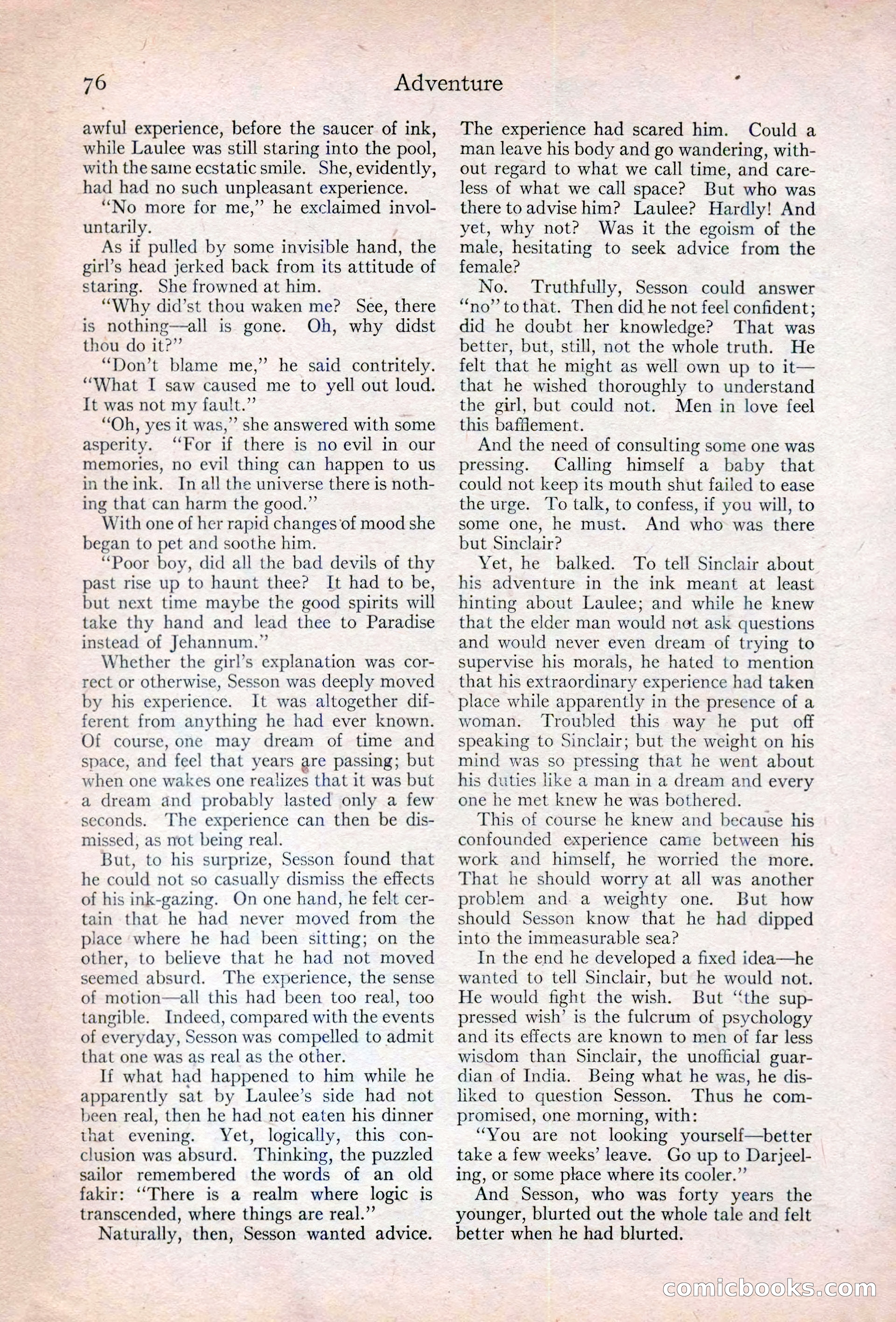
A restored page from Pulp Fiction, 1921. Page through the whole issue in the reader above.
📄 Transcribed text from this page (OCR, searchable)
Machine-transcribed from the original scan — historical spelling and the odd misread are preserved.
70 awful experience, before the saucer of ink, while Laulee was still staring into the pool, with the same ecstatic smile. She, evidently, had had no such unpleasant experience. “No more for me,” he exclaimed invol- untarily. : As if pulled by some invisible hand, the girl’s head jerked back from its attitude of staring. She frowned at him. “Why did’st thou waken me? See, there is nothing—all is gone. Oh, why didst thou do it?” “Don’t blame me,” he said contritely. “What I saw caused me to yell out loud. It was not my fault.” “Oh, yes it was,”’ she answered with some asperity. ‘For if there is no evil in our memories, no evil thing can happen to us in the ink. In all the universe there is noth- ing that can harm the good.” With one of her rapid changes of mood she began to pet and soothe him. “Poor boy, did all the bad devils of thy past rise up to haunt thee? It had to be, but next time maybe the good spirits will take thy hand and lead thee to Paradise instead of Jehannum.” Whether the girl’s explanation was cor- rect or otherwise, Sesson was deeply moved by his experience. It was altogether dif- ferent from anything he had ever known. Of course, one may dream of time and space, and feel that years are passing; but when one wakes one realizes that it was but a dream and probably lasted only a few seconds. The experience can then be dis- missed, as not being real. But, to his surprize, Sesson found that he could not so casually dismiss the effects of his ink-gazing. On one hand, he felt cer- tain that he had never moved from the place where he had been sitting; on the other, to believe that he had not moved seemed absurd. The experience, the sense of motion—all this had been too real, too tangible. Indeed, compared with the events of everyday, Sesson was compelled to admit that one was as real as the other. If what had happened to him while he apparently sat by Laulee’s side had not been real, then he had not eaten his dinner that evening. Yet, logically, this con- clusion was absurd. Thinking, the puzzled sailor remembered the words of an old fakir: “There is a realm where logic is transcended, where things are real.”’ Naturally, then, Sesson wanted advice. Adventure The experience had scared him. Could a man leave his body and go wandering, with- out regard to what we call time, and care- less of what we call space? But who was there to advise him? Laulee? Hardly! And yet, why not? Was it the egoism of the male, hesitating to seek advice from the female? No. Truthfully, Sesson could answer “no” to that. Then did he not feel confident; did he doubt her knowledge? That was better, but, still, not the whole truth. He felt that he might as well own up to it— that he wished thoroughly to understand the girl, but could not. Men in love feel this bafflement. And the need of consulting some one was pressing. Calling himself a baby that could not keep its mouth shut failed to ease the urge. To talk, to confess, if you will, to some one, he must. And who was there but Sinclair? Yet, he balked. To tell Sinclair about his adventure in the ink meant at least hinting about Laulee; and while he knew that the elder man would net ask questions and would never even dream of trying to supervise his morals, he hated to mention that his extraordinary experience had taken place while apparently in the presence of a woman. ‘Troubled this way he put off speaking to Sinclair; but the weight on his mind was so pressing that he went about his duties ike a man in a dream and every one he met knew he was bothered. This of course he knew and because his confounded experience came between his work and himself, he worried the more. That he should worry at all was another problem and a weighty one. But how should Sesson know that he had dipped into the immeasurable sea? In the end he developed a fixed idea—he wanted to tell Sinclair, but he would not. He would fight the wish. But “the sup- pressed wish’ is the fulcrum of psychology and its effects are known to men of far less wisdom than Sinclair, the unofficial guar- dian of India. Being what he was, he dis- hiked to question Sesson. Thus he com- promised, one morning, with: “You are not looking yourself—better take a few weeks’ leave. Go up to Darjeel- ing, or some place where its cooler.”’ And Sesson, who was forty years the younger, blurted out the whole tale and felt better when he had blurted. CORNICLOO© (C@