
Pulp Fiction, 1921 · page 99 of 200
Adventure Magazine Cover — page 99: what you’re looking at
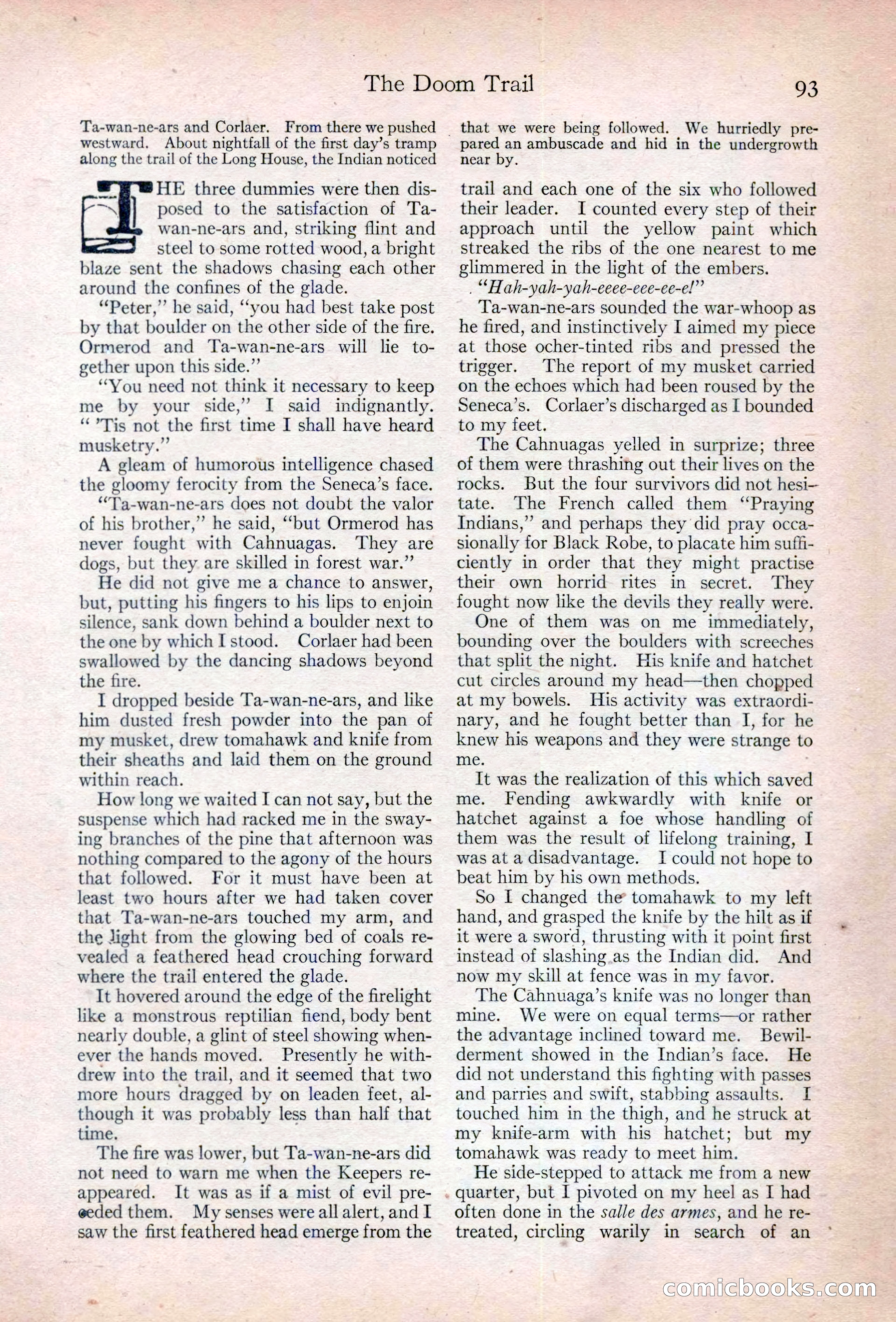
A restored page from Pulp Fiction, 1921. Page through the whole issue in the reader above.
📄 Transcribed text from this page (OCR, searchable)
Machine-transcribed from the original scan — historical spelling and the odd misread are preserved.
The Doom Trail Ta-wan-ne-ars and Corlaer. From there we pushed westward. About nightfall of the first day’s tramp along the trail of the Long House, the Indian noticed eo) wan-ne-ars and, striking flint and steel to some rotted wood, a bright blaze sent the shadows chasing each other around the confines of the glade. “Peter,” he said, “you had best take post by that boulder on the other side of the fire. Ormerod and Ta-wan-ne-ars will le to- gether upon this side.” “You need not think it necessary to keep me by your side,’ I said indignantly. “*Tis not the first time I shall have heard musketry.” A gleam of humorous intelligence chased the gloomy ferocity from the Seneca’s face. “Ta-wan-ne-ars does not doubt the valor of his brother,” he said, “but Ormerod has never fought with Cahnuagas. They are dogs, but they are skilled in forest war.” He did not give me a chance to answer, but, putting his fingers to his lips to enjoin silence, sank down behind a boulder next to the one by which I stood. Corlaer had been swallowed by the dancing shadows beyond the fire. I dropped beside Ta-wan-ne-ars, and like him dusted fresh powder into the pan of my musket, drew tomahawk and knife from their sheaths and laid them on the ground within reach. How long we waited I can not say, but the suspense which had racked me in the sway- ing branches of the pine that afternoon was nothing compared to the agony of the hours that followed. For it must have been at least two hours after we had taken cover that Ta-wan-ne-ars touched my arm, and the Jight from the glowing bed of coals re- vealed a feathered head crouching forward where the trail entered the glade. It hovered around the edge of the firelight like a monstrous reptilian fiend, body bent nearly double, a glint of steel showing when- ever the hands moved. Presently he with- drew into the trail, and it seemed that two more hours dragged by on leaden feet, al- though it was probably less than half that time. The fire was lower, but Ta-wan-ne-ars did not need to warn me when the Keepers re- appeared. It was as if a mist of evil pre- eeded them. My senses were all alert, and I saw the first feathered head emerge from the HE three dummies were then dis- posed to the satisfaction of Ta- 93 _ that we were being followed. We hurriedly pre- pared an ambuscade and hid in the undergrowth near by. trail and each one of the six who followed their leader. I counted every step of their approach until the yellow paint which streaked the ribs of the one nearest to me glimmered in the light of the embers. . “Hah-yah-yah-eeee-ece-ce-el”’ Ta-wan-ne-ars sounded the war-whoop as he fired, and instinctively I aimed my piece at those ocher-tinted ribs and pressed the trigger. The report of my musket carried on the echoes which had been roused by the Seneca’s. Corlaer’s discharged as I bounded to my feet. The Cahnuagas yelled in surprize; three of them were thrashing out their lives on the rocks. But the four survivors did not hesi— tate. The French called them “Praying Indians,” and perhaps they did pray occa- sionally for Black Robe, to placate him suffi- ciently in order that they might practise their own horrid rites in secret. They fought now like the devils they really were. One of them was on me immediately, bounding over the boulders with screeches that split the night. His knife and hatchet cut circles around my head—then chopped at my bowels. His activity was extraordi- nary, and he fought better than I, for he knew his weapons and they were strange to me. : It was the realization of this which saved me. Fending awkwardly with knife or hatchet against a foe whose handling of them was the result of lifelong training, I was at a disadvantage. I could not hope to beat him by his own methods. So I changed the tomahawk to my left hand, and grasped the knife by the hilt as if it were a sword, thrusting with it point first _ instead of slashing as the Indian did. And now my skill at fence was in my favor. The Cahnuaga’s knife was no longer than mine. We were on equal terms—or rather the advantage inclined toward me. Bewil- derment showed in the Indian’s face. He did not understand this fighting with passes and parries and swift, stabbing assaults. I touched him in the thigh, and he struck at my knife-arm with his hatchet; but my tomahawk was ready to meet him. He side-stepped to attack me from a new . quarter, but I pivoted on my heel as I had often done in the salle des armes, and he re- treated, circling warily in search of an CORMICLOOOKS (E@)