
Pulp Fiction, 1921 · page 109 of 204
Adventure Magazine Cover — page 109: what you’re looking at
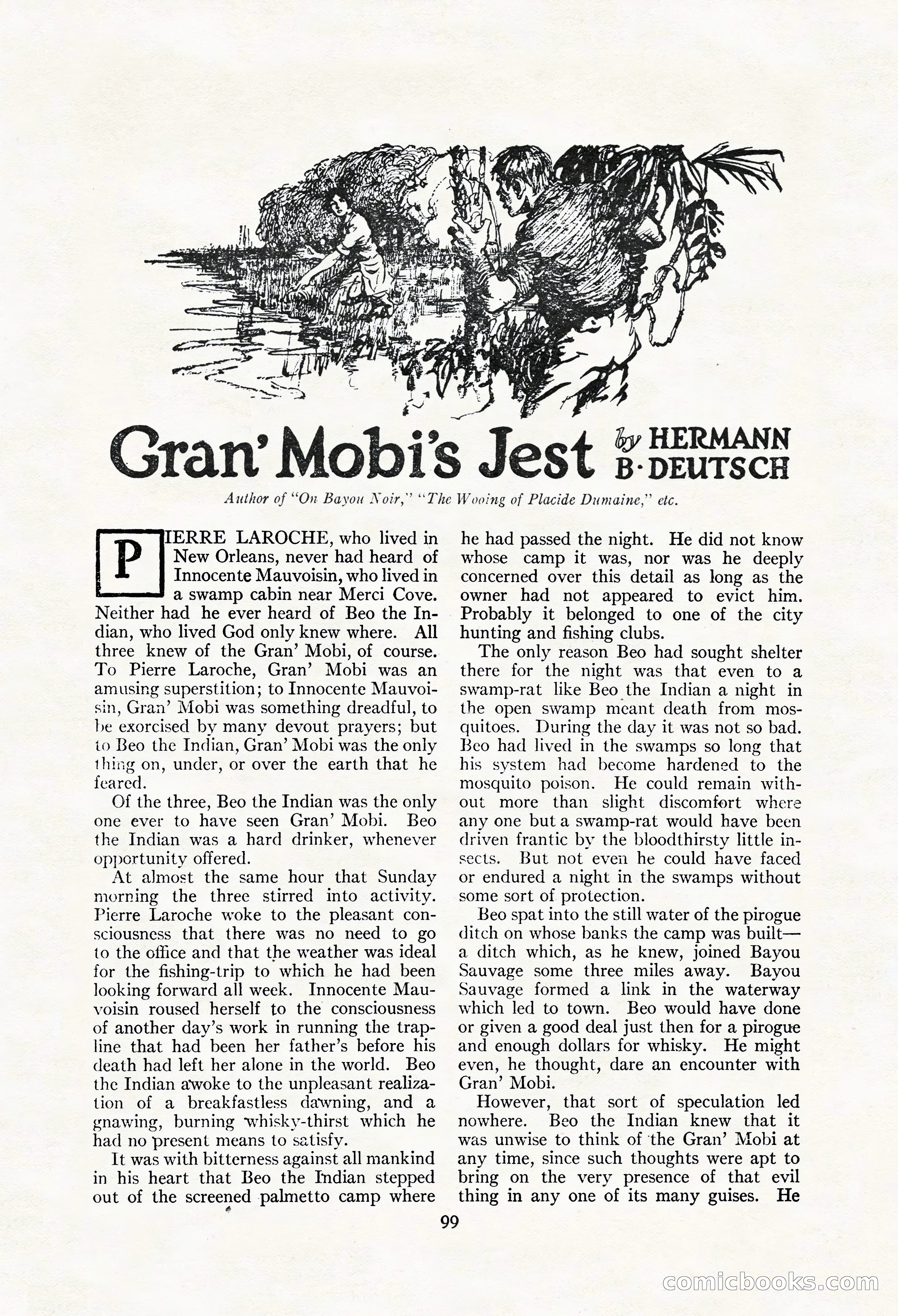
A restored page from Pulp Fiction, 1921. Page through the whole issue in the reader above.
📄 Transcribed text from this page (OCR, searchable)
Machine-transcribed from the original scan — historical spelling and the odd misread are preserved.
ah GCrar’ Mobi’s Jest y by HERMANN B- DEUTSCH Fe Author of “On Bayou Noir,” “The Wooing of Placide Dumaine,’ etc. TERRE LAROCHE, who lived in New Orleans, never had heard of Innocente Mauvoisin, who lived in home a swamp cabin near Merci Cove. Neither had he ever heard of Beo the In- dian, who lived God only knew where. All three knew of the Gran’ Mobi, of course. To Pierre Laroche, Gran’ Mobi was an amusing superstition; to Innocente Mauvoi- sin, Gran’ Mobi was something dreadful, to be exorcised by many devout prayers; but io Beo the Indian, Gran’ Mobi was the only thing on, under, or over the earth that he feared. Of the three, Beo the Indian was the only one ever to have seen Gran’ Mobi. Beo the Indian was a hard drinker, whenever opportunity offered. At almost the same hour that Sunday morning the three stirred into activity. Pierre Laroche woke to the pleasant con- sciousness that there was no need to go to the office and that the weather was ideal for the fishing-trip to which he had been looking forward all week. Innocente Mau- voisin roused herself to the consciousness of another day’s work in running the trap- line that had been her father’s before his death had left her alone in the world. Beo the Indian awoke to the unpleasant realiza- tion of a breakfastless dawning, and a gnawing, burning whisky-thirst which he had no present means to satisfy. It was with bitterness against all mankind in his heart that Beo the Indian stepped out of the screened palmetto camp where he had passed the night. He did not know whose camp it was, nor was he deeply concerned over this detail as long as the owner had not appeared to evict him. Probably it belonged to one of the city hunting and fishing clubs. The only reason Beo had sought shelter there for the night was that even to a swamp-rat like Beo the Indian a night in the open swamp meant death from mos- quitoes. During the day it was not so bad. Beo had lived in the swamps so long that his system had become hardened to the mosquito poison. He could remain with- out more than slight discomfort where any one but a swamp-rat would have been driven frantic by the bloodthirsty little in- sects. But not even he could have faced or endured a night in the swamps without some sort of protection. Beo spat into the still water of the pirogue ditch on whose banks the camp was built— a ditch which, as he knew, joined Bayou Sauvage some three miles away. Bayou Sauvage formed a link in the waterway which led to town. Beo would have done or given a good deal just then for a pirogue and enough dollars for whisky. He might even, he thought, dare an encounter with Gran’ Mobi. However, that sort of speculation led nowhere. Beo the Indian knew that it was unwise to think of the Gran’ Mobi at any time, since such thoughts were apt to bring on the very presence of that evil thing in any one of its many guises. He 99 NOOLK S C@ iin