
Pulp Fiction, 1921 · page 184 of 204
Adventure Magazine Cover — page 184: what you’re looking at
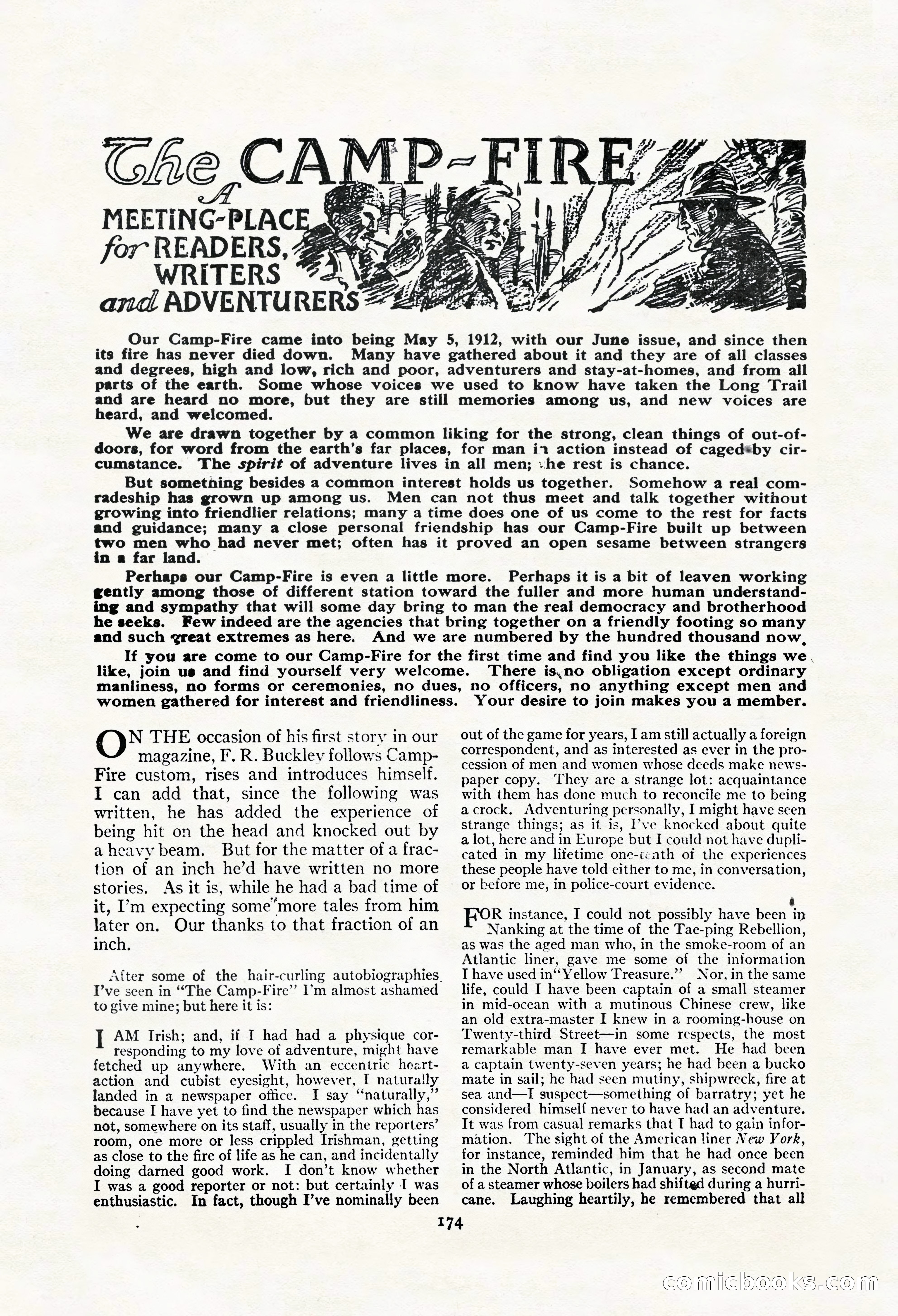
A restored page from Pulp Fiction, 1921. Page through the whole issue in the reader above.
📄 Transcribed text from this page (OCR, searchable)
Machine-transcribed from the original scan — historical spelling and the odd misread are preserved.
MEETING-PLACE, for READERS, WRITERS ZN anc. ADVENTURERS 4 Es fe ‘ Our Camp-Fire came into being May 5, 1912, with our June issue, and since then its fire has never died down. Many have gathered about it and they are of all classes and degrees, high and low, rich and poor, adventurers and stay-at-homes, and from all parts of the earth. Some whose voices we used to know have taken the Long Trail and are heard no more, but they are still memories among us, and new voices are heard, and welcomed. We are drawn together by a common liking for the strong, clean things of out-of- doors, for word from the earth’s far places, for man i action instead of caged*by cir- cumstance. The spirit of adventure lives in all men; whe rest is chance. But something besides a common interest holds us together. Somehow a real com- radeship has grown up among us. Men can not thus meet and talk together without growing into friendlier relations; many a time does one of us come to the rest for facts and guidance; many a close personal friendship has our Camp-Fire built up between two men who had never met; often has it proved an open sesame between strangers in a far land. Perhaps our Camp-Fire is even a little more. Perhaps it is a bit of leaven working gently among those of different station toward the fuller and more human understand- ing and sympathy that will some day bring to man the real democracy and brotherhood he seeks. and such great extremes as here. Few indeed are the agencies that bring together on a friendly footing so many And we are numbered by the hundred thousand now, If you are come to our Camp-Fire for the first time and find you like the things we. like, join us and find yourself very welcome. There is,no obligation except ordinary manliness, no forms or ceremonies, no dues, no officers, no anything except men and women gathered for interest and friendliness. N THE occasion of his first story in our magazine, F. R. Buckley follows Camp- Fire custom, rises and introduces himself. I can add that, since the following was written, he has added the experience of being hit on the head and knocked out by aheavy beam. But for the matter of a frac- tion of an inch he’d have written no more stories, As it is, while he had a bad time of it, I’m expecting some ‘more tales from him later on. Our thanks to that fraction of an inch. After some of the hair-curling autobiographies. I’ve seen in “The Camp-Fire”’ I’m almost ashamed to give mine; but here it is: AM Trish; and, if I had had a physique cor- responding to my love of adventure, might have fetched up anywhere. With an eccentric heart- action and cubist eyesight, however, I natura! ly landed in a newspaper office. I say ‘‘naturally,” because I have yet to find the newspaper which has not, somewhere on its staff, usually in the reporters’ room, one more or less crippled Irishman, getting as close to the fire of life as he can, and incidentally doing darned good work. I don’t know whether I was a good reporter or not: but certainly I was enthusiastic. In fact, though I’ve nominally been Your desire to join makes you a member. out of the game for years, I am still actually a foreign correspondent, and as interested as ever in the pro- cession of men and women whose deeds make news- paper copy. They are a strange lot: acquaintance with them has done much to reconcile me to being acrock. Adventuring personally, I might have seen strange things; as it is, I’ve knocked about quite a lot, here and in Europe but I could not have dupli- cated in my lifetime one-ieath of the experiences these people have told cither to me, in conversation, or before me, in police-court evidence. 4 FoR instance, I could not possibly have been in Nanking at the time of the Tae-ping Rebellion, as was the aged man who, in the smoke-room of an Atlantic liner, gave me some of the information T have used in‘‘ Yellow Treasure.” Nor, in the same life, could I have been captain of a small steamer in mid-ocean with a mutinous Chinese crew, like an old extra-master I knew in a rooming-house on Twenty-third Street—in some respects, the most remarkable man I have ever met. He had been a captain twenty-seven years; he had been a bucko mate in sail; he had seen mutiny, shipwreck, fire at sea and—I suspect—something of barratry; yet he considered himself never to have had an adventure. It was from casual remarks that I had to gain infor- mation. The sight of the American liner New York, for instance, reminded him that he had once been in the North Atlantic, in January, as second mate of a steamer whose boilers had shifted during a hurri- cane. Laughing heartily, he remembered that all 174 (C DOOKS (©