
Pulp Fiction, 1921 · page 188 of 204
Adventure Magazine Cover — page 188: what you’re looking at
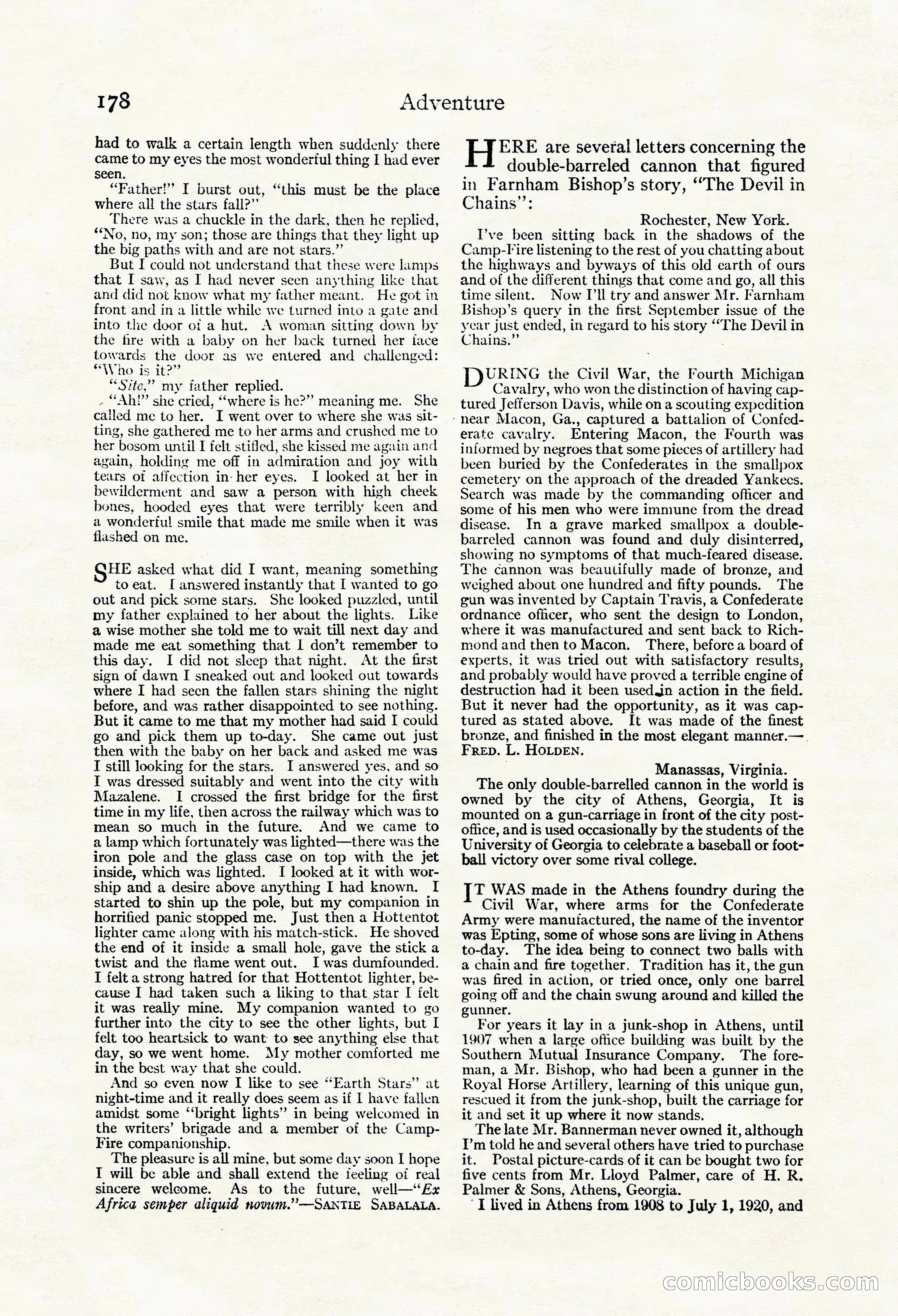
A restored page from Pulp Fiction, 1921. Page through the whole issue in the reader above.
📄 Transcribed text from this page (OCR, searchable)
Machine-transcribed from the original scan — historical spelling and the odd misread are preserved.
178 had to walk a certain length when suddenly there came to my eyes the most wonderiul thing I had ever seen. “Father!”’ I burst out, “this must be the place where all the stars fall?” There was a chuckle in the dark, then he replied, **No, no, my son; those are things that they light up the big paths with and are not stars.”’ But I could not understand that these were lamps that I saw, as I had never seen anything like that and did not know what my father meant. He got in front and in a little while we turned into a gate and into the door of a hut. A woman sitting down by the fire with a baby on her back turned her face towards the door as we entered and challenged: “Who is it?” “Site,” my father replied. - “Ah!” she cried, ‘‘where is he?”” meaning me. She called me to her. I went over to where she was sit- ting, she gathered me to her arms and crushed me to her bosom until I felt stifled, she kissed me again and again, holding me off in admiration and joy with tears of affection in-her eyes. I looked at her in bewilderment and saw a person with high cheek bones, hooded eyes that were terribly keen and a wonderfu! smile that made me smile when it was flashed on me. SHE asked what did I want, meaning something to eat. I answered instantly that I wanted to go out and pick some stars. She looked puzzled, until my father explained to her about the lights. Like a wise mother she told me to wait till next day and made me eat something that I don’t remember to this day. I did not sleep that night. At the first sign of dawn I sneaked out and looked out towards where I had seen the fallen stars shining the night before, and was rather disappointed to see nothing. But it came to me that my mother had said I could go and pick them up to-day. She came out just then with the baby on her back and asked me was I still looking for the stars. I answered yes, and so I was dressed suitably and went into the city with Mazalene. I crossed the first bridge for the first time in my life, then across the railway which was to mean so much in the future. And we came to a lamp which fortunately was lighted—there was the iron pole and the glass case on top with the jet inside, which was lighted. I looked at it with wor- ship and a desire above anything I had known. I started to shin up the pole, but my companion in horrified panic stopped me. Just then a Hottentot lighter came along with his match-stick. He shoved the end of it inside a small hole, gave the stick a twist and the flame went out. I was dumfounded. I felt a strong hatred for that Hottentot lighter, be- cause I had taken such a liking to that star I felt it was really mine. My companion wanted to go further into the city to see the other lights, but I felt too heartsick to want to see anything else that day, so we went home. My mother comforted me in the best way that she could. And so even now [I like to see “‘Earth Stars” at night-time and it really does seem as if I have fallen amidst some ‘“‘bright lights” in being welcomed in the writers’ brigade and a member of the Camp- Fire companionship. The pleasure is all mine, but some day soon I hope I will be able and shall extend the feeling of real sincere welcome. As to the future, well—“Ex Africa semper aliquid novuwm.”—SANTIE SABALALA. Adventure jae are several letters concerning the double-barreled cannon that figured in Farnham Bishop’s story, “The Devil in Chains”’: Rochester, New York. I’ve been sitting back in the shadows of the Camp-Fire listening to the rest of you chatting about the highways and byways of this old earth of ours and of the different things that come and go, all this time silent. Now [ll try and answer Mr. Farnham Bishop’s query in the first September issue of the year just ended, in regard to his story “The Devil in Chains.” [JD URIN G the Civil War, the Fourth Michigan Cavalry, who won the distinction of having cap- tured Jefferson Davis, while on a scouting expedition ‘near Macon, Ga., captured a battalion of Confed- erate cavalry. Entering Macon, the Fourth was informed by negroes that some pieces of artillery had been buried by the Confederates in the smallpox cemetery on the approach of the dreaded Yankecs. Search was made by the commanding officer and some of his men who were immune from the dread disease. In a grave marked smallpox a double- barreled cannon was found and duly disinterred, showing no symptoms of that much-feared disease. The cannon was beautifully made of bronze, and weighed about one hundred and fifty pounds. The gun was invented by Captain Travis, a Confederate ordnance oflicer, who sent the design to London, where it was manufactured and sent back to Rich- mond andthento Macon. There, before a board of experts, it was tried out with satisfactory results, and probably would have proved a terrible engine of destruction had it been usedJjn action in the field. But it never had the opportunity, as it was cap- tured as stated above. It was made of the finest bronze, and finished in the most elegant manner.—. Frep. L. HOLDEN. Manassas, Virginia. The only double-barrelled cannon in the world is owned by the city of Athens, Georgia, It is mounted on a gun-carriage in front of the city post- ofitce, and is used occasionally by the students of the University of Georgia to celebrate a baseball or foot- ball victory over some rival college. [tz WAS made in the Athens foundry during the Civil War, where arms for the Confederate Army were manufactured, the name of the inventor was Epting, some of whose sons are living in Athens to-day. The idea being to connect two balls with a chain and fire together. Tradition has it, the gun was fired in action, or tried once, only one barrel going off and the chain swung around and killed the gunner. For years it lay in a junk-shop in Athens, until 1907 when a large office building was built by the Southern Mutual Insurance Company. The fore- man, a Mr. Bishop, who had been a gunner in the Royal Horse Artillery, learning of this unique gun, rescued it from the junk-shop, built the carriage for it and set it up where it now stands. The late Mr. Bannerman never owned it, although I’m told he and several others have tried to purchase it. Postal picture-cards of it can be bought two for five cents from Mr. Lloyd Palmer, care of H. R. Palmer & Sons, Athens, Georgia. I lived in Athens from 1908 to July 1, 1920, and CONMUC DOOKS (©