
Pulp Fiction, 1921 · page 22 of 204
Adventure Magazine Cover — page 22: what you’re looking at
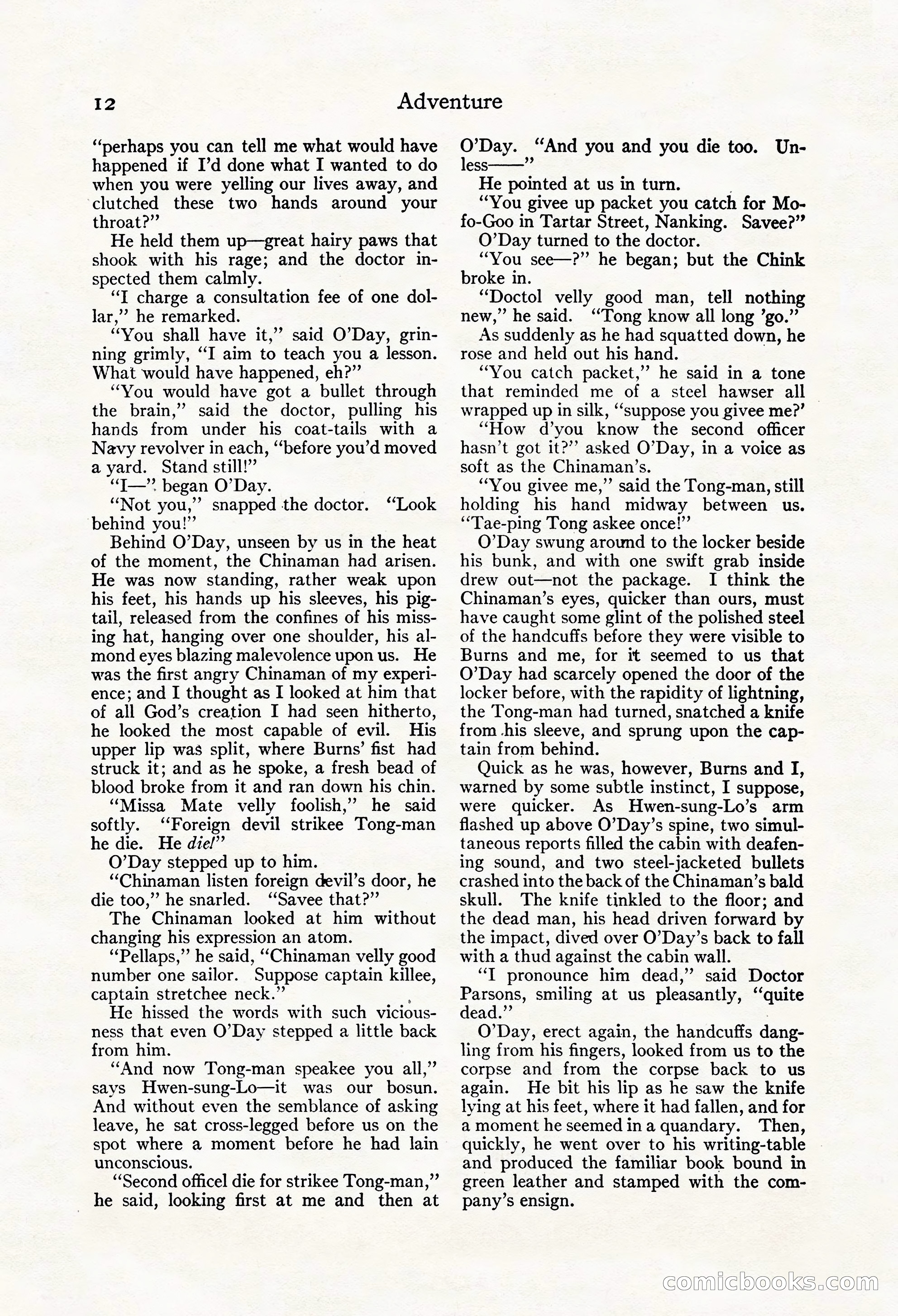
A restored page from Pulp Fiction, 1921. Page through the whole issue in the reader above.
📄 Transcribed text from this page (OCR, searchable)
Machine-transcribed from the original scan — historical spelling and the odd misread are preserved.
12 “perhaps you can tell me what would have happened if I’d done what I wanted to do when you were yelling our lives away, and clutched these two hands around your throat?” He held them up—great hairy paws that shook with his rage; and the doctor in- spected them calmly. “T charge a consultation fee of one dol- lar,” he remarked. “You shall have it,’’ said O’Day, grin- ning grimly, “I aim to teach you a lesson. What would have happened, eh?” “Vou would have got a bullet through the brain,’ said the doctor, pulling his hands from under his coat-tails with a Navy revolver in each, ‘“‘before you’d moved a yard. Stand still!” “T—”. began O’ Day. “Not you,” snapped the doctor. behind you!” Behind O’Day, unseen by us in the heat of the moment, the Chinaman had arisen. He was now standing, rather weak upon his feet, his hands up his sleeves, his pig- tail, released from the confines of his miss- ing hat, hanging over one shoulder, his al- mond eyes blazing malevolence upon us. He was the first angry Chinaman of my experi- ence; and I thought as I looked at him that of all God’s creation I had seen hitherto, he looked the most capable of evil. His upper lip was split, where Burns’ fist had struck it; and as he spoke, a fresh bead of blood broke from it and ran down his chin. “Missa Mate velly foolish,’ he said softly. ‘Foreign devil strikee Tong-man he die. He die!” O’Day stepped up to him. “Chinaman listen foreign devil’s door, he die too,” he snarled. ‘‘Savee that?” The Chinaman looked at him without changing his expression an atom. “Pellaps,” he said, ‘Chinaman velly good number one sailor. Suppose captain killee, captain stretchee neck.” He hissed the words with such vicious- ness that even O’Day stepped a little back from him. ‘‘And now Tong-man speakee you all,” says Hwen-sung-Lo—it was our bosun. And without even the semblance of asking leave, he sat cross-legged before us on the spot where a moment before he had lain unconscious. ‘Second officel die for strikee Tong-man,”’ he said, looking first at me and then at “Look Adventure O’Day. less He pointed at us in turn. “You givee up packet you catch for Mo- fo-Goo in Tartar Street, Nanking. Savee?” O’Day turned to the doctor. “You see—?” he began; but the Chink broke in. “Doctol velly good man, tell nothing new,” he said. “Tong know all long ’go.”’ As suddenly as he had squatted down, he rose and held out his hand. “You catch packet,” he said in a tone “And you and you die too. Un- bb) that reminded me of a steel hawser all — wrapped up in silk, ‘suppose you givee me?’ “How d’you know the second officer hasn’t got it?” asked O’Day, in a voice as soft as the Chinaman’s. “You givee me,”’ said the Tong-man, still holding his hand midway between us. ‘“Tae-ping Tong askee once!”’ O’Day swung around to the locker beside his bunk, and with one swift grab inside drew out—not the package. I think the Chinaman’s eyes, quicker than ours, must have caught some glint of the polished steel of the handcuffs before they were visible to Burns and me, for it seemed to us that O’Day had scarcely opened the door of the locker before, with the rapidity of lightning, the Tong-man had turned, snatched a knife from -his sleeve, and sprung upon the cap- tain from behind. Quick as he was, however, Burns and I, warned by some subtle instinct, I suppose, were quicker. As Hwen-sung-Lo’s arm flashed up above O’Day’s spine, two simul- taneous reports filled the cabin with deafen- ing sound, and two steel-jacketed bullets crashed into the back of the Chinaman’s bald skull. The knife tinkled to the floor; and the dead man, his head driven forward by the impact, dived over O’Day’s back to fall with a thud against the cabin wall. “T pronounce him dead,’ said Doctor Parsons, smiling at us pleasantly, “‘quite dead.”’ O’Day, erect again, the handcuffs dang- ling from his fingers, looked from us to the corpse and from the corpse back to us again. He bit his lip as he saw the knife lying at his feet, where it had fallen, and for a moment he seemed ina quandary. Then, quickly, he went over to his writing-table | and produced the familiar book bound in green leather and stamped with the com- pany’s ensign. GOMIIGoOO S (©