
Pulp Fiction, 1922 · page 105 of 196
Adventure, January 20, 1922 — page 105: what you’re looking at
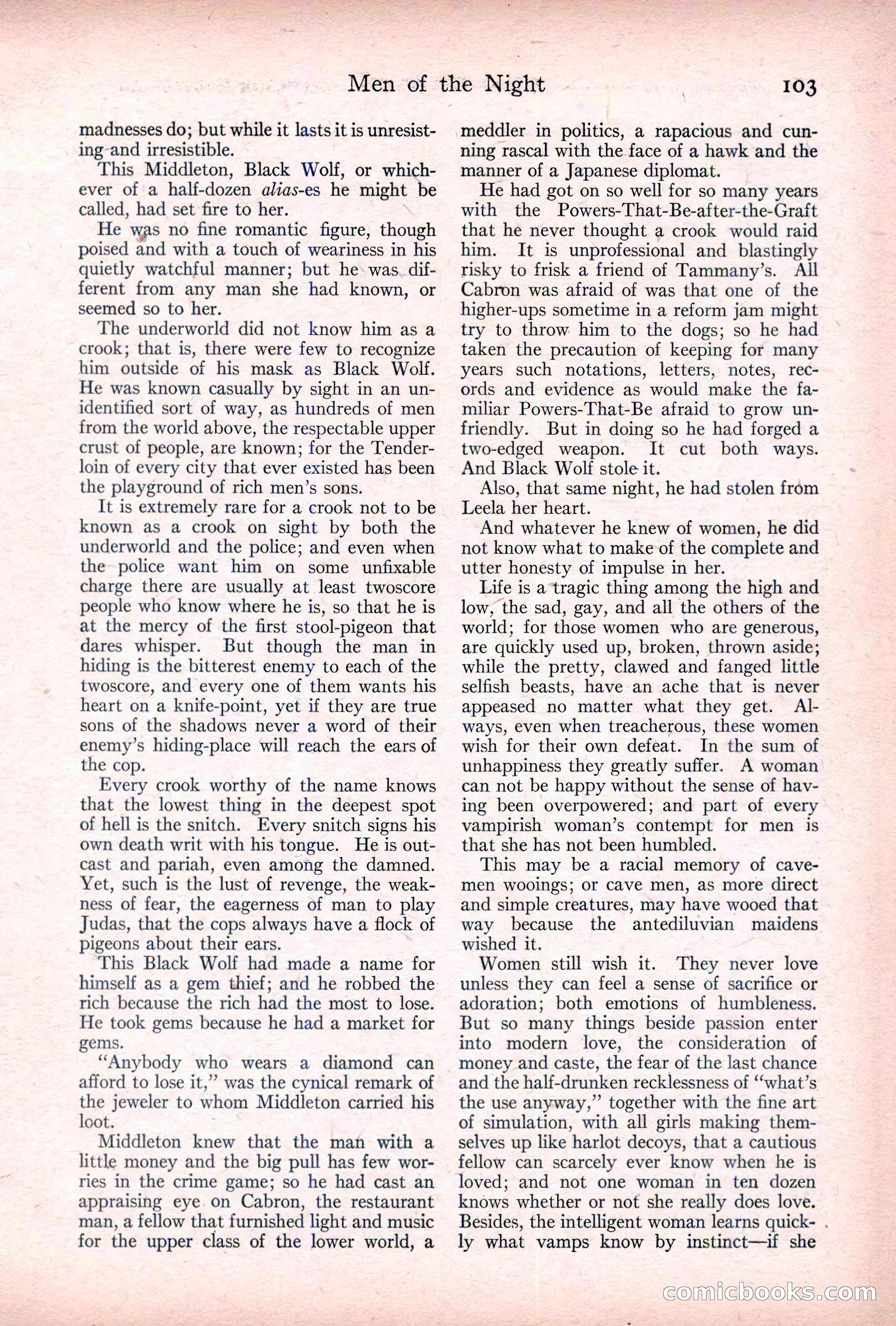
A restored page from Pulp Fiction, 1922. Page through the whole issue in the reader above.
📄 Transcribed text from this page (OCR, searchable)
Machine-transcribed from the original scan — historical spelling and the odd misread are preserved.
Men of the Night madnesses do; but while it lasts it is unresist- ing-and irresistible. This Middleton, Black Wolf, or which- ever of a half-dozen alias-es he might be called, had set fire to her. He was no fine romantic figure, though poised and with a touch of weariness in his quietly watchful manner; but he: was. dif- ferent from any man she had known, or seemed so to her. The underworld did not know him as a crook; that is, there were few to recognize him outside of his mask as Black Wolf. He was known casually by sight in an un- identified sort of way, as hundreds of men from the world above, the respectable upper crust of people, are known; for the Tender- loin of every city that ever existed has been the playground of rich men’s sons. It is extremely rare for a crook not to be known as a crook on sight by both the underworld and the police; and even when the police want him on some _ unfixable charge there are usually at least twoscore people who know where he is, so that he is at the mercy of the first stool-pigeon that dares whisper. But though the man in hiding is the bitterest enemy to each of the twoscore, and every one of them wants his heart on a knife-point, yet if they are true sons of the shadows never a word of their enemy’s hiding-place will reach the ears of the cop. Every crook worthy of the name knows that the lowest thing in the deepest spot of hell is the snitch. Every snitch signs his own death writ with his tongue. He is out- cast and pariah, even among the damned. Yet, such is the lust of revenge, the weak- ness of fear, the eagerness of man to play Judas, that the cops always have a flock of pigeons about their ears. This Black Wolf had made a name for himself as a gem thief; and he robbed the rich because the rich had the most to lose. He took gems because he had a market for gems. “Anybody who wears a diamond can afford to lose it,’’ was the cynical remark of the jeweler to whom Middleton carried his loot. Middleton knew that the man with a little money and the big pull has few wor- ries in the crime game; so he had cast an appraising eye on Cabron, the restaurant man, a fellow that furnished light and music for the upper class of the lower world, a 103 meddler in politics, a rapacious and cun- ning rascal with the face of a hawk and the manner of a Japanese diplomat. He had got on so well for so many years with the Powers-That-Be-after-the-Graft that he never thought a crook would raid him. It is unprofessional and _ blastingly risky to frisk a friend of Tammany’s. All Cabron was afraid of was that one of the higher-ups sometime in a reform jam might try to throw him to the dogs; so he had taken the precaution of keeping for many years such notations, letters, notes, rec- ords and evidence as would make the fa- miliar Powers-That-Be afraid to grow un- friendly. But in doing so he had forged a two-edged weapon. It cut both ways. And Black Wolf stole it. Also, that same night, he had stolen from Leela her heart. And whatever he knew of women, he did not know what to make-of the complete and utter honesty of impulse in her. Life is a tragic thing among the high and low, the sad, gay, and all the others of the world; for those women who are generous, are quickly used up, broken, thrown aside; while the pretty, clawed and fanged little selfish beasts, have an ache that is never appeased no matter what they get. Al- ways, even when treacherous, these women wish for their own defeat. In the sum of unhappiness they greatly suffer. A woman can not be happy without the sense of hav- ing been overpowered; and part of every vampirish woman’s contempt for men is that she has not been humbled. This may be a racial memory of cave- men wooings; or cave men, as more direct and simple creatures, may have wooed that way because the antediluvian maidens wished it. Women still wish it. They never love unless they can feel a sense of sacrifice or adoration; both emotions of humbleness. But so many things beside passion enter into modern love, the consideration of money and caste, the fear of the last chance and the half-drunken recklessness of ‘“‘what’s the use anyway,” together with the fine art of simulation, with all girls making them- selves up like harlot decoys, that a cautious fellow can scarcely ever know when he is loved; and not one woman in ten dozen knows whether or not she really does love. Besides, the intelligent woman learns quick- . ly what vamps know by instinct—if she Gomichbooks (C@