
Pulp Fiction, 1922 · page 110 of 196
Adventure, January 20, 1922 — page 110: what you’re looking at
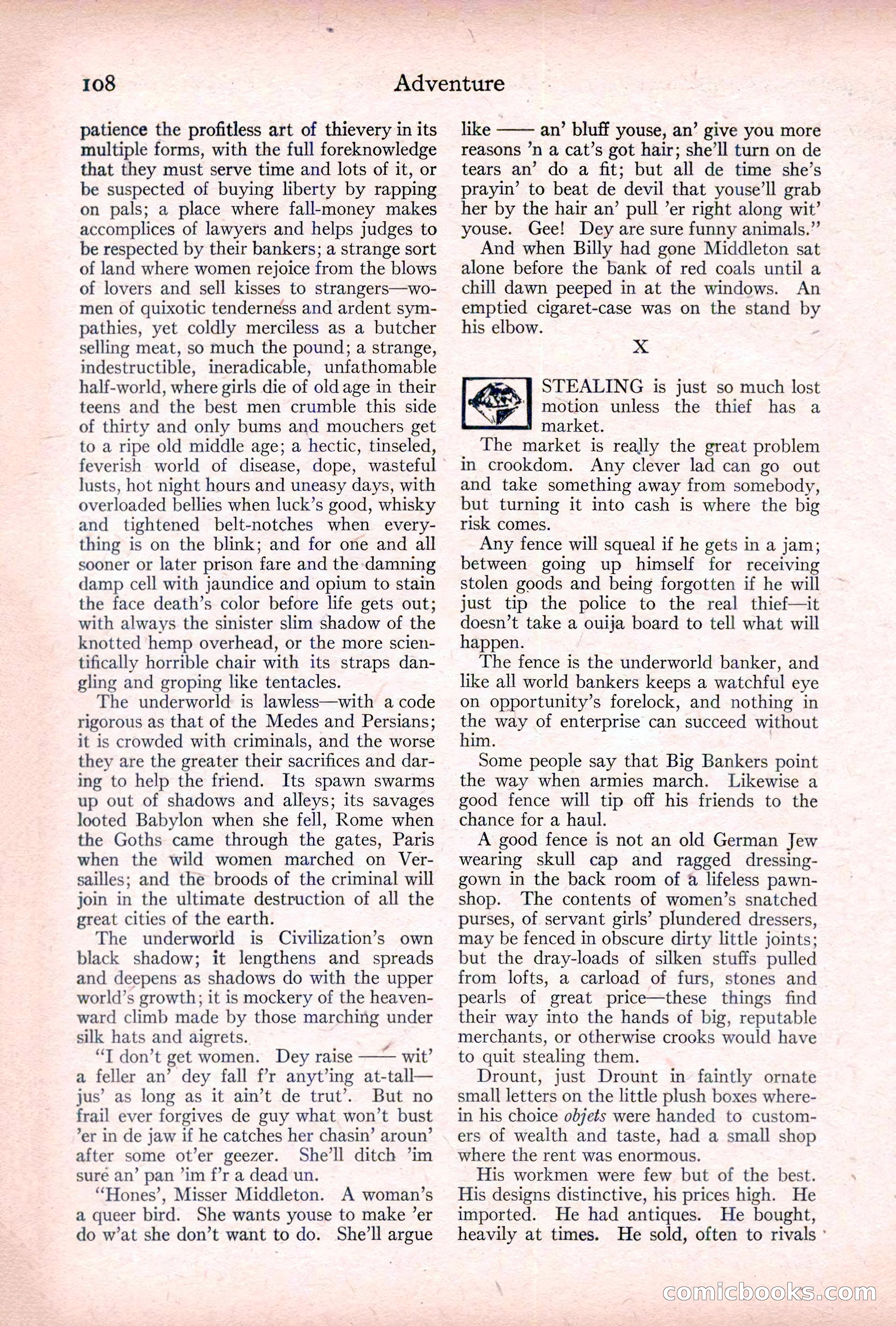
A restored page from Pulp Fiction, 1922. Page through the whole issue in the reader above.
📄 Transcribed text from this page (OCR, searchable)
Machine-transcribed from the original scan — historical spelling and the odd misread are preserved.
108 patience the profitless art of thievery in its multiple forms, with the full foreknowledge that they must serve time and lots of it, or be suspected of buying liberty by rapping on pals; a place where fall-money makes accomplices of lawyers and helps judges to be respected by their bankers; a strange sort of land where women rejoice from the blows of lovers and sell kisses to strangers—wo- men of quixotic tenderness and ardent sym- pathies, yet coldly merciless as a butcher selling meat, so much the pound; a strange, indestructible, ineradicable, unfathomable half-world, where girls die of old age in their teens and the best men crumble this side of thirty and only bums and mouchers get to a ripe old middle age; a hectic, tinseled, feverish world of disease, dope, wasteful lusts, hot night hours and uneasy days, with overloaded bellies when luck’s good, whisky and tightened belt-notches when every- thing is on the blink; and for one and all sooner or later prison fare and the damning damp cell with jaundice and opium to stain the face death’s color before life gets out; with always the sinister slim shadow of the knotted hemp overhead, or the more scien- tifically horrible chair with its straps dan- gling and groping like tentacles. The underworld is lawless—with a code rigorous as that of the Medes and Persians; it is crowded with criminals, and the worse they are the greater their sacrifices and dar- ing to help the friend. Its spawn swarms up out of shadows and alleys; its savages looted Babylon when she fell, Rome when the Goths came through the gates, Paris when the wild women marched on Ver- sailles; and the broods of the criminal will join in the ultimate destruction of all the great cities of the earth. The underworld is Civilization’s own black shadow; it lengthens and spreads and deepens as shadows do with the upper world’s growth; it is mockery of the heaven- ward climb made by those marching under silk hats and aigrets. “T don’t get women. Dey raise wit’ a feller an’ dey fall f’r anyt’ing at-tall— jus’ as long as it ain’t de trut’. But no frail ever forgives de guy what won’t bust ’er in de jaw if he catches her chasin’ aroun’ after some ot’er geezer. She'll ditch ’im sure an’ pan ’im f’r a dead un. “Hones’, Misser Middleton. A woman’s a queer bird. She wants youse to make ’er do w’at she don’t want to do. She’ll argue - Adventure like —— an’ bluff youse, an’ give you more reasons ’n a cat’s got hair; she’ll turn on de tears an’ do a fit; but all de time she’s prayin’ to beat de devil that youse’ll grab her by the hair an’ pull ’er right along wit’ youse. Gee! Dey are sure funny animals.” And when Billy had gone Middleton sat alone before the bank of red coals until a chill dawn peeped in at the windows. An emptied cigaret-case was on the stand by his elbow. motion unless the thief has a Se! market. The market is really the great problem in crookdom. Any clever lad can go out and take something away from somebody, but turning it into cash is where the big risk comes. Any fence will squeal if he gets in a jam; between going up himself for receiving stolen goods and being forgotten if he will just tip the police to the real thief—it doesn’t take a ouija board to tell what will happen. | The fence is the underworld banker, and like all world bankers keeps a watchful eye on opportunity’s forelock, and nothing in the way of enterprise can succeed without him. Some people say that Big Bankers point the way when armies march. Likewise a good fence will tip off his friends to the chance for a haul. A good fence is not an old German Jew wearing skull cap and ragged dressing- gown in the back room of a lifeless pawn- shop. The contents of women’s snatched purses, of servant girls’ plundered dressers, may be fenced in obscure dirty little joints; but the dray-loads of silken stuffs pulled from lofts, a carload of furs, stones and pearls of great price—these things find their way into the hands of big, reputable merchants, or otherwise crooks would have to quit stealing them. Drount, just Drount in faintly ornate small letters on the little plush boxes where- in his choice objets were handed to custom- ers of wealth and taste, had a small shop where the rent was enormous. His workmen were few but of the best. His designs distinctive, his prices high. He imported. He had antiques. He bought, heavily at times. x STEALING is just so much lost COnMICLOOOKS He sold, often to rivals ° (C@