
Pulp Fiction, 1922 · page 114 of 196
Adventure, January 20, 1922 — page 114: what you’re looking at
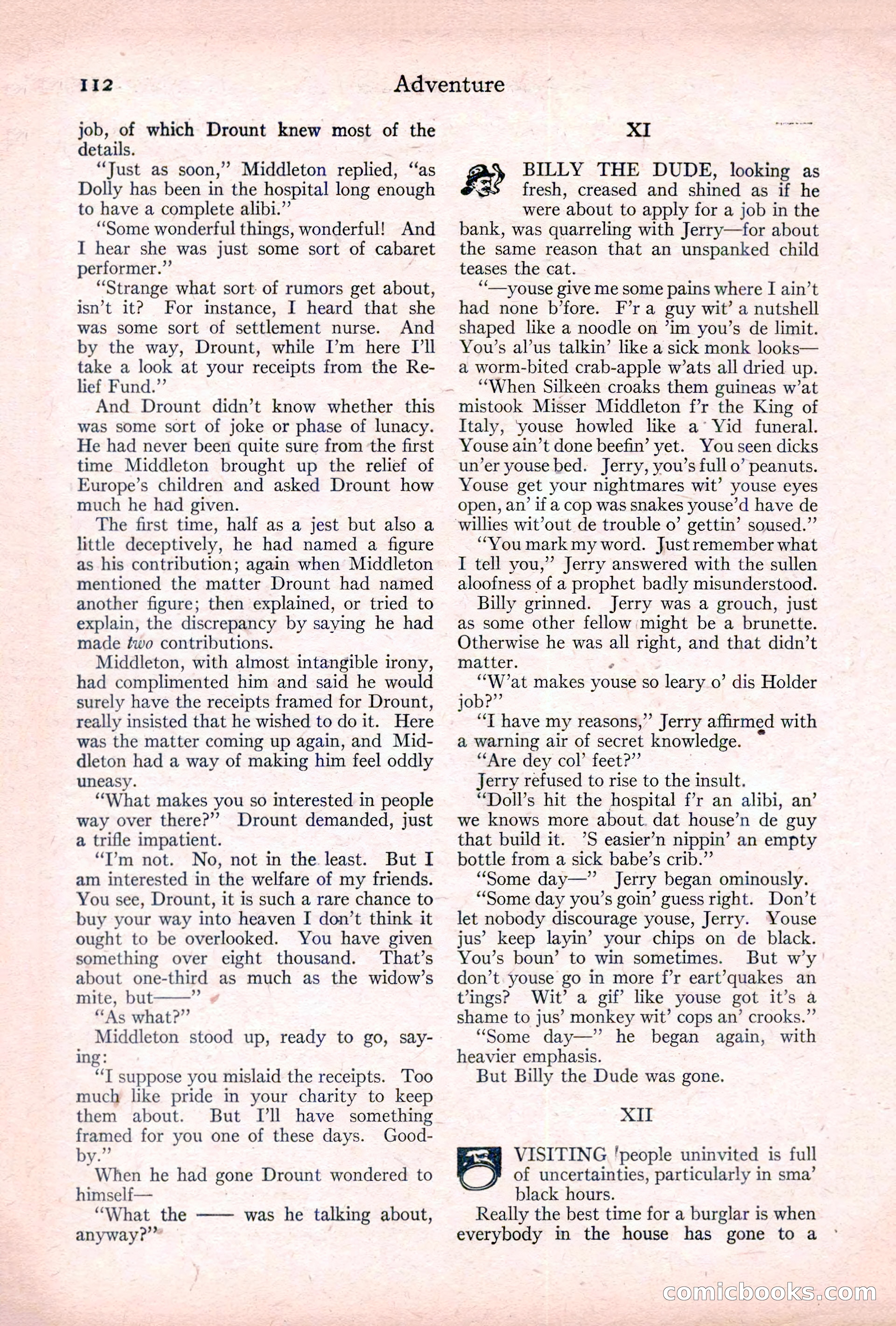
A restored page from Pulp Fiction, 1922. Page through the whole issue in the reader above.
📄 Transcribed text from this page (OCR, searchable)
Machine-transcribed from the original scan — historical spelling and the odd misread are preserved.
IIi2 job, of which Drount knew most of the details. “Just as soon,” Middleton replied, ‘ Dolly has been in the hospital long enough to have a complete alibi.” “Some wonderful things, wonderful! And I hear she was just some sort of cabaret performer.” “Strange what sort: of rumors get about, isn’t it? For instance, I heard that she was some sort of settlement nurse. And by the way, Drount, while I’m here I'll take a look at your receipts from the Re- lef Fund.” And Drount didn’t know whether this was some sort of joke or phase of lunacy. He had never been quite sure from the first time Middleton brought up the relief of Europe’s children and asked Drount how much he had given. The first time, half as a jest but also a little deceptively, he had named a figure as his contribution; again when Middleton mentioned the matter Drount had named another figure; then explained, or tried to explain, the discrepancy by saying he had made fwo contributions. Middleton, with almost intangible irony, had complimented him and said he would surely have the receipts framed for Drount, really insisted that he wished to do it. Here was the matter coming up again, and Mid- dleton had a way of making him feel oddly uneasy. “‘What makes you so interested in people way over there?” Drount demanded, just a trifle impatient. “T’m not. No, not in the least. But I am interested in the welfare of my friends. You see, Drount, it is such a rare chance to buy your way into heaven I don’t think it ought to be overlooked. You have given something over eight thousand. That’s about one-third as much as the widow’s mite, but - “As what?” Middleton stood up, ready to go, say- ing: “T suppose you mislaid the receipts. Too much like pride in your charity to keep them about. But [ll have something framed for you one of these days. Good- by.” When he had gone Drount wondered to himself— “What the —— was he talking about, anyway?” Adventure XI —-_—-—— BILLY THE DUDE, looking as fresh, creased and shined as if he were about to apply for a job in the bank, was quarreling with Jerry—for about the same reason that an unspanked child teases the cat. “_vouse give me some pains where I ain’t had none b’fore. F’ra guy wit’ a nutshell shaped like a noodle on *im you’s de limit. You’s al’us talkin’ like a sick monk looks— a worm-bited crab-apple w’ats all dried up. ‘When Silkeen croaks them guineas w’at mistook Misser Middleton f’r the King of Italy, ‘youse howled like a’ Yid funeral. Youse ain’t done beefin’ yet. You seen dicks un’er youse bed. Jerry, you’s fullo’ peanuts. Youse get your nightmares wit’ youse eyes open, an’ if a cop was snakes youse’d have de willies wit’out de trouble o’ gettin’ soused.” “You mark my word. Just remember what I tell you,” Jerry answered with the sullen aloofness of a prophet badly misunderstood. Billy grinned. Jerry was a grouch, just as some other fellow might be a brunette. Otherwise he was all right, and that didn’t matter. “W’at makes vais so leary o’ dis Holder jobe”’ “T have my reasons,” Jerry affirmed with a warning air of secret knowledge. “Are dey col’ feet?” Jerry refused to rise to the insult. “Doll’s hit the hospital f’r an alibi, an’ we knows more about. dat house’n de guy that build it. ’S easier’n nippin’ an empty bottle from a sick babe’s crib.” , “Some day—” Jerry began ominously. “Some day you’s goin’ guess right. Don’t let nobody discourage youse, Jerry. Youse jus’ keep layin’ your chips on de black. You’s boun’ to win sometimes. But w’y don’t youse go in more f’r eart’quakes an tings? Wit’ a gif’ like youse got it’s a shame to jus’ monkey wit’ cops an’ crooks.”’ “Some day—” he began again, with heavier emphasis. XII But Billy the Dude was gone. m= VISITING 'people uninvited is full of uncertainties, particularly in sma’ black hours. ee the best time for a burglar is when everybody in the house has gone to a COMNICOOOLKS. (C@