
Pulp Fiction, 1922 · page 135 of 196
Adventure, January 20, 1922 — page 135: what you’re looking at
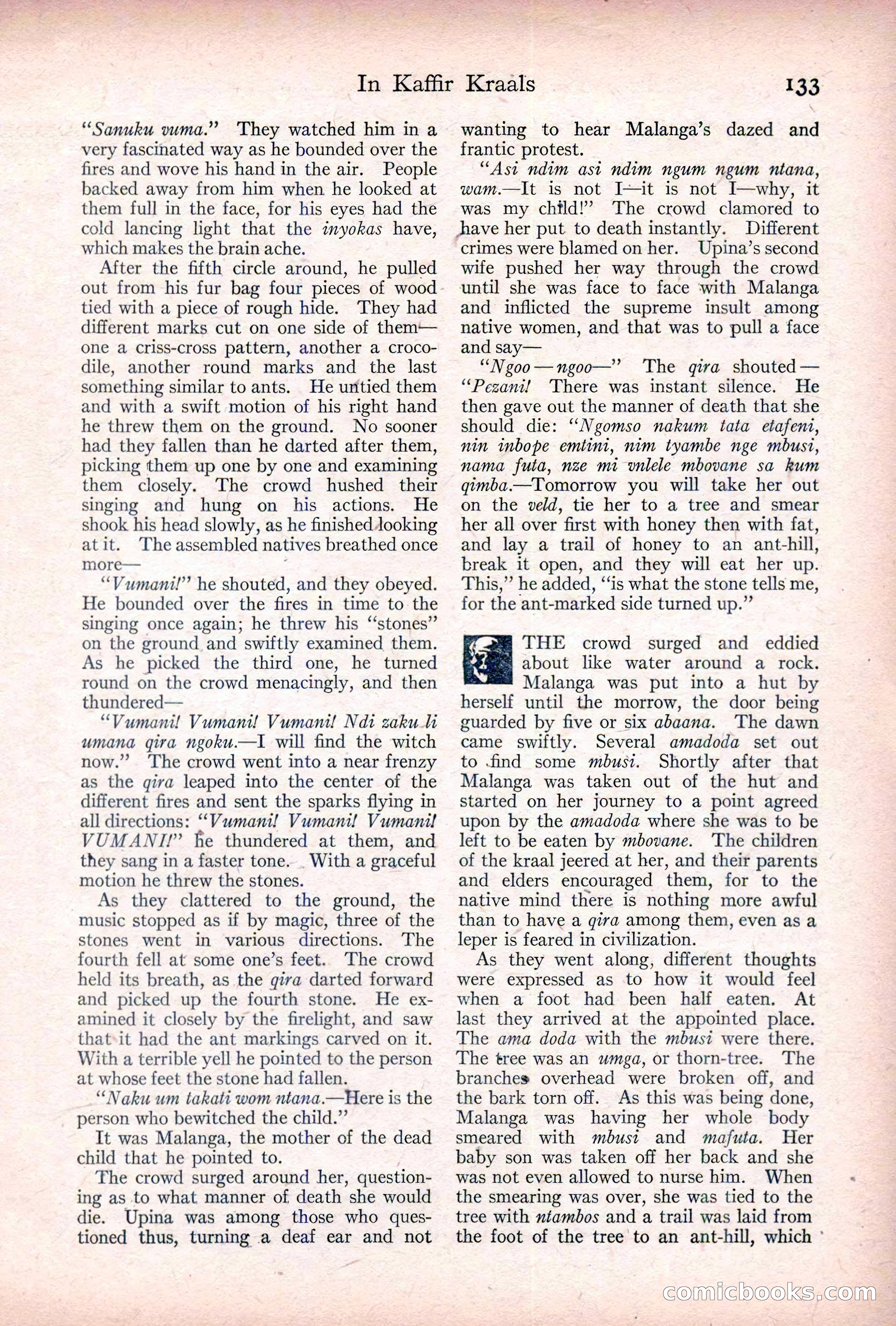
A restored page from Pulp Fiction, 1922. Page through the whole issue in the reader above.
📄 Transcribed text from this page (OCR, searchable)
Machine-transcribed from the original scan — historical spelling and the odd misread are preserved.
In Kaffir Kraals “Sanuku vuma.” They watched him in a very fascinated way as he bounded over the fires and wove his hand in the air. People backed away from him when he looked at them full in the face, for his eyes had the cold lancing light that the inyokas have, which makes the brain ache. After the fifth circle around, he pulled out from his fur bag four pieces of wood. tied with a piece of rough hide. They had different marks cut on one side of them— one a criss-cross pattern, another a croco- dile, another round marks and the last something similar to ants. He untied them and with a swift motion of his right hand he threw them on the ground. No sooner had they fallen than he darted after them, picking them up one by one and examining them closely. The crowd hushed their singing and hung on his actions. He shook his head slowly, as he finished looking atit. The assembled natives breathed once more— “Vumanil’’ he shouted, and they obeyed. He bounded over the fires in time to the singing once again; he threw his ‘‘stones” on the ground and swiftly examined them. As he picked the third one, he turned round on the crowd menacingly, and then thundered— “Vumanil Vumanil Vumant Ndi zaku lh umana gira ngoku.—I will find the witch now.” ‘The crowd went into a near frenzy as the gira leaped into the center of the different fires and sent the sparks flying in all directions: “Vumant! Vumanil Vumanil VUMANI?!’ he thundered at them, and they sang in a faster tone. . With a graceful motion he threw the stones. As they clattered to the ground, the music stopped as if by magic, three of the stones went in various directions. The fourth fell at some one’s feet. The crowd held its breath, as the gira darted forward and picked up the fourth stone. He ex- amined it closely by the firelight, and saw that-it had the ant markings carved on it. With a terrible yell he pointed to the person at whose feet the stone had fallen. “Naku um takati wom ntana.—Here is the person who bewitched the child.” It was Malanga, the mother of the dead child that he pointed to. The crowd surged around her, question- ing as to what manner of death she would die. Upina was among those who ques- tioned thus, turning a deaf ear and not 133 wanting to hear Malanga’s dazed and frantic protest. “Ast ndim ast ndim ngum ngum ntana, wam.—It is not I~—it is not I—why, it was my child!’ The crowd clamored to have her put to death instantly. Different crimes were blamed on her. Upina’s second wife pushed her way through the crowd until she was face to face with Malanga and inflicted the supreme insult among native women, and that was to pull a face and say— ‘“Ngoo—ngoo—’ The gira shouted — “Pezani! There was instant silence. He then gave out the manner of death that she should die: ‘“Ngomso nakum tata etafent, nin inbope emtim, nim tyambe nge mbust, nama futa, nze mi vnlele mbovane sa kum gimba.—Tomorrow you will take her out on the veld, tie her to a tree and smear her all over first with honey then with fat, and lay a trail of honey to an ant-hill, break it open, and they will eat her up. This,” he added, “‘is what the stone tells me, for the ant-marked side turned up.” = about like water around a rock. Ny Malanga was put into a hut by herself until the morrow, the door being guarded by five or six abaana. The dawn came swiftly. Several amadoda set out to find some mbusi. Shortly after that Malanga was taken out of the hut and started on her journey to a point agreed upon by the amadoda where she was to be left to be eaten by mbovane. ‘The children of the kraal jeered at her, and their parents and elders encouraged them, for to the native mind there is nothing more awful than to have a gira among them, even as a leper is feared in civilization. As they went along, different thoughts were expressed as to how it would feel when a foot had been half eaten. At last they arrived at the appointed place. The ama doda with the mbusi were there. The tree was an umga, or thorn-tree. The branches overhead were broken off, and the bark torn off. As this was being done, Malanga was having her whole body smeared with mbust and mafuta. Her baby son was taken off her back and she was not even allowed to nurse him. When the smearing was over, she was tied to the tree with niambos and a trail was laid from ) THE crowd surged and eddied the foot of the tree to an ant-hill, which ° COmicloooks (C@