
Pulp Fiction, 1922 · page 145 of 196
Adventure, January 20, 1922 — page 145: what you’re looking at
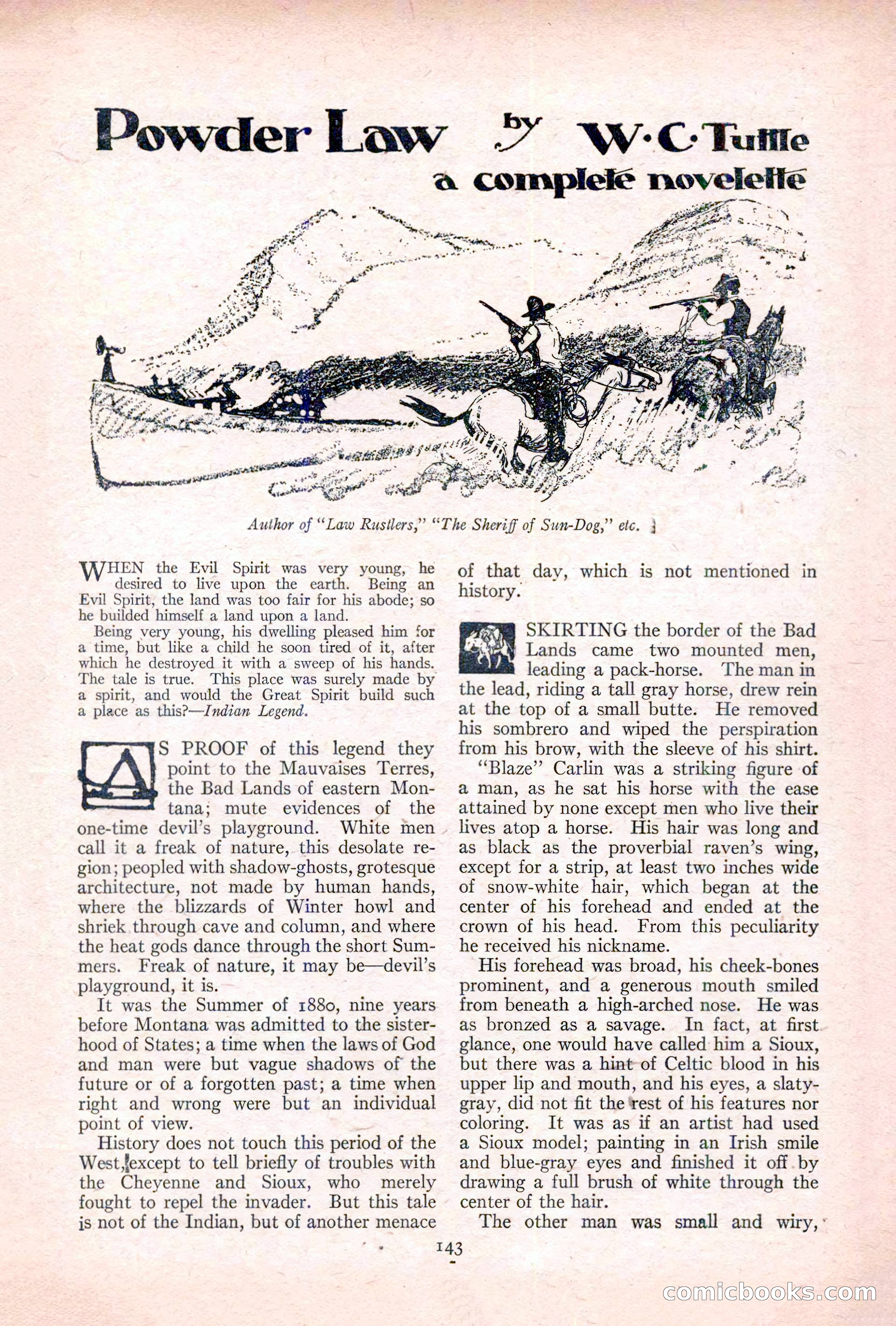
A restored page from Pulp Fiction, 1922. Page through the whole issue in the reader above.
📄 Transcribed text from this page (OCR, searchable)
Machine-transcribed from the original scan — historical spelling and the odd misread are preserved.
Powder Law a compleice movelete Coke ail coe - WW-C Tattle a > em + ~ 4 Gs s asst Pe ae ¥ Ri Wee Pant ae" Khe LS SGT Author of “Law Rusilers,” “The Sheriff of Sun-Dog,” etc. 3 HEN the Evil Spirit was very young, he desired to live upon the earth. Being an Evil Spirit, the land was too fair for his abode; so he builded himself a land upon a land. Being very young, his dwelling pleased him for a time, but like a child he soon tired of it, after which he destroyed it with a sweep of his hands. The tale is true. a spirit, and would the Great Spirit build such a place as thisP—IJndian Legend. S PROOF of this legend they point to the Mauvaises Terres, the Bad Lands of eastern Mon- tana; mute evidences of the one-time devil’s playground. White men call it a freak of nature, this desolate re- gion; peopled with shadow-ghosts, grotesque architecture, not made by human hands, where the blizzards of Winter howl and shriek through cave and column, and where the heat gods dance through the short Sum- mers. Freak of nature, it may be—devil’s playground, it is. It was the Summer of 1880, nine years before Montana was admitted to the sister- hood of States; a time when the laws of God and man were but vague shadows of the future or of a forgotten past; a time when right and wrong were but an individual point of view. Eistery does not touch this period of the West,fexcept to tell briefly of troubles with the Cheyenne and Sioux, who merely fought to repel the invader. But this tale is not of the Indian, but of another menace This place was surely made by of that day, which is not mentioned history. SKIRTING the border of the Bad ~y Lands came two mounted men, leading a pack-horse. The man in the lead, riding a tall gray horse, drew rein at the top of a small butte. He removed his sombrero and wiped the perspiration from his brow, with the sleeve of his shirt. “Blaze” Carlin was a striking figure of a man, as he sat his horse with the ease attained by none except men who live their lives atop a horse. His hair was long and as black as the proverbial raven’s wing, except for a strip, at least two inches wide of snow-white hair, which began at the center of his forehead and ended at the crown of his head. From this peculiarity he received his nickname. His forehead was broad, his cheek-bones prominent, and a generous mouth smiled from beneath a high-arched nose. He was as bronzed as a savage. In fact, at first glance, one would have called him a Sioux, but there was a hint of Celtic blood in his upper lip and mouth, and his eyes, a slaty- gray, did not fit the rest of his features nor coloring. It was as if an artist had used a Sioux model; painting in an Irish smile and blue-gray eyes and finished it off. by drawing a full brush of white through the center of the hair. The other man was small and wiry,’ 143 CORMICLOO S (C@