
Pulp Fiction, 1922 · page 156 of 196
Adventure, January 20, 1922 — page 156: what you’re looking at
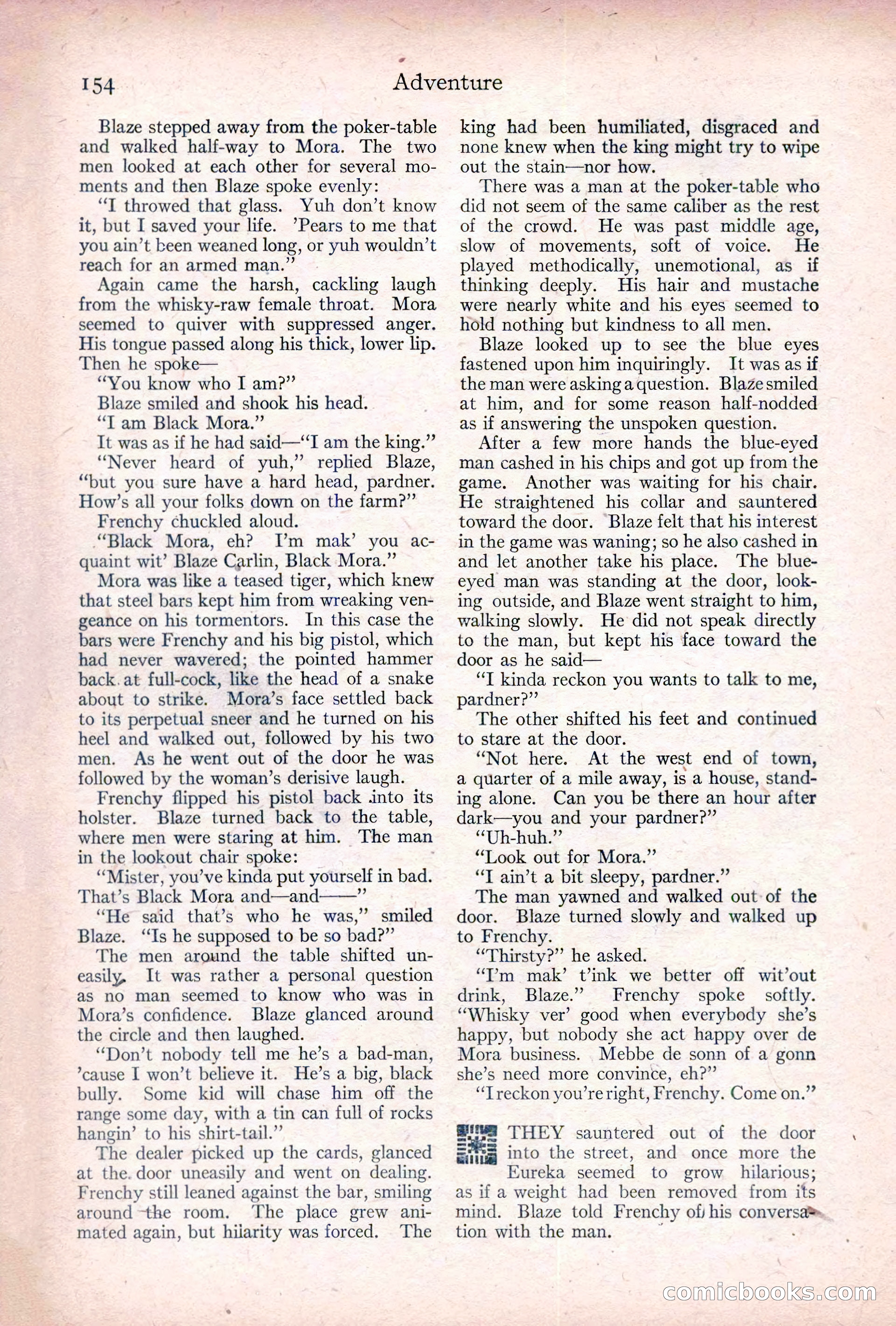
A restored page from Pulp Fiction, 1922. Page through the whole issue in the reader above.
📄 Transcribed text from this page (OCR, searchable)
Machine-transcribed from the original scan — historical spelling and the odd misread are preserved.
g 154 Blaze stepped away from the poker-table and walked half-way to Mora. The two men looked at each other for several mo- ments and then Blaze spoke evenly: “T throwed that glass. Yuh don’t know it, but I saved your life. ’Pears to me that you ain’t keen weaned long, or yuh wouldn’t reach for an armed man.”’ Again came the harsh, cackling laugh from the whisky-raw female throat. Mora - seemed to quiver with suppressed anger. His tongue passed along his thick, lower lip. Then he spoke— “You know who I am?” Blaze smiled and shook his head. “T am Black Mora.” It was as if he had said—“‘T am the king.” “Never heard of yuh,” replied Blaze, “but you sure have a hard head, pardner. How’s all your folks down on the farm?” Frenchy chuckled aloud. “Black Mora, eh? I’m mak’ you ac- quaint wit’ Blaze Carlin, Black Mora.” Mora was like a teased tiger, which knew that steel bars kept him from wreaking ven- geance on his tormentors. In this case the bars were Frenchy and his big pistol, which had never wavered; the pointed hammer back. at full-cock, like the head of a snake about to strike. Mora’s face settled back to its perpetual sneer and he turned on his heel and walked out, followed by his two men. As he went out of the door he was followed by the woman’s derisive laugh. Frenchy flipped his pistol back into its holster. Blaze turned back to the table, where men were staring at him. The man in the lookout chair spoke: “Mister, you’ve kinda put yourself in bad. That’s Black Mora and—and “He said that’s who he was,” smiled Blaze. “Is he supposed to be so bad?” The men around the table shifted un- easily. It was rather a personal question as no man seemed to know who was in Mora’s confidence. Blaze glanced around the circle and then laughed. “Don’t nobody tell me he’s a bad-man, ‘cause I won’t believe it. He’s a big, black bully. Some kid will chase him off the range some day, with a tin can full of rocks hangin’ to his shirt-tail.”’ The dealer picked up the cards, glanced at the. door uneasily and went on dealing. Frenchy still leaned against the bar, smiling around the room. ‘The place grew ani- mated again, but hiiarity was forced. The Adventure king had been humiliated, disgraced and none knew when the king might try to wipe out the stain—nor how. There was a man at the poker-table who did not seem of the same caliber as the rest of the crowd. He was past middle age, slow of movements, soft of voice. He played methodically, unemotional, as if thinking deeply. His hair and mustache were nearly white and his eyes seemed to hold nothing but kindness to all men. Blaze looked up to see the blue eyes fastened upon him inquiringly. It was as if the man were asking a question. Blazesmiled at him, and for some reason half-nodded as if answering the unspoken question. After a few more hands the blue-eyed man cashed in his chips and got up from the game. Another was waiting for his chair. He straightened his collar and sauntered toward the door. Blaze felt that his interest in the game was waning; so he also cashed in and let another take his place. The blue- eyed man was standing at the door, look- ing outside, and Blaze went straight to him, walking slowly. He did not speak directly to the man, but kept his face toward the door as he said— “T kinda reckon you wants to talk to me, pardner?”’ The other shifted his feet and continued to stare at the door. ‘Not here. At the west end of town, a quarter of a mile away, is a house, stand- ing alone. Can you be there an hour after dark—you and your pardner?” “Tih-huk”’ “Look out for Mora.” “T ain’t a bit sleepy, pardner.” The man yawned and walked out of the door. Blaze turned slowly and walked up to Frenchy. “Thirsty?” he asked. “Tm mak’ t’ink we better off wit’out drink, Blaze.” Frenchy spoke softly. “Whisky ver’ good when everybody she’s happy, but nobody she act happy over de Mora business. Mebbe de sonn of a gonn she’s need more convince, eh?” “Treckon you’reright, Frenchy. Come on.” eure THEY sauntered out of the door Siu into the street, and once more the Eureka seemed to grow hilarious; as if a weight had been removed from ifs mind. Blaze told Frenchy of) his conversa® tion with the man. Go NOOK = a (C@