
Pulp Fiction, 1922 · page 181 of 196
Adventure, January 20, 1922 — page 181: what you’re looking at
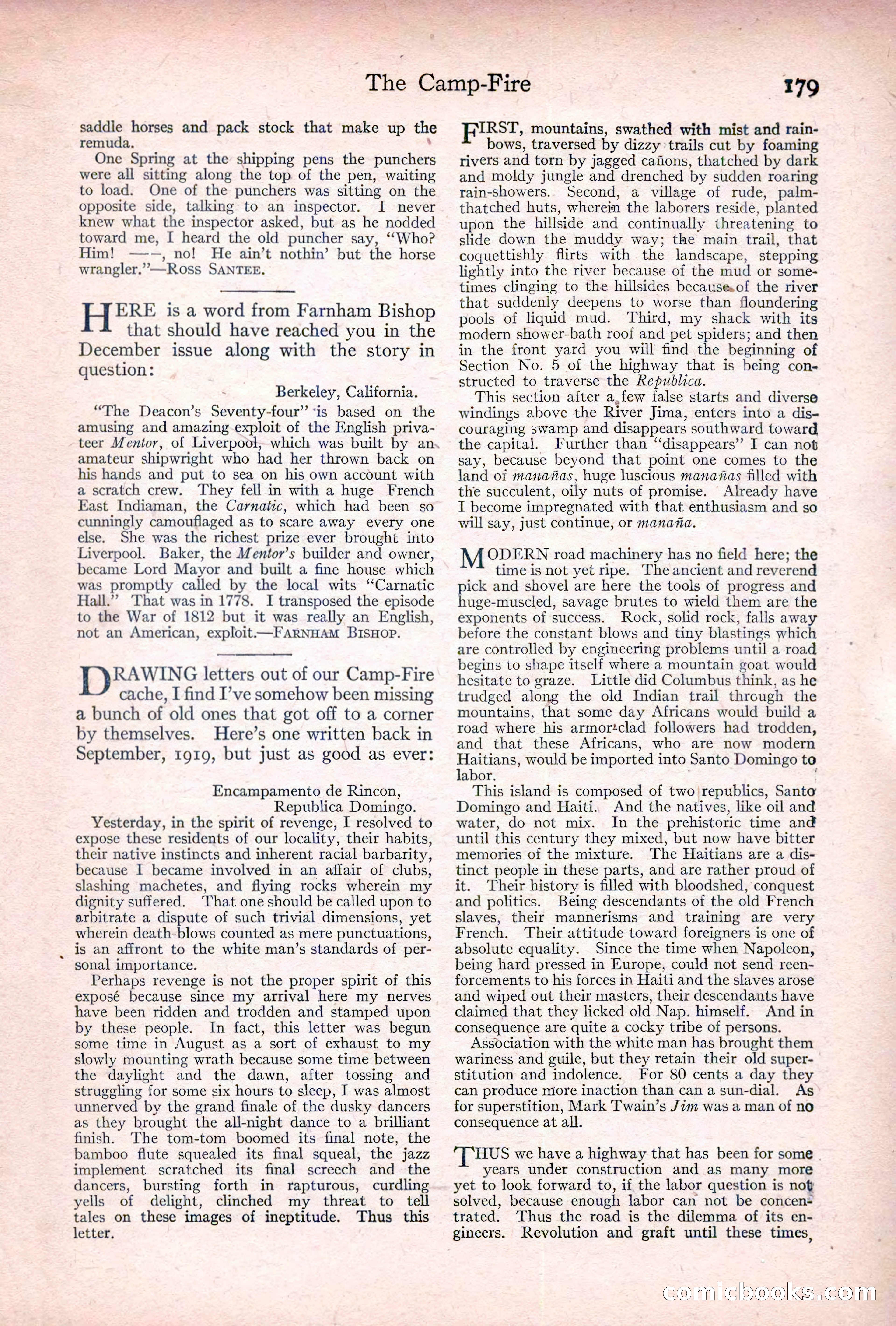
A restored page from Pulp Fiction, 1922. Page through the whole issue in the reader above.
📄 Transcribed text from this page (OCR, searchable)
Machine-transcribed from the original scan — historical spelling and the odd misread are preserved.
The Camp-Fire saddle horses and pack stock that make up the remuda. One Spring at the shipping pens the peandikes were all sitting along the top of the pen, waiting to load. One of the punchers was sitting on the opposite side, talking to an inspector. I never knew what the inspector asked, but as he nodded toward me, I heard the old puncher say, ““Who? Him! ———, no! He ain’t nothin’ but the horse wrangler.””—Ross SANTEE. PERE is a word from Farnham Bishop that should have reached you in the December issue along with the story in question: Berkeley, California. “The Deacon’s Seventy-four’ ‘is based on the amusing and amazing exploit of the English priva- teer Mentor, of Liverpool, which was built by an. amateur shipwright who had her thrown back on his hands and put to sea on his own account with a scratch crew. They fell in with a huge French East Indiaman, the Carnatic, which had been so cunningly camouflaged as to scare away every one else. She was the richest prize ever brought into Liverpool. Baker, the Mentor’s builder and owner, became Lord Mayor and built a fine house which was promptly called by the local wits ‘Carnatic Hall.” That was in 1778. I transposed the episode to the War of 1812 but it was really an English, not an American, exploit—FARNHAM BISHOP. 1 pRAWING letters out of our Camp-Fire cache, I find I’ve somehow been missing a bunch of old ones that got off to a corner by themselves. Here’s one written back in September, 1919, but just as good as ever: Encampamento de Rincon, Republica Domingo. Yesterday, in the spirit of revenge, I resolved to expose these residents of our locality, their habits, their native instincts and inherent racial barbarity, because I became involved in an affair of clubs, slashing machetes, and flying rocks wherein my dignity suffered. That one should be called upon to arbitrate a dispute of such trivial dimensions, yet wherein death-blows counted as mere punctuations, is an affront to the white man’s standards of per- sonal importance. Perhaps revenge is not the proper spirit of this exposé because since my arrival here my nerves have been ridden and trodden and stamped upon by these people. In fact, this letter was begun some time in August as a sort of exhaust to my slowly mounting wrath because some time between the daylight and the dawn, after tossing and struggling for some six hours to sleep, I was almost unnerved by the grand finale of the dusky dancers as they hrought the all-night dance to a brilliant finish. The tom-tom boomed its final note, the bamboo flute squealed its final squeal, the jazz implement scratched its final screech and the dancers, bursting forth in rapturous, curdling yells of delight, clinched my threat to tell tales on these images of ineptitude. Thus this letter. 179 FIRST, mountains, swathed with mist and rain- bows, traversed by dizzy trails cut by foaming rivers and torn by jagged cafions, thatched by dark and moldy jungle and drenched by sudden roaring rain-showers. Second, a village of rude, palm- thatched huts, wherein the laborers reside, planted upon the hillside and continually threatening to slide down the muddy way; the main trail, that coquettishly flirts with the landscape, stepping lightly into the river because of the mud or some- times clinging to the hillsides because.of the river that suddenly deepens to worse than floundering pools of liquid mud. Third, my shack with its modern shower-bath roof and pet spiders; and then in the front yard you will find the beginning of Section No. 5 of the highway that is being con- structed to traverse the Republica. This section after a,few false starts and diverse windings above the River Jima, enters into a dis- couraging swamp and disappears southward toward the capital. Further than “disappears’’ I can not say, because beyond that point one comes to the land of manavas, huge luscious mananas filled with the succulent, oily nuts of promise. Already have I become impregnated with that enthusiasm and so will say, just continue, or manana. MODERN road machinery has no field here; the time is not yet ripe. The ancient and reverend pick and shovel are here the tools of progress and huge-muscled, savage brutes to wield them are the exponents of success. Rock, solid rock, falls away before the constant blows and tiny blastings which are controlled by engineering problems until a road begins to shape itself where a mountain goat would hesitate to graze. Little did Columbus think, as he trudged along the old Indian trail through the mountains, that some day Africans would build a road where his armortclad followers had trodden, and that these Africans, who are now modern Hage would be imported into Santo Domingo to abor This island is composed of two republics, Santo Domingo and Haiti. And the natives, like oil and water, do not mix. In the prehistoric time and until this century they mixed, but now have bitter memories of the mixture. The Haitians are a dis- tinct people in these parts, and are rather proud of it. Their history is filled with bloodshed, conquest and politics. Being descendants of the old French slaves, their mannerisms and training are very French. Their attitude toward foreigners is one of absolute equality. Since the time when Napoleon, being hard pressed in Europe, could not send reen- forcements to his forces in Haiti and the slaves arose and wiped out their masters, their descendants have claimed that they licked old Nap. himself. And in consequence are quite a cocky tribe of persons. Association with the white man has brought them wariness and guile, but they retain their old super- stitution and indolence. For 80 cents a day they can produce more inaction than can a sun-dial. As for superstition, Mark Twain’s Jim was a man of no consequence at all. HUS we have a highway that has been for some - years under construction and as many more yet to look forward to, if the labor question is not solved, because enough labor can not be concen- trated. Thus the road is the dilemma of its en- gineers. Revolution and graft until these times, COnmmiclbooks (C@