
Pulp Fiction, 1922 · page 185 of 196
Adventure, January 20, 1922 — page 185: what you’re looking at
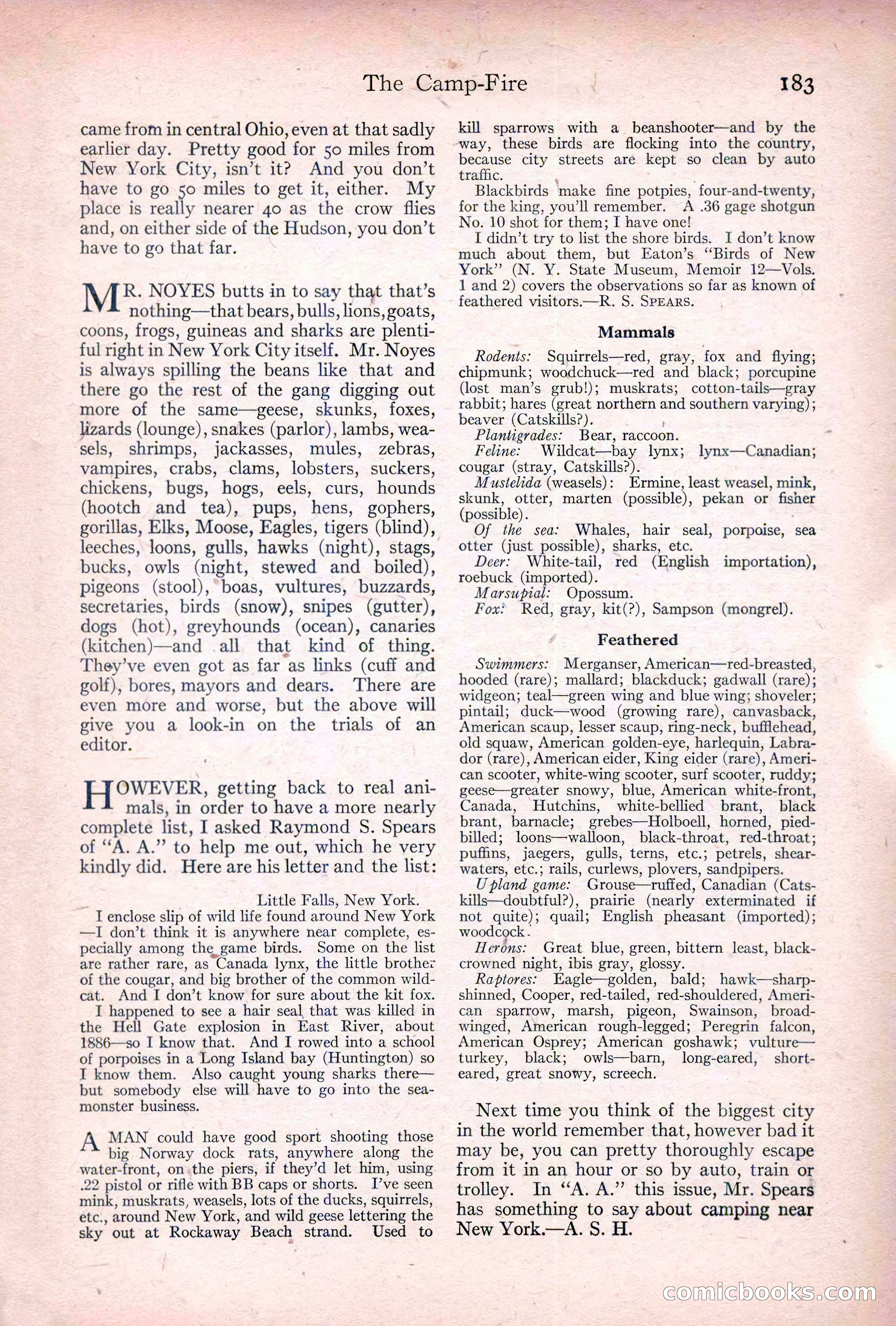
A restored page from Pulp Fiction, 1922. Page through the whole issue in the reader above.
📄 Transcribed text from this page (OCR, searchable)
Machine-transcribed from the original scan — historical spelling and the odd misread are preserved.
The Camp-Fire came from in central Ohio, even at that sadly earlier day. Pretty good for 50 miles from New York City, isn’t it? And you don’t have to go 50 miles to get it, either. My place is really nearer 40 as the crow flies and, on either side of the Hudson, you don’t have to go that far. R. NOYES butts in to say that that’s nothing—that bears, bulls, lions, goats, coons, frogs, guineas and sharks are plenti- ful right in New York City itself. Mr. Noyes is always spilling the beans like that and there go the rest of the gang digging out more of the same—geese, skunks, foxes, lizards (lounge), snakes (parlor), lambs, wea- sels, shrimps, jackasses, mules, zebras, vampires, crabs, clams, lobsters, suckers, chickens, bugs, hogs, eels, curs, hounds (hootch and tea), pups, hens, gophers, gorillas, Elks, Moose, Eagles, tigers (blind), leeches, loons, gulls, hawks (night), stags, bucks, owls (night, stewed and boiled), pigeons (stool), boas, vultures, buzzards, secretaries, birds (snow), snipes (gutter), dogs (hot), greyhounds (ocean), canaries (kitchen)—and .all that kind of thing. They’ve even got as far as links (cuff and golf), bores, mayors and dears. ‘There are even more and worse, but the above will give you a look-in on the trials of an editor. OWEVER, getting back to real ani- mals, in order to have a more nearly complete list, I asked Raymond S. Spears of “A. A.”’ to help me out, which he very kindly did. Here are his letter and the list: Little Falls, New York. T enclose slip of wild life found around New York —I don’t think it is anywhere near complete, es- pecially among the game birds. Some on the list are rather rare, as Canada lynx, the little brother of the cougar, and big brother of the common wild- cat. And I don’t know for sure about the kit fox. I happened to see a hair seal that was killed in the Hell Gate explosion in East River, about 1886—so I know that. And I rowed into a school of porpoises in a Long Island bay (Huntington) so I know them. Also caught young sharks there— but somebody else will have to go into the sea- monster business. A MAN could have good sport shooting those big Norway dock rats, anywhere along the water-front, on the piers, if they’d let him, using .22 pistol or rifle with BB caps or shorts. I’ve seen mink, muskrats, weasels, lots of the ducks, squirrels, etc., around New York, and wild geese lettering the sky out at Rockaway Beach strand. Used to 183 kill sparrows with a beanshooter—and by the way, these birds are flocking into the country, because city streets are kept so clean by auto traffic. ‘ : Blackbirds make fine potpies, four-and-twenty, for the king, you’ll remember. <A .36 gage shotgun No. 10 shot for them; I have one! I didn’t try to list the shore birds. I don’t know much about them, but Eaton’s “Birds of New York” (N. Y. State Museum, Memoir 12—Vols. 1 and 2) covers the observations so far as known of feathered visitors.—R. S. SPEARS. Mammals Rodents: Squirrels—red, gray, fox and flying; chipmunk; woodchuck—red and black; porcupine (lost man’s grub!); muskrats; cotton-tails—gray rabbit; hares (great northern and southern varying); beaver (Catskills?). Plantigrades: Bear, raccoon. Feline: Wildcat—bay lynx; cougar (stray, Catskills?). Mustelida (weasels): Ermine, least weasel, mink, skunk, otter, marten (possible), pekan or fisher (possible). Of the sea: Whales, hair seal, porpoise, sea otter (just possible), sharks, etc. Deer: White-tail, red (English importation), roebuck (imported). Marsupial: Opossum. Fox: Red, gray, kit(?), Sampson (mongrel). Feathered Swimmers: Merganser, American—red-breasted, hooded (rare); mallard; blackduck; gadwall (rare); widgeon; teal—green wing and blue wing; shoveler; pintail; duck—wood (growing rare), canvasback, American scaup, lesser scaup, ring-neck, bufflehead, old squaw, American golden-eye, harlequin, Labra- dor (rare), American eider, King eider (rare), Ameri- can scooter, white-wing scooter, surf scooter, ruddy; geese—greater snowy, blue, American white-front, Canada, Hutchins, white-bellied brant, black brant, barnacle; grebes—Holboell, horned, pied- billed; loons—walloon, black-throat, red-throat; puffins, jaegers, gulls, terns, etc.; petrels, shear- waters, etc.; rails, curlews, plovers, sandpipers. Upland game: Grouse—ruffed, Canadian (Cats- kills—doubtful?), prairie (nearly exterminated if not quite); quail; English pheasant (imported); woodcock - Herons: Great blue, green, bittern least, black- crowned night, ibis gray, glossy. Raptores: Eagle—golden, bald; hawk—sharp- shinned, Cooper, red-tailed, red-shouldered, Ameri- can sparrow, marsh, pigeon, Swainson, broad- winged, American rough-legged; Peregrin falcon, American Osprey; American goshawk; vulture— turkey, black; owls—barn, long-eared, short- eared, great snowy, screech. lynx—Canadian; Next time you think of the biggest city in the world remember that, however bad it may be, you can pretty thoroughly escape from it in an hour or so by auto, train or trolley. In “A. A.” this issue, Mr. Spears has something to say about camping near New York.—A. S. H. CORNICLOOO© (E@