
Pulp Fiction, 1922 · page 192 of 196
Adventure, January 20, 1922 — page 192: what you’re looking at
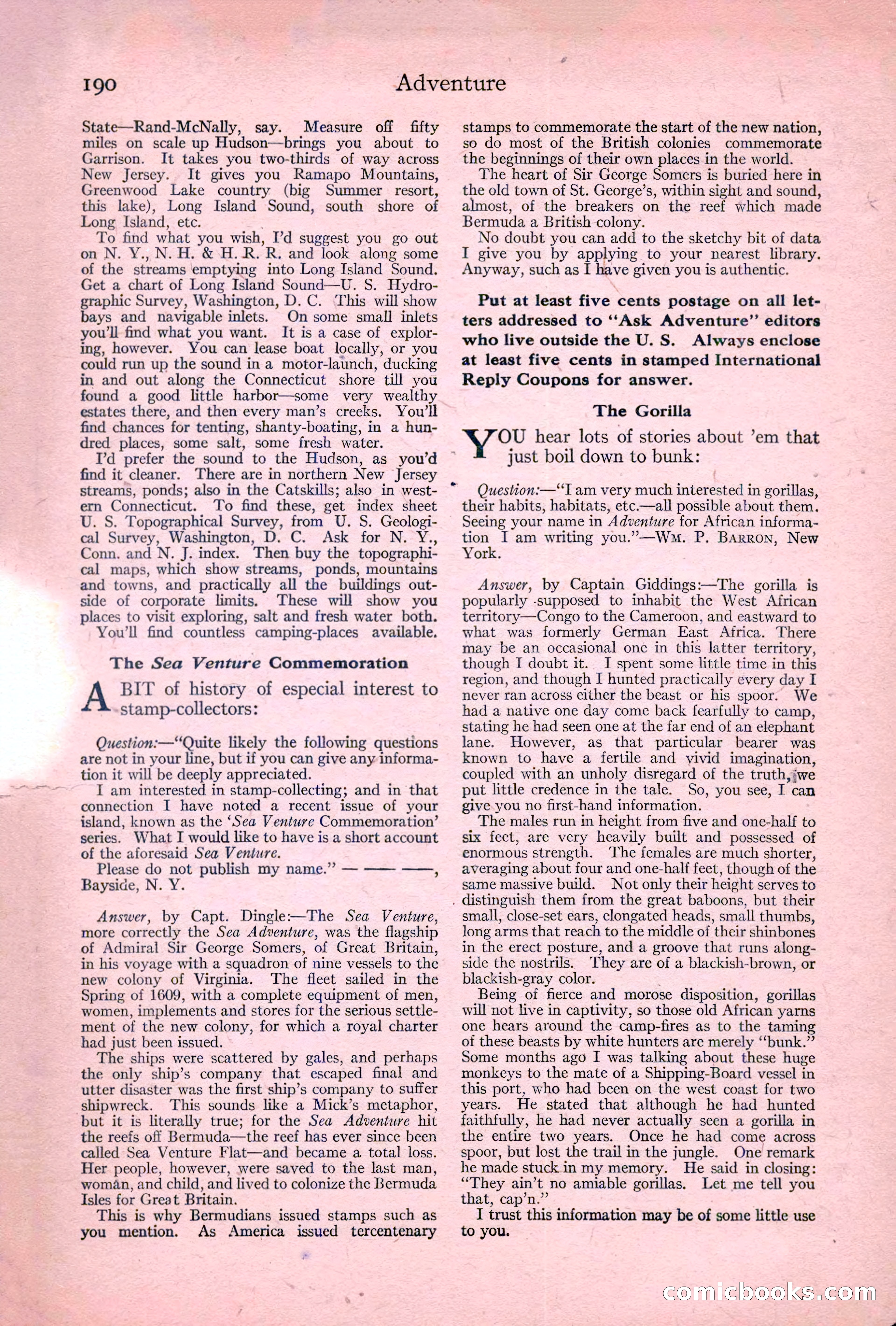
A restored page from Pulp Fiction, 1922. Page through the whole issue in the reader above.
📄 Transcribed text from this page (OCR, searchable)
Machine-transcribed from the original scan — historical spelling and the odd misread are preserved.
190 State—Rand-McNally, say. Measure off fifty miles on scale up Hudson—brings you about to Garrison. It takes you two-thirds of way across New Jersey. It gives you Ramapo Mountains, Greenwood Lake country (big Summer resort, this lake), Long Island Sound, south shore of Long Island, etc. To find what you wish, I’d suggest you go out on N. -Y., N.H. & GR: ’R. and look along some of the streams emptying into Long Island ‘Sound. Get a chart of Long Island Sound—U. S. Hydro- graphic Survey, Washington, D. C. This will show bays and navigable inlets. On some small inlets you'll find what you want. It is a case of explor- ing, however. You can lease boat locally, or you could run up the sound in a motor-launch, ducking in and out along the Connecticut shore till you found a good little harbor—some very wealthy estates there, and then every man’s creeks. You’ll find chances for tenting, shanty-boating, in a hun- dred places, some salt, some fresh water. I’d prefer the sound to the Hudson, as you’d find it cleaner. There are in northern New Jersey streams, ponds; also in the Catskills; also in west- ern Connecticut. To find these, get index sheet U. S. Topographical Survey, from U. S. Geologi- cal Survey, Washington, D. C. Ask for N. Y., Conn. and N. J. index. Then buy the topographi- cal maps, which show streams, ponds, mountains and towns, and practically all the buildings out- side of corporate limits. These will show you places to visit exploring, salt and fresh water both. You’ll find countless camping-places available. The Sea Venture Commemoration BIT of history of especial interest to stamp-collectors: Question: —“Quite likely the following questions are not in your line, but if you can give any informa- tion it will be deeply appreciated. I am interested in stamp-collecting; and in that connection I have noted a recent issue of your island, known as the ‘Sea Venture Commemoration’ series. What I would like to have is a short account of the aforesaid Sea Venture. Please do not publish my name.” — —— ——, Bayside, N. Y. Answer, by Capt. Dingle:—The Sea Venture, more correctly the Sea Adventure, was the flagship of Admiral Sir George Somers, of Great Britain, in his voyage with a squadron of nine vessels to the new colony of Virginia. The fleet sailed in the Spring of 1609, with a complete equipment of men, women, implements and stores for the serious settle- ment of the new colony, for which a royal charter had just been issued. The ships were scattered by gales, and perhaps the only ship’s company that escaped final and utter disaster was the first ship’s company to suffer shipwreck. This sounds like a Mick’s metaphor, but it is literally true; for the Sea Adventure hit the reefs off Bermuda—the reef has ever since been called Sea Venture Flat—and became a total loss, Her people, however, were saved to the last man, woman, and child, and lived to colonize the Bermuda Isles for Great Britain. This is why Bermudians issued stamps such as you mention. As America issued tercentenary Adventure stamps to commemorate the start of the new nation, so do most of the British colonies commemorate the beginnings of their own places in the world. The heart of Sir George Somers is buried here in the old town of St. George’s, within sight and sound, almost, of the breakers on the reef which made Bermuda a British colony. No doubt you can add to the sketchy bit of data I give you by applying to your nearest library. Anyway, such as I have given you is authentic. Put at least five cents postage on all let- ters addressed to ‘‘Ask Adventure’”’ editors who live outside the U. S. Always enclose at least five cents in stamped International Reply Coupons for answer. The Gorilla OU hear lots of stories about ’em that just boil down to bunk: Question: —“T am very much interested in gorillas, their habits, habitats, etc.—all possible about them. Seeing your name in ‘Adventure for African informa- Lae I am writing you.”—Wwm. P. Barron, New York. Answer, by Captain Giddings:—The gorilla is popularly -supposed to inhabit the West African territory—Congo to the Cameroon, and eastward to what was formerly German East Africa. There may be an occasional one in this latter territory, though I doubt it. I spent some little time in this region, and though I hunted practically every day I never ran across either the beast or his spoor. We had a native one day come back fearfully to camp, stating he had seen one at the far end of an elephant lane. However, as that particular bearer was known to have a fertile and vivid imagination, coupled with an unholy disregard of the truth, jwe put little credence in the tale. So, you see, I can give you no first-hand information. The males run in height from five and one-half to six feet, are very heavily built and possessed of enormous strength. The females are much shorter, averaging about four and one-half feet, though of the same massive build. Not only their height serves to . distinguish them from the great baboons, but their small, close-set ears, elongated heads, small thumbs, long arms that reach to the middle of their shinbones in the erect posture, and a groove that runs along- side the nostrils. They are of a blackish-brown, or blackish-gray color. Being of fierce and morose disposition, gorillas will not live in captivity, so those old African yarns one hears around the camp-fires as to the taming of these beasts by white hunters are merely ‘‘bunk.” Some months ago I was talking about these huge monkeys to the mate of a Shipping-Board vessel in this port, who had been on the west coast for two years. He stated that although he had hunted faithfully, he had never actually seen a gorilla in the entire two years. Once he had come across spoor, but lost the trail in the jungle. One remark he made stuck in my memory. He said in closing: “They ain’t no amiable gorillas. Let me tell you that, cap’n.” I trust this information may be of some little use to you. (E) _DOOK = a (E@)