
Pulp Fiction, 1922 · page 38 of 196
Adventure, January 20, 1922 — page 38: what you’re looking at
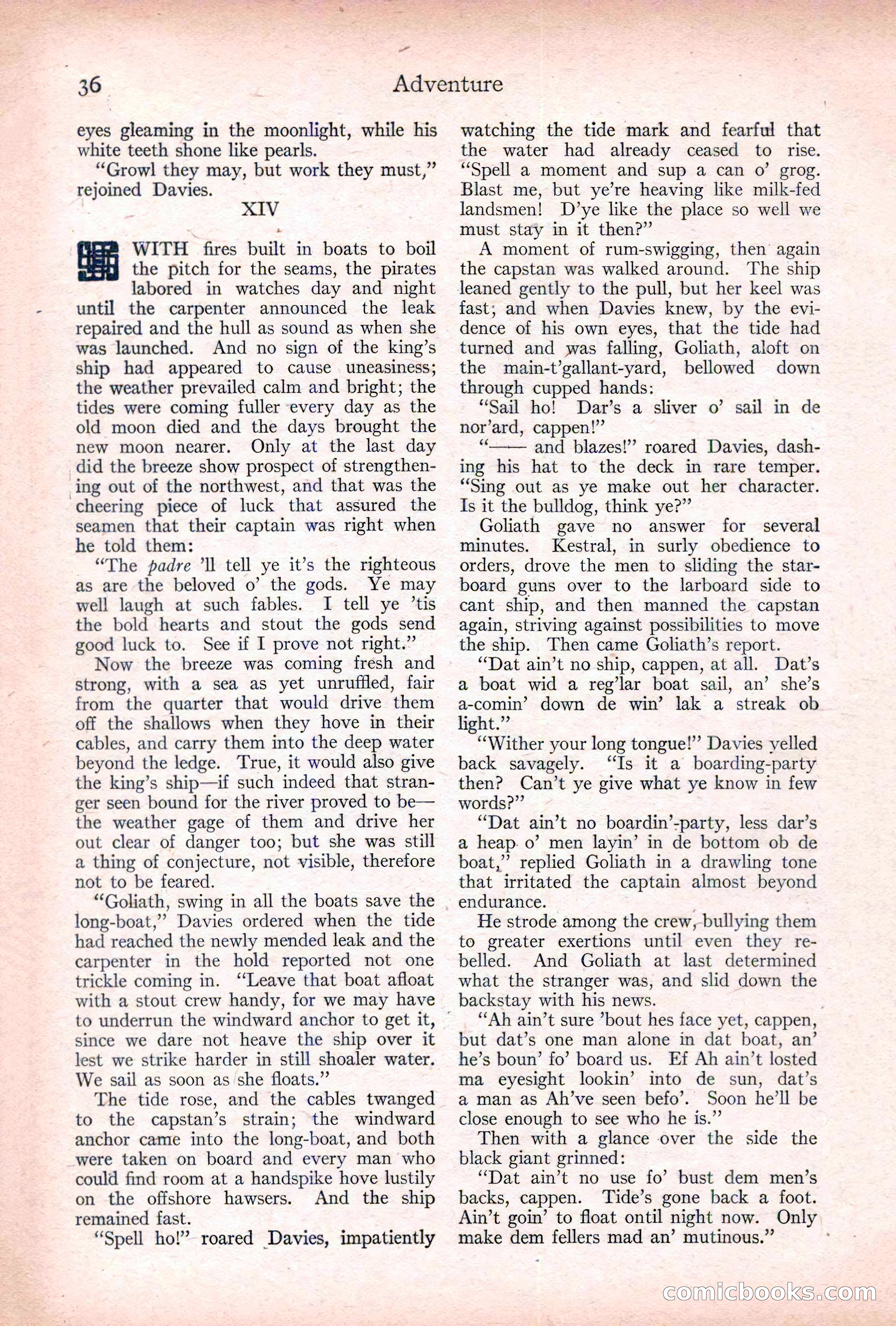
A restored page from Pulp Fiction, 1922. Page through the whole issue in the reader above.
📄 Transcribed text from this page (OCR, searchable)
Machine-transcribed from the original scan — historical spelling and the odd misread are preserved.
oe eyes gleaming in the moonlight, while his white teeth shone like pearls. “Growl they may, but work they must,” rejoined Davies. XIV WITH fires built in boats to boil the pitch for the seams, the pirates labored in watches day and night until the carpenter announced the leak repaired and the hull as sound as when she was launched. And no sign of the king’s ship had appeared to cause uneasiness; the weather prevailed calm and bright; the tides were coming fuller every day as the old moon died and the days brought the new moon nearer. Only at the last day did the breeze show prospect of strengthen- ing out of the northwest, and that was the ‘cheering piece of luck that assured the seamen that their captain was right when he told them: “The padre ’ll tell ye it’s the righteous as are the beloved o’ the gods. Ye may well laugh at such fables. I tell ye ’tis the bold hearts and stout the gods send good luck to. See if I prove not right.” Now the breeze was coming fresh and strong, with a sea as yet unruffled, fair from the quarter that would drive them off the shallows when they hove in their cables, and carry them into the deep water beyond the ledge. True, it would also give the king’s ship—if such indeed that stran- ger seen bound for the river proved to be— the weather gage of them and drive her out clear of danger too; but she was still a thing of conjecture, not visible, therefore not to be feared. “‘Goliath, swing in all the boats save the long-boat,’”’ Davies ordered when the tide had reached the newly mended leak and the carpenter in the hold reported not one trickle coming in. “Leave that boat afloat with a stout crew handy, for we may have to underrun the windward anchor to get it, © since we dare not heave the ship over it lest we strike harder in still shoaler water. We sail as soon as she floats.” The tide rose, and the cables twanged to the capstan’s strain; the windward anchor came into the long-boat, and both were taken on board and every man who could find room at a handspike hove lustily on the offshore hawsers. And the ship remained fast. Spell ho!” roared Davies, impatiently Adventure watching the tide mark and fearful that the water had already ceased to rise. “Spell a moment and sup a can o’ grog. Blast me, but ye’re heaving like milk-fed landsmen! D’ye like the place so well we must stay in it then?” A moment of rum-swigging, then’ again the capstan was walked around. The ship leaned gently to the pull, but her keel was fast; and when Davies knew, by the evi- dence of his own eyes, that the tide had turned and was falling, Goliath, aloft on the main-t’gallant-yard, bellowed down through cupped hands: “Sail ho! Dar’s a sliver o’ sail in de nor’ard, cappen!”’ = and blazes!’’ roared Davies, dash- ing his hat to the deck in rare temper. “Sing out as ye make out her character. Is it the bulldog, think ye?” Goliath gave no answer for several minutes. Kestral, in surly obedience to orders, drove the men to sliding the star- board guns over to the larboard side to cant ship, and then manned the capstan again, striving against possibilities to move the ship. Then came Goliath’s report. “Dat ain’t no ship, cappen, at all. Dat’s a boat wid a reg’lar boat sail, an’ she’s a-comin’ down de win’ lak a streak ob light.” “Wither your long tongue!” Davies velled back savagely. “Is it a boarding-party then? Can’t ye give what ye know in few words?” “Dat ain’t no boardin’-party, less dar’s a heap. o’ men layin’ in de bottom ob de boat,” replied Goliath in a drawling tone that irritated the captain almost beyond endurance. He strode among the crew, bullying them to greater exertions until even they re- belled. And Goliath at last determined what the stranger was, and slid down the backstay with his news. “Ah ain’t sure ’bout hes face yet, cappen, but dat’s one man alone in dat boat, an’ he’s boun’ fo’ board us. Ef Ah ain’t losted ma eyesight lookin’ into de sun, dat’s a man as Ah’ve seen befo’. Soon he’ll be close enough to see who he is.” Then with a glance over the side the black giant grinned: “Dat ain’t no use fo’ bust dem men’s backs, cappen. Tide’s gone back a foot. Ain’t goin’ to float ontil night now. Only make dem fellers mad an’ mutinous.” COnmiclboool< (C@